
Annualization Explained: Calculating Annual Rates & Returns
To annualize is to convert a short-term or partial period result into an annual basis. Annualization is helpful when comparing the returns of two or more investments or if a borrower wants to know how much interest they would need to pay for taking a loan.

A return of a short-term investment – e.g., Treasury billsTreasury Bills (T-Bills)Treasury Bills (or T-Bills for short) are a short-term financial instrument issued by the US Treasury with maturity periods from a few days up to 52 weeks. that mature within one year – is annualized to compare it with a long-term investment. Annualizing, in such a case, helps an investor to make a decision in selecting the investment product that would yield the best returns.
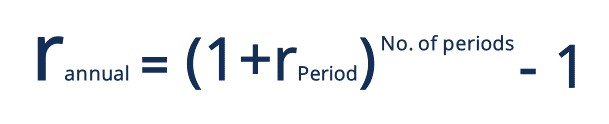
Below is the formula for converting a return into annualized terms. For example, if the monthly returns on an investment are 2%. The annualized return using the below formula is (1 + 0.02) ^ 12 – 1 = 26.8%.
Summary
- Annualization is the process of converting a short-term figure into annualized terms so that it’s easy to compare values to make an informed decision.
- The APR or the annual percentage rate is the annualized cost of taking out a loan, including the fees charged by the lender to the borrower over and above the interest rate.
- The equivalent annual cost (EAC) is the cost of owning an asset over its life. By calculating the EAC, the company can decide which asset will provide them with a cost-effective return on their investment.
Benefits of Annualization
Suppose the employment in Toronto grew by 0.90% in the first six months of the year. In July and August, they grew by 0.10% and 0.15%, respectively. In order to know if employment in July and August were better than the first six months, we would need to annualize all the figures.
The six-month growth rate of 0.90% converts to 1.81% per year. The growth rate in July comes to 1.21% annually and 1.81% per year in August.
After the annualization of the growth rates, Toronto’s employment growth was down compared to the annualized growth rate in the first six months, while in August, the growth rate was flat compared to the first six months.
Annualization helps individuals and companies make significant comparisons. For example, a photographer currently earns weekly pay of $1,000. If a different company offers $78,000 annually, should the photographer apply for the new role?
Here, they would need to convert their current weekly pay into annual terms. By multiplying $1,000 per week into 52 weeks in a year, the annual salary comes to $52,000 per year. It clearly shows that the new role will pay $26,000 more than the current salary, and hence, they should apply for the new role.
Annual Percentage Rate (APR)
An interest rate on a loan is the extra cost that a borrower pays for taking the loan from the financial institution. However, it does not include the fees for the loan. Hence the APR comes into the picture. The APR includes the fees and the interest rate on the loan, which is expressed in terms of a percentage.
If the APR is higher, it is an indication that the lenderLenderA lender is defined as a business or financial institution that extends credit to companies and individuals, with the expectation that the full amount of is charging a higher fee for the loan. Since all the lenders are required to disclose the APR along with the interest rates, it helps the borrower to compare the products and make an accurate decision.
Equivalent Annualized Cost (EAC)
Equivalent annualized cost (EAC) is the annualized price of owning an asset over its life. It is an important concept in capital budgeting that helps companies make decisions on which project to select.
Below is the formula to calculate EAC:

Where:
- r = Discount rate or rate of return
- n = Life span of the asset
For example, suppose a transportation company is looking at buying a bus, narrowing it down to two buses. Bus A costs $50,000 with a life span of five years, while bus B costs $80,000 with a life span of seven years. The company is looking at a return of 10%, which is the discount rateDiscount RateIn corporate finance, a discount rate is the rate of return used to discount future cash flows back to their present value. This rate is often a company’s Weighted Average Cost of Capital (WACC), required rate of return, or the hurdle rate that investors expect to earn relative to the risk of the investment.. Bus A is expected to incur an annual maintenance cost of $10,000, while bus B is $8,000. Using the above formula, the EAC is calculated as below,
EAC (Bus A) = $50,000 * 10% / [1 – (1+10%)-5] + $10,000 = $23,189.87
EAC (Bus B) = $80,000 * 10% / [1– (1+10%)-7] + $8,000 = $24,432.44
It is clear that bus B is more cost-efficient, with a savings of around $1,242.57 per year.
Learn More
CFI offers the Capital Markets & Securities Analyst (CMSA)®Program Page - CMSAEnroll in CFI's CMSA® program and become a certified Capital Markets &Securities Analyst. Advance your career with our certification programs and courses. certification program for those looking to take their careers to the next level. To keep learning and advance your career, the following resources will be helpful:
- Annualized IncomeAnnualized IncomeAnnualized income refers to an estimate of the total income generated for one year. It is calculated using partial data, and therefore, the
- Principal PaymentPrincipal PaymentA principal payment is a payment toward the original amount of a loan that is owed. In other words, a principal payment is a payment made on a loan that reduces the remaining loan amount due, rather than applying to the payment of interest charged on the loan.
- Annual Percentage Rate (APR)Annual Percentage Rate (APR)The Annual Percentage Rate (APR) is the yearly rate of interest that an individual must pay on a loan, or that they receive on a deposit account. Ultimately, APR is a simple percentage term used to express the numerical amount paid by an individual or entity yearly for the privilege of borrowing money.
- Interest ExpenseInterest ExpenseInterest expense arises out of a company that finances through debt or capital leases. Interest is found in the income statement, but can also
-

Understanding Residential Leases: A Comprehensive Guide
When you lease a home, you sign a rental agreement to live there. An executed lease is a legal document that includes your information, the property owner's information, rental terms and signature
-

Understanding Subleases: A Comprehensive Guide
A sublease, like a lease, is an agreement to allow a person or company to occupy real estate in return for regular rent payments. In a sublease, the tenant leasing from the original landlord in turn l
invest
- Understanding Prorated Payments: Definition & Calculation
- Understanding a $9,000 Salary: Annual Income Explained
- Understanding Par Loans: Rates, Benefits & How They Work
- HODL Explained: The Origin and Meaning of a Bitcoin Term
- Annualized Rate of Return: Definition & Calculation
- Understanding 'At Par': Definition & Implications in Finance
- Understanding Multi-Asset Class Investing: Diversification Explained
- Understanding Opportunity Cost: A Guide for Investors
- Kasasa: The Meaning Behind Our Name & Mission
-
 Quarterly Billing: Advantages, Disadvantages & What You Need to Know
Paying quarterly can be an advantage if your income fluctuates. Sending out monthly bills can be an expensive proposition for businesses and governments, requiring an investment of time, labo...
-
 Understanding APY: Annual Percentage Yield Explained
When it comes to investing and banking, you want to make sure you are getting the best interest rate. You will often see the term "annual percentage yield" (APY) when opening an interest-bea...