
Understanding FAANG Stocks: A Guide to Tech Giants
FAANG stocks are the publicly tradedPrivate vs Public CompanyThe main difference between a private vs public company is that the shares of a public company are traded on a stock exchange, while a private company's shares are not. stocks of U.S. technology giants Facebook, Amazon, Apple, Netflix, and Google. They are among the best-performing technology and most well-known companies in the world.
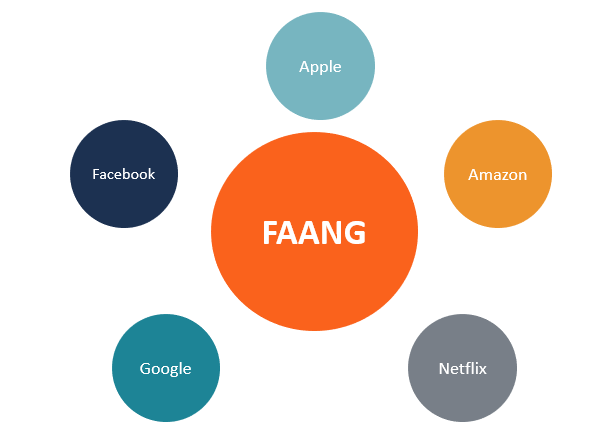
Currently, the combined market value of FAANG exceeds $3 trillion. It accounts for almost 10% of the U.S. stock market’s total market capitalization of $31 trillion. The price movement of FAANG stocks impacts the entire market, affecting even investors who do not own FAANG stocks.
All the companies are traded on the NASDAQ Stock Market. In addition, the FAANG stocks are part of the S&P 500 Index, which includes the 500 largest publicly-traded companies by market capitalizationMarket CapitalizationMarket Capitalization (Market Cap) is the most recent market value of a company’s outstanding shares. Market Cap is equal to the current share price multiplied by the number of shares outstanding. The investing community often uses the market capitalization value to rank companies traded on the NYSE or NASDAQ.
List of FAANG Stocks
1. Facebook
Facebook, Inc. (TickerTickerA Ticker is a symbol, a unique combination of letters and numbers that represent a particular stock or security listed on an exchange. The ticker symbol is used to refer to a specific stock, particularly during trading. Trades are executed based on a company's ticker symbols: FB) is an online social media and social networking service company founded in 2004. The company’s primary revenue stream comes from online advertisements. Facebook also owns several prominent subsidiaries, including Instagram, WhatsApp, and Oculus VR.
Facebook currently lists over 2.5 billion active users, and it was the most downloaded mobile app in the world during the 2010s. It is available in 111 different languages to anyone who claims to be at least 13 years old. As of December 2020, the social media giant’s market capitalization is over $780.5 billion.
2. Amazon
Amazon Inc. (Ticker: AMZN) is a diversified technology company operating in e-commerceIntroduction to E-commerceE-commerce refers to commercial transactions of goods or services conducted over the internet. E-commerce companies sell various products and services., consumer electronics, and cloud computing industries. Jeff Bezos established the company in 1994 as an online bookstore. Amazon is now the world’s biggest e-commerce retailer based on market capitalization. The company owns several subsidiaries, including Whole Foods Market (chain of supermarkets) and Twitch (live streaming platform).
Amazon operates in countries around the world. By 2018, its two-day delivery system (Amazon Prime) listed over 100 million subscribers worldwide. As of December 2020, Amazon’s market capitalization is more than $1.62 trillion.
3. Apple
Apple is a multinational technology company based in California, known for selling consumer electronics such as phones, tablets, and computers. It was founded by Steve Jobs and two others in 1976, making it the oldest of the FAANG stocks. Apple went public in December 1980, with an IPO that raised over $100 million (at $22 per share).
Nowadays, Apple is the largest IT company in the world. In addition, on August 2, 2018, it became the first U.S. company with a market capitalization of over $1 trillion. As of December 2020, its market capitalization is almost $2.2 trillion, with revenues of almost $275 billion.
To learn how to value companies and stocks, check out CFI’s Business Valuation Modeling Course.
4. Netflix
Netflix Inc. (Ticker: NFLX) is a media provider that provides customers with subscription-based online streaming of films and TV shows. Recently, the company entered the content-production industry, producing its own movies and TV shows.
Netflix counts almost 200 million paid subscriptions worldwide, making it a dominant player in the entertainment industry. It operates in over 190 countries and also produces a variety of Netflix Original content. As of December 2020, its market capitalization is over $235 billion.
5. Google (Alphabet)
Headquartered in California, U.S., Google specializes in providing internet-based services and products. It was founded in 1998 by Larry Page and Sergey Brin and is perhaps best known for its web search engine. The company went public in August 2004, offering almost 20 million shares at $85 per share.
Google Search is the United States’ dominant internet search engine. Its success triggered the creation of numerous other products, including work and productivity services (Google Docs, Google Sheets), email (Gmail), and video sharing (YouTube).
Also, Google developed a mobile operating system called Android, which runs the majority of today’s smartphones. Finally, the company produces consumer electronics such as Chromebook laptops, Pixel smartphones, and Google Home devices.
As of December 2020, Google’s market capitalization is $1.18 trillion, trading under its parent company, Alphabet.
To learn how to value companies and stocks, check out CFI’s Business Valuation Modeling Course.
Related Readings
Thank you for reading CFI’s explanation of the FAANG stocks. CFI is the official provider of the Capital Markets & Securities Analyst (CMSA)®Program Page - CMSAEnroll in CFI's CMSA® program and become a certified Capital Markets &Securities Analyst. Advance your career with our certification programs and courses. designation for financial analysts. To continue learning and advancing your career, these additional resources will be helpful:
- Comparable Company AnalysisComparable Company AnalysisThis guide shows you step-by-step how to build comparable company analysis ("Comps") and includes a free template and many examples.
- Key Players in the Capital MarketsKey Players in the Capital MarketsIn this article, we provide a general overview of the key players and their respective roles in the capital markets. The capital markets consist of two types of markets: primary and secondary. This guide will provide an overview of all the major companies and careers across the capital markets.
- Preferred SharesPreferred SharesPreferred shares (preferred stock, preference shares) are the class of stock ownership in a corporation that has a priority claim on the company’s assets over common stock shares. The shares are more senior than common stock but are more junior relative to debt, such as bonds.
- Valuation MethodsValuation MethodsWhen valuing a company as a going concern there are three main valuation methods used: DCF analysis, comparable companies, and precedent transactions
-

Understanding Cyclical Stocks: Definition & Investment Strategies
Cyclical stocks tend to rise and fall with the general economic cycle. Their revenues and profits typically rise swiftly during economic expansions and fall sharply during recessions. Many cyclical s
-

Stocks Explained: A Beginner's Guide to Investing
What are stocks?A stock is born when a company decides that it in order to grow even bigger, it will need a fat injection of cash. Unless the owner is lucky enough to have 10,000 rich uncles, the meth
invest
- Understanding Company Bylaws: A Comprehensive Guide
- Dual-Class Stock Structures: Understanding Voting Rights & Dividends
- Understanding Earnings: A Guide to Financial Profitability
- Bonds vs. Stocks: A Comprehensive Guide for Investors
- Understanding Growth Stocks: Definition, Characteristics & Investing
- Income Stocks: A Guide to Dividend Investing
- Penny Stocks: Risks, Rewards, and What You Need to Know
- Penny Stocks: Risks, Definition & What You Need to Know
- Treasury Stock: Definition, Purpose, and Implications
-
 Value Traps: Identifying & Avoiding Investment Pitfalls
A value trap occurs when an investor looks at the fundamentals and market priceDow Jones Industrial Average (DJIA)The Dow Jones Industrial Average (DJIA), also referred to as Dow Jones” or the D...
-
Blue Chip Stocks: Definition, Characteristics & Investment Strategy
Blue chip stock definitionBlue chip stocks are well-known companies that generally have long-term track records of success. A blue chip company tends to be a large, well-established leader in its sec...