
Understanding Implied Rates: A Comprehensive Guide
The implied rate is an interest rate that expresses the difference between the forward/future rate and the spot rate. It serves as a useful tool for comparing returns across different assets and can be applied to any scenario that involves a forward or futures contractFutures ContractA futures contract is an agreement to buy or sell an underlying asset at a later date for a predetermined price. It’s also known as a derivative because future contracts derive their value from an underlying asset. Investors may purchase the right to buy or sell the underlying asset at a later date for a predetermined price..
Summary
- The implied rate is the difference between the forward/future rate and the spot rate.
- The forward/future rate is the predetermined rate to buy or sell an underlying asset in the future. The spot rate is the current market rate.
- The implied rate is useful for comparing returns across different assets.
- It can be applied to exchange rates, commodity prices, and stock prices.
Understanding Implied Rates
Forward/Futures Contracts
Forward and futures contracts are very similar; both engage in buying or selling an underlying asset in the future at a predetermined price or rate. The difference between the two is that the forward contractForward ContractA forward contract, often shortened to just "forward", is an agreement to buy or sell an asset at a specific price on a specified date in the future is over-the-counter (OTC), meaning that it is a private transaction. Therefore, it is more customizable for the parties involved and is settled only at maturity. On the other hand, futures contracts are regulated on options exchanges, less flexible, and settled daily.
Forwards and futures are used to lock in prices or rates in the future for hedging purposes. In the context of the implied rate, both forwards and futures can be used interchangeably.
The forward/future rate represents expectations of future value. For example, if silver is trading today at $25 (spot price) and the futures contract price is $30, it means that we expect silver to appreciate in the future.
Therefore, we can understand the implied rate as a way to compare returns across different assets. A positive implied rate means that future borrowing rates are expected to increase, while a negative implied rate suggests that future borrowing rates are expected to decrease.
Spot Rate
The spot rate is the current rate offered on the market. It represents the prevailing equilibrium value of supply and demand.
Practical Examples
The implied rate applies in any scenario that involves futures/forward contracts; it includes exchange rates, commodity prices, and stock prices.
Exchange Rates
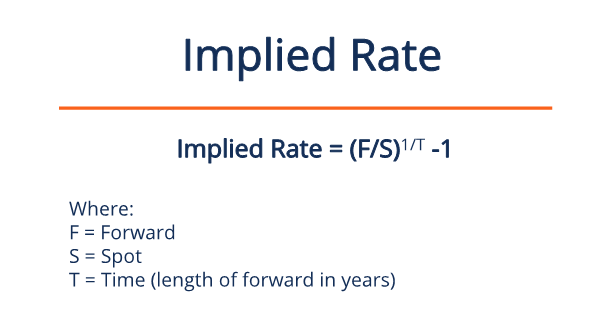
The current exchange rate is 1.3 CAD/USD. A forward contract maturing in 3 years comes with a forward exchange rate of 1.4 CAD/USD.
Implied Rate = (1.4/1.3)(1/3) – 1 = 2.5%
Commodity Prices
Crude oil is trading at $52.85 as of April 2021. The futures price is $60.13, with a settlement date in December 2021 (8 months to maturity).
Implied Rate = (60.13/52.85)(1/(8/12)) – 1 = 21.36%
Since the contract matures in less than a year, our T is 8 months out of the 12 months in a year. Our exponent (1/(8/12)) becomes 12/8, or 1.5.
Stock Prices
The S&P 500 IndexS&P 500 IndexThe Standard and Poor’s 500 Index, abbreviated as S&P 500 index, is an index comprising the stocks of 500 publicly traded companies in the is trading at $4180.17 as of April 2021. A futures contract for September 2021 comes with a settlement price of $4161.75 (5 months maturity).
Implied Rate = (4161.75/4180.17)(1/(5/12)) – 1 = -1.05%
Similar to the last example, our T is a fraction of a year. Therefore, the exponent is (1/(5/12)), which becomes 12/5 or 2.4.
Learn More
CFI offers the Capital Markets & Securities Analyst (CMSA)®Program Page - CMSAEnroll in CFI's CMSA® program and become a certified Capital Markets &Securities Analyst. Advance your career with our certification programs and courses. certification program for those looking to take their careers to the next level. To keep learning and developing your knowledge base, please explore the additional relevant resources below:
- Options: Calls and PutsOptions: Calls and PutsAn option is a derivative contract that gives the holder the right, but not the obligation, to buy or sell an asset by a certain date at a specified price.
- Over-the-Counter (OTC)Over-the-Counter (OTC)Over-the-counter (OTC) is the trading of securities between two counter-parties executed outside of formal exchanges and without the supervision of an exchange regulator. OTC trading is done in over-the-counter markets (a decentralized place with no physical location), through dealer networks.
- Spot MarketSpot MarketA spot market is a financial market where financial instruments and commodities are traded for instantaneous delivery. Delivery refers to the
- Underlying SecurityUnderlying SecurityUnderlying security is a term in investing that denotes the negotiable financial instrument upon which a financial derivative, such as an
-

Understanding the Policy Interest Rate: Its Impact on the Economy
Three more sleep inducing words have perhaps never been strung together, but the policy interest rate is actually pretty exciting insofar as it's a little number that has a profound effect on a c
-
Understanding the Overnight Interest Rate: Impact on the Economy
Overnight rate might sound like the five-dollars-more alternative to the hourly rate for the least reputable hotel in town, but in fact it’s a number that has a profound effect on a country’s entire e
invest
- Implied Rate Explained: Understanding Interest Rate Differentials
- Compound Growth Rate: Definition & Calculation | [Your Brand]
- Understanding Forward Rates: A Comprehensive Guide
- Understanding the Overnight Interest Rate: A Comprehensive Guide
- Prime Rate Explained: Understanding Interest Rates for Businesses & Consumers
- Interbank Rate Explained: Understanding Foreign Exchange Rates
- Nominal Rate of Return: Definition & Calculation
- Understanding the Required Rate of Return: A Key Finance Concept
- Prime Rate Explained: Understanding Interest Rates & Its Impact
-
 Understanding Swap Rate Curves: A Comprehensive Guide
The swap rate curve is a chart that depicts the relationship between swap rates and all available corresponding maturities. Essentially, it indicates the expected returnsExpected ReturnThe expected re...
-
 Standard Mileage Rate: IRS Deduction for Business Vehicle Use
A standard mileage rate is the dollar amount per mile imposed by the Internal Revenue Service (IRS) when calculating the deductible costs for business use of automobiles. The standard mileage rate is ...