
Stock Screeners: A Comprehensive Guide for Investors & Traders
A stock screener is an instrument used by investors and traders for the separation of stocks based on defined metrics. It provides its users with a choice to select trading instruments suitable for any criteria or profile. Stock screeners are available on trading platforms and popular websites, either free or at a specific subscription fee.
Investors use a stock screener to find stocks that will perform well over time. Traders use stock screener tools to identify the set-up possibilities of short positionsLong and Short PositionsIn investing, long and short positions represent directional bets by investors that a security will either go up (when long) or down (when short). In the trading of assets, an investor can take two types of positions: long and short. An investor can either buy an asset (going long), or sell it (going short)..
A stock screener can be used to separate stocks based on price, market capitalization, dividend ratio, P/E ratio, and debt-to-equity ratio, among others. The higher the number of applied filters, the lower the number of stocks listed.
The filters of stock screeners are effective if users have the specifics in mind about the type of companies that they want to invest in. Yahoo! Finance, FinViz, Google Finance, and Chart Mill offer some of the free screeners on the web.
Summary
- A stock screener is an instrument that traders and investors use for choosing stocks based on search criteria.
- Stock screeners can be used to separate stocks based on price, market capitalization, dividend ratio, P/E ratio, and debt-to-equity ratio, among others.
- Yahoo! Finance, FinViz, and Chart Mill offer some of the free screeners and are available on the web.
Uses of a Stock Screener
Hundreds of thousands of companies have listed their stocks on national exchanges. Hence, selecting and tracking a good stock is difficult. A stock screener helps to focus on stocks that suit the investment strategies and meet the standards of traders.
A database of corporations and companies, a list of variables, and a screening engine to find the companies that satisfy the variables as defined by the users are the three constituents of a stock screener.
While using a stock screener, the user needs to answer some questions first. They will be regarding the user’s preference on the value of different ratios, 52-week high or low stocks, low or high cap stocks, and type of industry, among others.
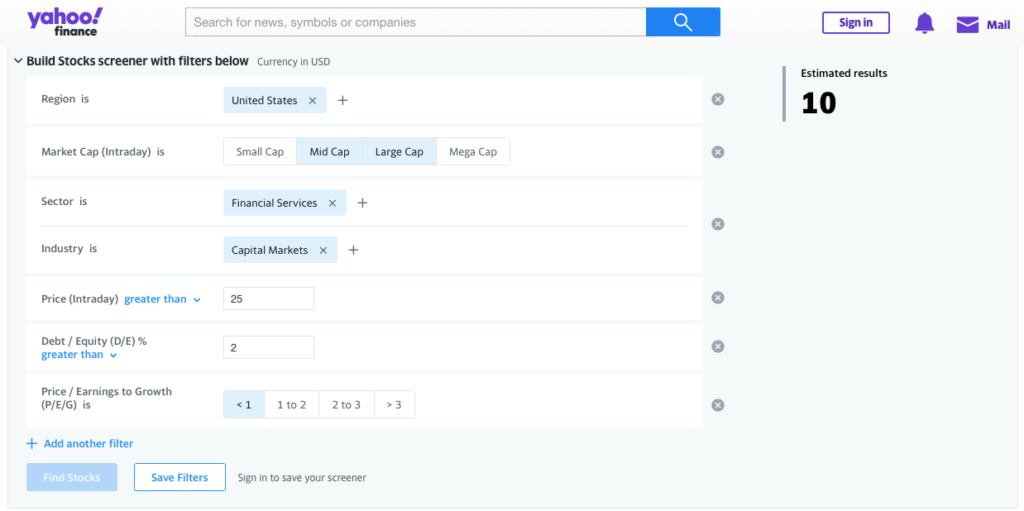
Below is an example of a Yahoo stock screener for finding stocks in the U.S. region in the capital marketsCapital MarketsCapital markets are the exchange system platform that transfers capital from investors who want to employ their excess capital to businesses industry with medium and large market capitalization, an intraday price more than $15, a debt-to-equity ratio more than 2, and a price-to-earnings-growth ratio less than 1.
After inputting all the filters, we receive the list of stocks below that satisfy our requirements:
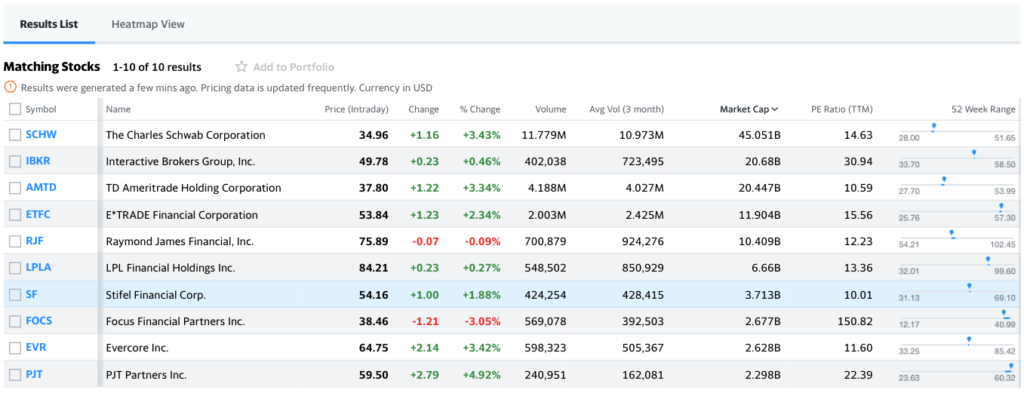
Users can add more filters according to their requirements. A good stock screener enables users to look for the stocks with any search criteria or metrics that they want. A stock screener can be used to perform numerical analysis, focusing on tangible parameters such as profit margins, revenue, and performance ratios.
Limitations of a Stock Screener
1. Potential bias
There are many stock screeners available in the market. However, if a user types in the same criteria on different stock screeners, he/she may find different listings of stocks. It is because of the potential bias of programmers of the stock screeners.
For example, the programmers of Company X may make sure that the stocks of the parent Company Y, operating in commoditiesCommoditiesCommodities are another class of assets just like stocks and bonds. Most commodities are products that come from the earth that possess, will appear at the top of the list of commodities stocks. It can be done by providing a higher weight to the stocks of the parent Company Y.
2. Need for specific criteria
It has become very convenient to add every available stock on every exchange to the overall matrix of the stock screeners. Thus, investors or traders have too many options to choose from.
Hence, to limit the number of options, the users must be aware of the criteria they want. They may be required to input over six specific search criteria to limit the selection results to below 100. Many investors input two to three criteria, which results in too many search results to make an informed decision.
3. Invalid comparisons
To some investors, a stock screener may seem to lack reasoning ability. For example, a user may have inputted search criteria that is not dependent on the stock price. However, the stock screener may be trying to provide a comparison between stocks based on their price to produce a result.
4. Quantitative comparison only
The majority of the stock screeners have only quantitative parameters as the criteria for selecting the stocks. However, many qualitative parameters should be considered as well. They can be customer satisfaction, any lawsuit pending, problems related to labor or business operations, and corporate governanceCorporate GovernanceCorporate governance is something altogether different from the daily operational management activities enacted by a company’s executives. It is a system of, among others.
More Resources
CFI offers the Commercial Banking & Credit Analyst (CBCA)™Program Page - CBCAGet CFI's CBCA™ certification and become a Commercial Banking & Credit Analyst. Enroll and advance your career with our certification programs and courses. certification program for those looking to take their careers to the next level. To keep learning and developing your knowledge base, please explore the additional relevant resources below:
- Stock PriceStock PriceThe term stock price refers to the current price that a share of stock is trading for on the market. Every publicly traded company, when its shares are
- Debt to Equity RatioDebt to Equity RatioThe Debt to Equity Ratio is a leverage ratio that calculates the value of total debt and financial liabilities against the total shareholder’s equity.
- Market CapitalizationMarket CapitalizationMarket Capitalization (Market Cap) is the most recent market value of a company’s outstanding shares. Market Cap is equal to the current share price multiplied by the number of shares outstanding. The investing community often uses the market capitalization value to rank companies
- Price Earnings RatioPrice Earnings RatioThe Price Earnings Ratio (P/E Ratio is the relationship between a company’s stock price and earnings per share. It provides a better sense of the value of a company.
-

Phantom Stock: Definition, Benefits & How It Works
Many companies today are looking for creative ways to reward their senior managers and key executives for outstanding performance. One strategy is to provide these employees with what’s commonly refer
-

Investing in Stocks: A Beginner's Guide to the Stock Market
Buying stocks for the first time can feel like playing a new sport. You may feel uncertain. You may question the wisdom of getting involved. The fees may seem confusing or too steep. With sports as wi
invest
- Understanding Domestic Stocks: A Guide for Investors
- Bonds vs. Stocks: A Comprehensive Guide for Investors
- Defensive Stocks: A Guide to Stable Investments
- Penny Stocks: Definition, Risks & How They Work
- Understanding Small-Cap Stocks: Definition & Investment Insights
- Value Stocks Explained: Investing in Undervalued Companies
- Relative Strength Index (RSI) in Stock Analysis: A Comprehensive Guide
- Stock Screeners: Find Your Ideal Stocks | [Financial Publication Name]
- Stocks Explained: A Beginner's Guide to Investing
-
Stock Float Explained: Understanding Publicly Available Shares
A stock float can mean a couple different things. First, a stock float refers to the number of shares that are publicly available for investors. Second, investors may also talk about floating a stock...
-
Stock Splits Explained: What They Are & What They Mean for Investors
A stock split is when a company decides to exchange its stock for more (and sometimes fewer) shares of its own stock. Many stock splits are greeted by investors as good news, and shares often rise as...