
Stock Symbols (Ticker Symbols): A Comprehensive Guide
A stock symbol is a form of identification that is used to identify publicly-traded companies using a series of letters. Ticker symbols are often abbreviations utilizing a company’s name to describe a company’s stock.
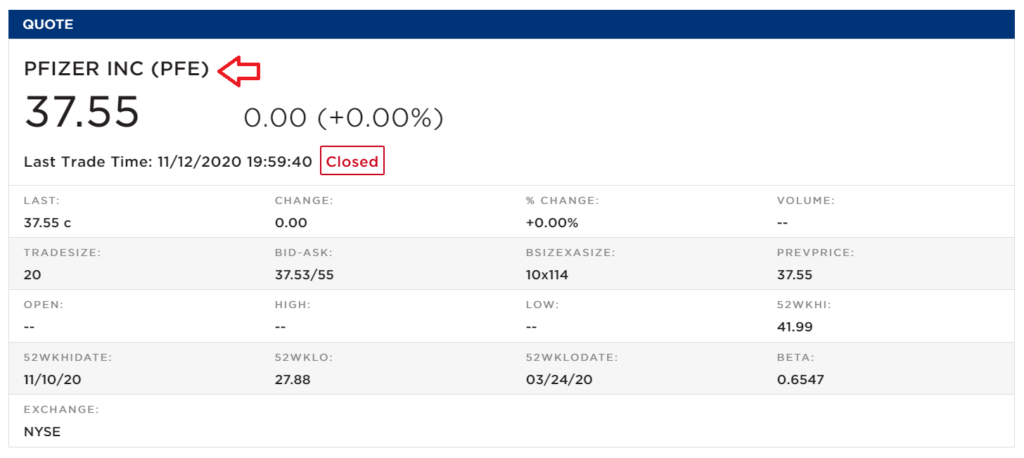
Different stock exchanges follow different conventions for allocating stock symbols. For example, securities listed on the New York Stock Exchange (NYSE)New York Stock Exchange (NYSE)The New York Stock Exchange (NYSE) is the largest securities exchange in the world, hosting 82% of the S&P 500, as well as 70 of the biggest can comprise a maximum of four letters with few exceptions, while NASDAQ stocks include up to five characters. Companies can choose stock symbols of their own, though stock exchanges can reject a company’s symbol if it is offensive, a duplicate of another company’s symbol, or misleading.
Summary
- A stock symbol refers to a combination of letters, numbers, or a combination of both assigned to a particular security for the purpose of trading on a specific market.
- Stocks listed and trading on the New York Stock Exchange (NYSE) have ticker symbols with up to three letters, while those listed on NASDAQ have a maximum of four letters.
- Stock exchanges portray stock symbols in different formatting conventions, depending on a company’s trading status or the trading share’s classes.
The Origin of Ticker Symbols
On a typical trading day in the 1800s, when stock exchanges came into operation, a company’s stock price was communicated by writing or shouting out its name. This method soon became onerous and time-consuming as the number of publicly-traded companies skyrocketed.
In 1867, Edward Calahan invented the single-letter ticker machine and installed it in stock brokerages. The device used telegraph networks to convert signals to letters and numbers and printed them on a ticker tape to efficiently transmit stock quotes to investors in close to real-time.
Company symbols were later shortened to one to five alpha symbols to increase the speed of relaying stock price changes to investors. Although the ticker machines became obsolete in the 1960s, ticker symbols continued to be used throughout as an NYSE marketing tool. Today, ticker symbols are used to save time and capture specific stock prices.
Ticker Symbols and Companies’ Identities
Ticker symbols are used to distinguish the identity of companies, especially when there are two companies with similar nicknames. In the past, several investors were victimized by mistaken identity after incorrectly associating ticker symbols and companies, resulting in huge volume surges for stocks.
For example, MassMutual Corporate Investors (which trades under the name MCI) and MCI Communications (which trades under the name MCIC) use nearly similar symbols but are not affiliated with each other in any way. However, when the two companies’ stock prices are examined together, there is a correlation between their returns, volatility, and volumeVolume of TradeVolume of trade, also known as trading volume, refers to the quantity of shares or contracts that belong to a given security traded on a daily basis around periods where MCIC has announced major news releases.
NYSE reinforced companies’ stature by either inviting the existing companies to change ticker symbols or enticing companies trading on other exchanges to join NYSE with prominent ticker symbols. The latter approach has played a significant role in maintaining the prominence of companies that trade on NYSE.
Basics of Stock Symbols
The most common type of stock symbol is the stock or equity symbol. Stocks listed and traded on the US markets bear stock symbols with a maximum of four letters. For example, ticker symbols of stocks trading on the NYSE include up to three letters, while those on the NASDAQ use tickers with four letters.
Investors use stock symbols to track individual securities for trading. Many new stock symbols do not have an association with its company’s name as pre-existing ticker symbols prevent it from selecting a symbol that bears its name.
In the same vein, tickers for options are designed to reflect the underlying stock ticker, such as the contract’s expiration dateExpiration Date (Derivatives)The expiration date refers to the date in which options or futures contracts expire. It is the last day of the validity of the derivatives contract. or the contract type. Conversely, ticker symbols for mutual funds comprise alphanumeric characters with the last character being the letter X to distinguish them from common stock symbols.
Stock Symbols of Companies Trading Different Classes of Shares
Companies that trade more than one class of shares have the class added to their suffix. For example, the letters “PR” and the letter assigned to its class are added for its preferred stock. Take, for example, a hypothetical stock named Masterfile’s Solutions Corporate Preferred B-shares. The company’s ticker symbol could be something like MSC.PR.B.
Another salient feature of a stock symbol is to denote whether a particular class of shares has voting rights. It is common with companies that trade multiple share classes. For example, Alphabet Inc. has two share classes listed and traded on NASDAQ with ticker symbols GOOGL and GOOG.
GOOGL includes class A shares; hence, each has one voting rights. On the other hand, GOOG shares belong to class C, and their common shareholders have no voting rights.
Stock symbols can also be used to suggest a company’s trading status. Such information is conveyed on the NYSE by the stock’s standard company symbol, followed by a dot and then a single letter. Comparatively, one letter is added for NASDAQ-listed stocks.
Related Readings
CFI is the official provider of the Capital Markets & Securities Analyst (CMSA)™Program Page - CMSAEnroll in CFI's CMSA® program and become a certified Capital Markets &Securities Analyst. Advance your career with our certification programs and courses. certification program, designed to transform anyone into a world-class financial analyst.
In order to help you become a world-class financial analyst and advance your career to your fullest potential, these additional resources will be very helpful:
- How to Read Stock ChartsHow to Read Stock ChartsIf you’re going to actively trade stocks as a stock market investor, then you need to know how to read stock charts. Even traders who primarily use fundamental analysis to select stocks to invest in still often use technical analysis of stock price movement to determine specific buy and sell, stock charting
- Private vs Public CompaniesPrivate vs Public CompanyThe main difference between a private vs public company is that the shares of a public company are traded on a stock exchange, while a private company's shares are not.
- Share ClassShare Classshare classes are usually created from various types of shares in a company. The type of shares and share classes that a company can create
- S&P 500 Index Ticker SymbolS&P 500 Index Ticker SymbolThe ticker symbol for the S&P 500 index is ^GSPC. The series of letters represents the performance of the 500 stocks listed on the S&P
-

Understanding Stocks: A Beginner's Guide to Share Ownership
When a person owns stock in a company, the individual is called a shareholder and is eligible to claim part of the company’s residual assets and earnings (should the company ever have to dissolv
-

Stock Dividends: Definition, Types & How They Work
A stock dividend, a method used by companies to distribute wealth to shareholders, is a dividend payment made in the form of shares rather than cash. Stock dividends are primarily issued in lieu of ca
invest
- Understanding Downtrends: Definition, Identification & Reversal
- Understanding Non-Assessable Stock: Limited Liability Explained
- Understanding Overweight Stocks: A Comprehensive Guide
- S&P 500 Ticker Symbol (^GSPC): What You Need to Know
- Stock Indexes Explained: A Beginner's Guide to Market Benchmarks
- Stock Symbols (Ticker Symbols): A Comprehensive Guide
- Stock Valuation: A Comprehensive Guide for Investors
- Understanding Stock Tickers: A Comprehensive Guide
- Understanding Stock Tickers: A Beginner's Guide to Ticker Symbols
-
 Founders Stock: Definition, Vesting, and Key Differences
Founders stock refers to the equity that is given to the early founders of an organization. This type of stock differs in a few important ways from common stock sold in the secondary marketSecondary M...
-
 Restricted Stock: Definition, Types & How It Works
Restricted stock refers to an award of stock to a person that is subject to conditions that must be met before the stockholderStockholders EquityStockholders Equity (also known as Shareholders Equity)...