
Passive Investing Strategy: How to Outperform the Market with Index Funds
In this post I will show you the exact portfolio and allocation strategy I’ve used to beat the S&P 500 and Dow so far this year. I did it without making a single trade or buying a single stock. I didn’t day trade or make any of my previous investing mistakes. In fact, I didn’t do much of anything except let my well-researched mix of index funds that I built in 2014 ride – with a few small tweaks. I like to call this the Millennial Money portfolio – my personal long term passive investing strategy influenced by the coffeehouse lazy portfolio, with my own modifications (mostly more exposure to emerging markets).
I am not an investing professional (but most professionals don’t beat the market over time!) and even though I feel confident in my portfolio allocation and fund selection strategy I welcome feedback – so please share your thoughts or questions in the comments. I am definitely still learning, but this strategy has worked well for me.
The Millennial Money Portfolio has beat the market by 1.23%
Here is a look at my returns year to date for 2016. Note how my year to date return is 5.51% compared to the S&P 500 4.28% growth and the Dow 4.79% Dow returns. While a return of 1%+ might not seem like a lot, this will compound over time and give me an advantage over the market if I can sustain these gains. One piece of advice – because it’s so easy to use Mint or Personal Capital I used to check my portfolio daily or multiple time a day. It drove me crazy so I only check it once a month now.
All of the images below are from the free account that I have at Personal Capital. They allow you to track all of your investment performance and provide free asset allocation recommendations.
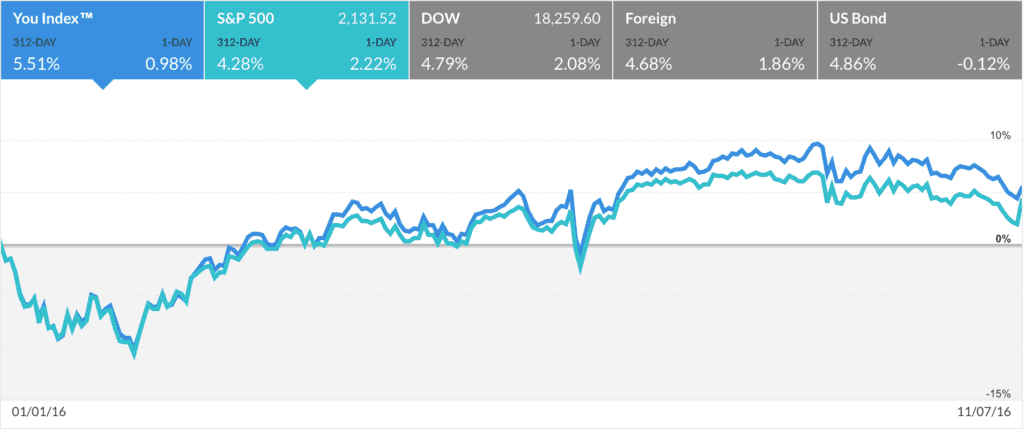
The Millennial Money portfolio returns have beat both the S&P 500 and Dow so far in 2016
The Millennial Money Portfolio Asset Classes and Allocations
Your investments by asset class and target allocation in many cases matters more than the funds that you select. This represents your exposure to different markets, so it’s important to find an ideal target asset allocation for your age and risk tolerance and try to hit it with your mix of funds.
The following is a breakdown of my exact portfolio by percentage asset class. You can see that I invest in a mixture of domestic and international stocks bonds, as well as alternative investments. I try to keep this percentage allocation very close to my target levels, which does require a bit of re-balancing every now and then.
I usually re-balance my portfolio twice a year or if something super weird happens and it gets more than 5% out of whack. I am planning to re-balance my portfolio on January 1st and you can see that I am getting close to being 5% off due to some strong returns in my international stock holdings over the past few months.
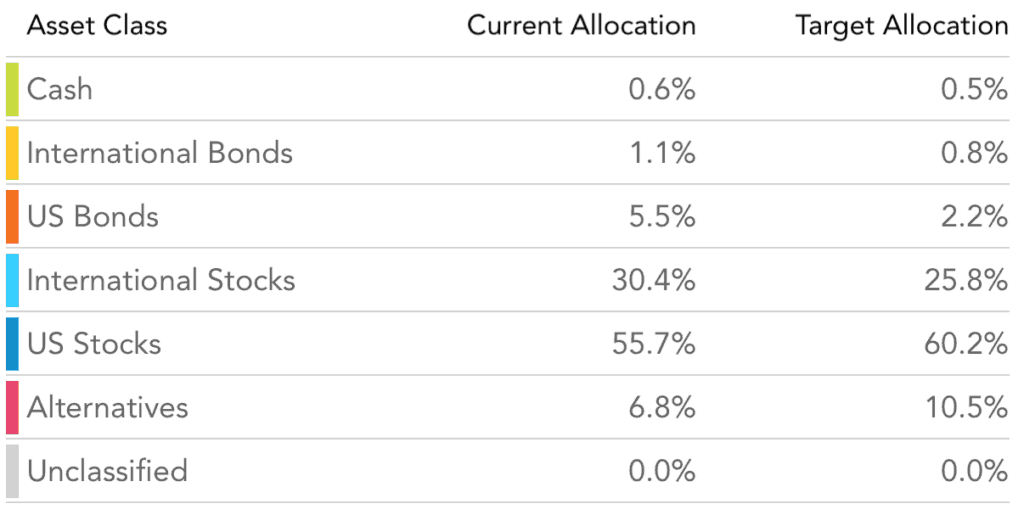
Portfolio Classes by Percentage
The Millennial Money Long Term Investment Portfolio
The following is a list of the exact funds that make up my portfolio. I chose this mix after a lot of research on Morningstar, the Bogleheads forum, and reading the best books on investing. While I have previously tested platforms like Betterment and reviewed services like Vanguard Personal Advisor Services, I ultimately wanted to the control of building and managing my own investment portfolio. It doesn’t take a lot of work, forces me to learn more about what I am investing in, and gives me more control.
This is by no means a recommendation on what you should invest in – just what has worked well for me over the past few years. I hope it gives you a few new ideas. The following funds I currently hold my longer term investments vehicles, but not all of these funds are in the same investment account. I invest some of these in my tax deferred (Roth 401k and Roth IRA) and others I invest in a taxable account once I have maxed out my pre-tax contributions limits. I use my tax advantaged accounts for funds where more trading occurs to I don’t get taxed on the gains, and only invest in full index funds (VTIAX and VTSAX) in my taxable account since there is little trading volume so I can minimize my tax exposure.
Check out the funds below and build your best mix to hit your ideal asset class allocation.
Cash
VMMXX: Vanguard Prime Money Market Fund
Stocks & Bonds
VWENX: Vanguard Wellington Fund Admiral Shares
International Stocks
VTIAX: Vanguard Total International Stock Index Fund Admiral Shares
VWO: Vanguard FTSE Emerging Markets Index Fund ETF Shares
VEA: Vanguard MSCI EAFE ETF
US Stocks
DVY: iShares Select Dividend ETF
IJR: iShares Core S&P Small-Cap ETF
VO: Vanguard Mid-Cap Index Fund ETF Shares
VTSAX: Vanguard Total Stock Market Index Fund Admiral Shares
VTV: Vanguard Value Index Fund ETF Shares
VUG: Vanguard Growth Index Fund ETF Shares
Alternatives
VNQ: Vanguard REIT ETF
What do you invest in?
-

Understanding Stock Market Proxies: A Comprehensive Guide
If you've ever tried to explain how the stock market did on a particular day, you'll know that it's a deceptively tricky question to answer. There are hundreds of thousands of publicly tra
-

Understanding Stock Market Volume: A Comprehensive Guide
Financial market data After price, volume is one of the most commonly quoted data points related to the stock market. Reflecting the overall activity in a stock or market, volume is the busin
invest
- Understanding the Stock Market: Key Characteristics & Exchanges
- The Presidential Cycle: Understanding Market Trends After Elections
- Understanding the Stock Market: A Beginner's Guide
- Stock Market Simulators: Your Guide to Virtual Trading & Practice
- Market-Neutral Funds: Performance & Investment Strategies
- Presidential Influence on the Stock Market: Separating Fact from Fiction
- Top 20 Stock Market Resources: Podcasts & Books for Investors
- Understanding the Stock Market: A Beginner's Guide
- Understanding the Stock Market: A Beginner's Guide
-
 Understanding the Stock Market: A Beginner's Guide to Tracking Market Activity
The Internet makes it easy to follow the stock market. It is not unusual for mainstream news outlets such as newspapers and television shows to occasionally report on particularly dramatic ev...
-
 Risks of Stock Market Investing: A Comprehensive Guide
Disadvantages of Stock Market Investing The stock market is a popular investment choice and the value of stocks owned by investors is more than $15 trillion for the two main stock exchanges l...