
Calculate ROI: A Simple Guide to Return on Investment
THIS POST MAY CONTAIN AFFILIATE LINKS. PLEASE SEE MY DISCLOSURES. FOR MORE INFORMATION.
 Have you ever wondered how to calculate return on investment? If so, you’ve come to the right place. The actual formula to calculate return on investment is simple enough that you can perform on a basic calculator. Let’s take a look.
Calculate Return on Investment Formula

Pretty straightforward right? Let’s walk through a calculation so that we are sure you have it down. Let’s say you purchased a stock for $1,000 and it is currently worth $1,600. Here is the breakdown of the return on investment calculation:
(Ending Value of Investment – Cost of Investment): $1,600 – $1,000 = $600
Next, take the $600 and divide that by the cost of the investment, $1,000 to arrive at the answer: 60%
Note that this formula will work if your ending balance is less than the cost of the investment. Your answer will be negative, which means you lost money on the investment. If you don’t feel actually performing the calculation, I have a calculator on my site that will do the math for you.
- Read now: Click here to learn why Dave Ramsey’s investing advice misleads investors
Importance of Return on Investment
Knowing the return of your investment is key for knowing whether or not your investments are profitable or not. In fact, there are many uses for the return on investment calculation:
- Investments: Stocks, bonds, etc.
- Resellers: If you buy something at a yard sale and resell it in eBay
- Landlords: determine which properties are most valuable to you
- Businesses: determine how much money certain products are generating. This can help you focus on higher producing items.
With all of these various ways to calculate the return on investment, you need to make certain you are using the correct inputs. Using the wrong values will give you the wrong answer and could prove to be very costly.
The Higher ROI The Better
Of course, you want to invest in the highest return on investment items the most. This is where the calculation really comes into play. Let’s say you have two products that you are selling. Below are the prices you paid for the item as well as how much you sold the item for.
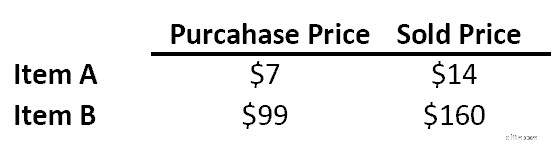
Just by looking at the numbers, it looks like Item B is the more profitable product. But when we calculate return on investment, we see this is not the case.
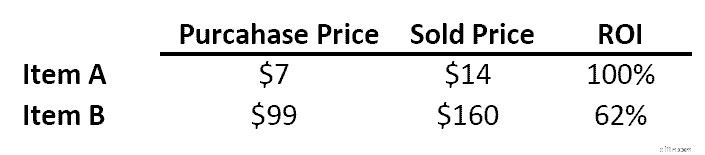
Item A has a 100% return on investment while Item B has a return of investment of 62%. Both of these are great returns to have, but if you want the best return for your money, Item A is where it’s at. Every time you sell one, you are doubling your money.
Final Thoughts
Knowing how to calculate return on investment is key for understanding the best investment you can make. As you can see from the bullet points above, you can calculate return on investment for many industries and needs. The key is just knowing which inputs to use.

Jon Dulin is a personal finance writer and founder of Money Smart Guides. Jon has been helping people improve their finances for over 20 years through personal coaching and while working for a financial planning firm. Jon understands every individual’s situation is unique and there is no one-size-fits-all personal finance solution. He helps people with personalized guidance to help them dig out of debt, start investing, and achieve their dreams. Jon’s writing appears on MSN, Media Decision, BBC, Wall Street Journal, and more. Jon also has a byline on AP News Wire.
Visit Our Staff page to learn more about me and why I am your trusted personal finance expert.
-

Dilma Rousseff Impeachment: Understanding the Allegations
Dilma Rousseff, Brazil’s first female president, is about to go on trial. She is temporarily suspended from office while Brazilian politicians debate wheth
-

Life Insurance Coverage: Is Your Employer's Plan Sufficient?
Image Credit: Piotrekswat/iStock/GettyImages Your companys open enrollment season is the time of year when you have to make decisions that impact your financial future as well as that of your loved
invest
- Essential Money Investing Tips for Financial Security
- Roth IRA vs. Traditional IRA for Young Investors: Which is Best?
- Top Options Brokers for 2024: Commission Fees & Features
- Strategies for Achieving Investment Returns: A Comprehensive Guide
- Top 11 Options Trading Platforms: 2024 Reviews & Comparisons
- Smart Investing Strategies: Where to Put Your Money for Growth
- ACATS Explained: Seamless Account Transfers for Investors
- Homeownership & Portfolio Growth: Understanding the Financial Impact
- Offshore Investing: Benefits, Risks & What You Need to Know
-
 Understanding Seller's Option in Forward Contracts
Seller’s option is a settlement option that allows a seller to set the timelines for the delivery of the underlying asset and determine when the final settlement will occur. Such a type of settl...
-
 Sunday Planning: 9 Steps for Financial Wellness & a Balanced Week
It’s no secret that Mondays are generally the least loved day of the week — but what if I told you it was possible to wake up actually looking forward to the first day b...