
Interest Rate Swap Valuation: A Comprehensive Guide
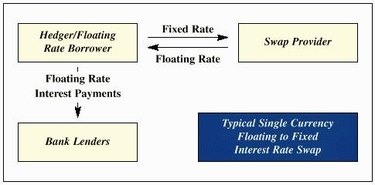
Interest rate swaps amount to exchange cash flows, with one flow based on variable payments and the other on fixed payments. To understand whether a swap is a good deal, investors need to figure the present value of both cash flows, based upon current and projected interest rates.
Step 1
Research key market variables that affect swap pricing and valuation. These include interest rate levels, swap spreads, currency swap spreads, and changes in the shape of the yield curve going out 30 years.
Step 2
Research transaction specific variables that might affect swap pricing and valuation. These include the national principal amount, amortization schedule, time to maturity, and the frequency of swap payments.
Step 3
Create a yield curve. Look up the market rates for treasury yields, interest rate swaps spreads and deposit rates for 1 year, 3 year, 5 year 10 year and 30 year intervals. Chart this in a spreadsheet. You might need to interpolate for missing data, but this will provide you with a basis for comparison against your own payments. Specifically, it will help to determine the forward rate for the variable side of the cash flows in the swap.
Step 4
Determine the appropriate discount factor. The discount factor is indirectly related to the yield curve. As the yield curve increases (decreases) over time, the discount factor will decrease (increase) over time. The exact formula is 1/(1+r)^n, where "r" is the interest rate and "n" is the number of periods.
Step 5
Calculate the fixed rate portion of cash flows and the variable (floating) rate portion of cash flows. That is, take the present value (PV) of cash flows using the forward rates derived in the yield curve for however many periods are in the payment. If the payment is made every 6 months, then you are looking to find the present value of cash flows every 6 months or twice a year.
Step 6
Calculate the difference between the two cash flows. This is the net present value (NPV) of the swap.
Warning
This is not to be construed as investment advice.
-

Understanding LIBOR: A Comprehensive Guide to the London Interbank Offered Rate
The LIBOR index is used to decide loan or mortgage rates. LIBOR is an acronym for London Interbank Offered Rate: a rate of interest calculated based on the information provided by London bank
-

Annual Percentage Rate (APR) Calculation: A Comprehensive Guide
When you're taking out a loan, you want to make sure you're getting the lowest interest rate possible. Or, if you're going to be earning interest, you want to make sure you get the highest
investing
- Understanding and Calculating the Interest Rate Factor
- Interest Calculation: Simple vs. Compound - A Clear Guide
- Semiannual Interest Calculation: A Simple Guide
- Accrued Interest Explained: Calculation & Examples
- Interest Rate Interpolation: A Comprehensive Guide
- Calculate Interest Rates: Present & Future Value Explained
- Calculate Maturity Value: A Comprehensive Guide
- Implied Interest Rate Calculation: A Comprehensive Guide
- Interest Rate Swaps: A Comprehensive Guide
-
 APR to Daily Interest Rate Conversion: A Simple Guide
Credit allows you to receive something in the present in exchange for a promise to pay for it in the future. Credit lets you take out a loan to purchase a house, use an installment plan to buy a refri...
-
 Calculate APR: A Step-by-Step Manual Guide
Calculating APR Annual percentage rate (APR) is the real cost of funds during the year. While credit card companies give an interest rate, the interest rate does not account for compounding. ...