
3 Time Decay Strategies for Options Trading | [Your Brand]
Got a little time? Interested in options trading strategies that target the passage of time? This article is for you.
Option traders know there are two ways for an position to be a winner:
- When a long option goes up in value
- When a short option goes down in value
If the option moves in the opposite direction, the position loses money. The same is true of spreads, which are made up of more than one leg, but one must look at the net value of the trade.
Don’t confuse this with what you want the underlying stock to do. For instance, if you’re short a put, you want the underlying to go up, which should lower the value of your put, thus allowing you to either buy it back for a lower price or allowing the option to expire worthless.
What exactly is it, then, that makes options prices (and thus spreads) go up or down in value? The short answer: Follow the options greeks. These risk metrics can help quantify the relationship between an underlying stock and its options prices. Delta and gamma relate to the movement of the underlying. Vega relates to changes in implied volatility. And then there’s theta.
What is Theta Decay (aka Why Am I Melting?)
“What is options theta,” you ask? Theta addresses the inevitable loss in value that options experience as time passes. Of all these risk measures, the passage of time is the one thing that’s certain. Time marches on, which means that most options prices will continue to “decay,” or lose value over time. And if an option is going to lose value over time, then it’s possible to profit from that option by shorting it.
Note that the other greeks are playing a part in how options prices change, but we’ll assume everything remains the same for the purposes of this article.
If you buy an option, your theta value is negative. Theta decay is one of the (few) consistencies that option traders can rely on. Long options lose time value as they near their expiration date. All else equal, the rate of theta decay accelerates the closer you get to contract expiration. However, if you’re short an option, time is on your side (so to speak) as your theta value is positive.
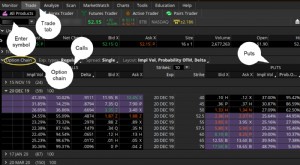
Take a look at the option chain in figure 1. You can set it up to display the theta of each option by selecting a column header, then Option Theoreticals & Greeks > Theta. Want your layout to display differently? Open the drop-down menu under Layout and choose from the preselected layout sets, or create your own by selecting Customize.
![3 Time Decay Strategies for Options Trading | [Your Brand]](https://www.etffin.com/Article/UploadFiles/202109/2021093009190880.jpg)
Extrinsic Value and the Dynamics of Options Theta
How much is an option expected to lose on a daily basis due to time decay? Check the theta in the option chain. For example, the 212.5- and 215-strike calls in figure 1 show a theoretical decay of $0.10 per day. The 230-strike call, which is out of the money (OTM), has a theoretical decay of only $0.06 per day. That makes sense because the further out of the money the option is, the less value there is to decay.
But theta isn’t just about price. That is, an in-the-money (ITM) option won’t have a higher theta than an at-the-money (ATM) option despite having a higher price. Why? The value of an option is broken down into two components: intrinsic value and extrinsic value. Intrinsic value is the difference between the stock price and strike price of an ITM option. It’s also the amount the option would be worth if it were exercised today. Extrinsic value is the difference between the options premium and the intrinsic value.
At expiration, an option has no extrinsic value. It’s either ITM by an amount equal to its intrinsic value, or it’s zero and expires worthless. That’s why many option traders refer to extrinsic value as its “time value” or “time premium.”
Looking for Theta-Based Options Strategies? Here Are 3 to Consider
Some options strategies seek to take advantage of the passage of time. Each has its own objectives—and its own set of risks. Make sure you understand them before jumping in.
Here’s the setup: Recall from above that time decay isn’t the same for every strike. ATM options have the highest rate of decay (all else equal). As options move either OTM or ITM, the rate of decay drops and approaches zero. Also, shorter-term options decay faster than longer-term options (again, all else equal). This rate of options decay speeds up as an option gets closer to expiration.
It’s these two facets that traders put to work when seeking to profit from the following strategies.
STRATEGY #1: SHORT OTM VERTICAL SPREAD
A short vertical spread involves selling an option that’s ATM or slightly OTM and buying an option that’s further OTM. A call vertical spread is made up of two call options; a put vertical is made up of two put options. Vertical spreads have a directional bias in the underlying stock—a call vertical is bearish, and a put vertical is bullish (see figure 2). Vertically challenged and would like more info? Here’s an overview on vertical credit spreads.
![3 Time Decay Strategies for Options Trading | [Your Brand]](https://tickertapecdn.tdameritrade.com/assets/images/pages/md/short-call-vertical-desktop.svg) For illustrative purposes only.">
For illustrative purposes only.">
FIGURE 2: SHORT CALL VERTICAL.
Note the points of maximum profit and maximum loss to see the directional bias. For illustrative purposes only.
![3 Time Decay Strategies for Options Trading | [Your Brand]](https://tickertapecdn.tdameritrade.com/assets/images/pages/md/short-put-vertical-desktop.svg) For illustrative purposes only.">
For illustrative purposes only.">
FIGURE 2: SHORT PUT VERTICAL.
Note the points of maximum profit and maximum loss to see the directional bias. For illustrative purposes only.
STRATEGY #2: IRON CONDOR
An iron condor is a four-legged spread made up of a short OTM call vertical spread and a short OTM put vertical spread in the same expiration cycle. Typically both vertical spreads are OTM and centered around the current price of the underlying. Similar to a single vertical spread, the risk is determined by the distance between the strikes of the vertical.
But unlike the vertical spreads themselves, the directional bias of an iron condor is neutral (see figure 3). In the best-case scenario, the price of the underlying stays between the two short strikes through expiration, and both vertical spreads expire worthless. Here’s a full rundown on iron condors.
![3 Time Decay Strategies for Options Trading | [Your Brand]](https://tickertapecdn.tdameritrade.com/assets/images/pages/md/iron-condor-desktop.svg)
STRATEGY #3: CALENDAR SPREAD
Note that when trading vertical spreads and iron condors, the strikes are all within the same expiration cycle. They target the points of maximum theta within a cycle by placing the short strikes closer to ATM than the long strikes. Calendar spreads, however, target the “other rule of theta”—theta tends to accelerate as you approach expiration.
A calendar spread involves the sale of an option (a call or a put) with a near-term expiration date and the purchase of the same option type and strike price but with a deferred expiration date. It’s a defined-risk strategy, with the risk typically limited to the amount you paid for the spread, or the debit. The best case scenario is for the underlying to be right at the strike price upon expiration of the short option (the near-term expiration date; see figure 4). Learn more about calendar spreads.
![3 Time Decay Strategies for Options Trading | [Your Brand]](https://www.etffin.com/Article/UploadFiles/202109/2021093009190830.jpg)
When trading calendar spreads, some management is required as the expiration date of the near-term option approaches. Once it expires (whether ITM or OTM), the deferred option lingers on. It becomes a long single-leg option. Many traders opt to liquidate or roll a calendar spread at least a few days before the first expiration date rolls around.
Bottom Line on Options Theta and Decay Strategies
Although each of the above strategies involve long options that experience their own time decay, if the trade goes as planned, then the short options bring in more than the long options lose to net out a profit. But if there’s an adverse move in the underlying, like when a short OTM vertical spread moves ITM, then the net time decay of the trade can work against you. Or in the case of a calendar spread, if the implied volatility of the front leg were to rise relative to the volatility in the deferred leg (all else equal), the spread price would go against you.
Still, time marches on, in constant fashion—minute by minute, day by day. Strategies that seek to profit from the inevitable options decay is one way to put time on your side and potentially have it work in your favor.
Are options the right choice for you?
While options trading involves unique risks and is definitely not suitable for everyone, if you believe options trading fits with your risk tolerance and overall investing strategy, TD Ameritrade can help you pursue your options trading strategies with powerful trading platforms, idea generation resources, and the support you need.
Learn more about the potential benefits and risks of trading options.
-

Options Trading: A Beginner's Guide to Profiting from Stocks
If you spend much time investing, you’ve undoubtedly heard about options. Options trading is a way to profit from stocks, whether they rise or fall. Best of all, it doesn’t require a long-
-

Mastering Options Trading: Bullish & Bearish Strategies
As an options trader, you know that trading options requires advanced strategy knowledge. In fact, it can take years to understand the complexities of option trading. (Just remember that nobo
Option
- Iron Condor Strategies: A Comprehensive Guide for Risk-Managed Options Trading
- Earnings Season Options Strategies: Navigating Volatility
- Profitable ETF Option Trading Strategies: A Comprehensive Guide
- Understanding American Options: Strategies & Expiration
- Understanding Stock Option Valuation: A Practical Guide
- Option Theta Explained: A Guide for Option Traders
- Options Trading: A Comprehensive Guide for Portfolio Diversification
- Avoid Costly Mistakes: Options Trading Strategies for Success
- Profitable Options Trading Strategies: A Comprehensive Guide
-
 Options Trading for Beginners: A Step-by-Step Guide to Your First Trade
So you own a bunch of stocks in your portfolio. Some have made a decent profit. You’ve heard you could potentially generate income from stocks you own by trading options. It sounds like a great idea, ...
-
 Navigating Options Trading: Avoiding Common Mistakes for Beginners
Trading options is one of the most complicated ways to trade in the financial markets. Stocks and bonds are very simple by comparison. Therefore, if you have no experience in the field of o...