
Retire at 35: A CPA's Blueprint for Early Financial Freedom
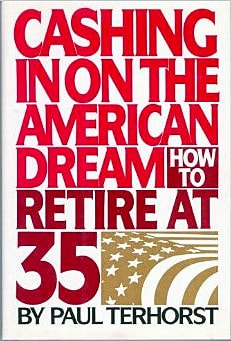
All his life, Paul Terhorst wanted to be rich. Even in grade school, he looked forward to having a corporate job, to joining the world of big business. “I didn't just dream about money and power and expense account living — I planned for it.” He grew up and made it happen.
He got his MBA from Stanford. He became a certified public accountant and joined a large accounting firm. At age 30, he became a partner in the company. He had “a huge office, a leather chair, and a view of a polluted river”. He'd achieved everything he'd always dreamed about.
But at age 33, while on a business trip to Europe, he overhead two guys talking about a friend who had retired early. Terhorst was intrigued. “I began toying with the notion that if I could come up with a way to live off what I already had, I'd never have to work again.”
It took him two years to figure everything out. But in 1984, at age 35, Terhorst made the leap. He retired. (And he's been retired ever since.) In 1988 he published Cashing In on the American Dream to share his experience — and the experience of others who made an early exit from worklife to pursue their passions.
“We need to find new opportunities for sharp, hardworking people who leave the corporate structure,” he writes. “Up to now, those outlets have been second careers, the Peace Corps, turning a hobby into a business, and the like. Those outlets give you at least some money to live on. The route I describe in this book offers more freedom.”
It Takes Less Money Than You Think
The first part of Cashing In on the American Dream is devoted to Terhorst's three-part formula for achieving early retirement:
- Do your arithmetic, by which he means crunch the numbers to see how low you can trim your expenses and how much you need to have saved in order to cover your costs.
- Do some soul-searching. Decide if early retirement is right for you. If so, what does it look like? How will you find meaning after work?
- Do what you want. Terhorst advocates a life of “responsible pleasure”: Do what you love, but don't spend a lot of money to make it happen.
It takes less money than you think to retire early. “Millions could retire right now,” Terhorst says. But many folks are bound by “golden handcuffs”. Their high incomes fund lavish lifestyles, which means they remain voluntarily shackled to their jobs.
In 1984, Terhorst believed you needed a net worth of $400,000 to $500,000 — which would be $972,000 to $1,216,000 today — to retire early. With this level of wealth, he thinks you could live well on $50 per day. (According to official government inflation data, $50 in 1984 is equivalent to $121.62 in 2018. That means Terhorst advocates spending roughly $44,000 per year.) If you opt for what he calls “bare-bones retirement” — what we might now call LeanFIRE — you can retire much sooner.
You Can Kick the Work Habit
Math is only part of the equation. Even you figure out how to make the money work, you'll have to do some soul-searching to figure out when retirement makes sense for you. The key, says Terhorst, is to look for meaning in yourself, not in your job. If you like your work, if you're doing what you love and getting paid for it, then keep doing it! But those cases tend to be the exception, not the rule.
Enjoy your career and then move on.
Before you make the leap, talk to others who've already done so. Learn what they did. What are the rewards? What are the unexpected pitfalls? As you explore the idea, don't expect your friends and colleagues to be supportive. Early retirement is weird. It's not normal. Some folks might even find it threatening. That's okay.
When Terhorst began to contemplate quitting, he faced a lot of pressure — both from himself and from others — to stay on the job. It was the socially acceptable thing to do. Plus, he was bound by those golden handcuffs! “But what kept hammering at my head was that Vicki and I could live without the big income.”

What will you do after you're done working? Whatever you want. “When you retire you have time to pursue any and all of your interests,” Terhorst writes. But getting retirement off the ground takes a bit of time. There's an adjustment period.
Financial independence changes your perspective. It allows you to break free from — and to see — the Matrix. “When you retire you change your frame of reference. You move from a world with work at the center to a playful, almost make-believe world with your life at the center.”
Early retirement isn't about an indolent life of leisure. Terhorst believes it's important to move from an active work life to an active retirement. He has a rule: Do what you want but you must do something. “The idea,” he says, “is to live, not dissipate time.” Have meaning and purpose.
How to Get Started
The second part of Cashing In on the American Dream offers a variety of tactics to get started down the path to early retirement. These suggestions will be familiar to folks who've read my The Money Boss Manifesto.
For instance, Terhorst rails against what he calls “mortgagitis” or “inflammation of the mortgage”. In 1984 — as in 2018 — Americans paid a third of their disposable income toward housing. This cripples any hope they might have of retiring early. Terhorst calls homeownership “the great American ripoff”.
“Our home is our security, a fuzzy blanket for [adults],” he writes.
To prime your economic engine, you have to control your living costs — starting with housing. “Why do you live where you live?” Terhorst asks. Why do you live in your home? Your neighborhood? Your city? Your state? Your country? He urges readers to move to cut housing costs: “Use your imagination to come up with a way to house yourself for less than you pay now. Start with the option most immediately upon you.”
After that immediate move, begin thinking about the long term. In general, this means moving south. It also means moving to where the jobs aren't. (This latter piece of advice might be tough to follow if you're still accumulating wealth. But if you've already retired, it makes perfect sense. Places with high unemployment tend to be cheaper. And since you're retired, the lack of work doesn't matter.)
For good reason, Terhorst devotes more time to housing costs than any other subject. But he also tackles other ways to cut down your infrastructure, especially transportation. In fact, he offers this radical advice: Sell your vehicles. He writes:
You need neither the expense nor the headache cars can bring. Ride with others or use bicycles, taxis, buses, or airplanes. At first it will seem an inconvenience. You'll have to learn to call cabs, arrange to meet others, and read bus schedules. You'll have to allow extra time to walk. But you can adjust if you work on it.
[…]In some parts of the country living without a car may be next to impossible. [Many cheap places to live] are small towns without much public transport. You may have to use bicycles to get around town and have a local cabbie take you shopping. If you absolutely must have a car, buy [a clunker].
After your living costs are under control, you'll begin building net worth. You can turbo-charge this process by managing your career, continuing to control your spending, and adopting a saving routine. Sooner than you think, you'll have accumulated the net worth needed to retire.
Cashing Out to Cash In
So, you've followed Terhorst's advice. You've moved someplace cheap. You've sold your vehicles. You've built your career and cut your infrastructure. You now have a new worth somewhere around a million bucks. What now? Now you cash out everything.
“You should convert your home equity to cash,” Terhorst writes. “You should also convert other assets to cash. Assets complicate our lives. We insure, store, haul, clean, repair, maintain, and talk about them.”
Terhorst says to sell everything but sentimental items. (He and his wife kept a piano when they retired.) Sell everything else, including your home and car. Convert all of your net worth to cash. Invest it. Then live on the proceeds. In 1988, Terhorst recommended putting your money into certificates of deposit; today he recommends stocks.
If you've followed his advice and cut your costs so that you're living on $50 per day (well, $122 per day in 2018), your savings should last indefinitely. But even if something goes wrong — the stock market crashes, you suffer a catastrophic illness, hyperinflation happens — it's not the end of the world. The worst-case scenario is that you go back to work. That's not likely to happen.
Terhorst writes: “The chances of being forced back to work for financial reasons are remote…But if you follow this book's formula, most of you will never work another day in your life unless you choose to do so.”
What Retirement Means
If you want to heed Terhorst's advice — and the advice of other early-retirement experts — you might have to let go of existing ideas and expectations. You might, for instance, have to forget everything you think you know about what retirement is — and what you think it means. “You might have to use your imagination,” Terhorst says. He writes:
Later on, when you're 55 or 65, if you want to you can “unretire” and go back to work. We used to work and then retire. This book suggests you work, then retire, then consider going back to work. Under this plan you devote your middle years to yourself and your family. During those years your mental and physical powers reach their height. You can explore, grow, and invest your time in what's important to you. You can enjoy your children while they're still at home. Later, after you've lived the best years for yourself, you can go back to work if you want to. The choice will be up to you.
“Stop working and start living,” Terhorst says. It's okay to have a job — but don't work for money. Work for fulfillment.
In the final segment of Cashing In on the American Dream, Tehorst admits that part of the reason he has such a great life is that he was born in the right place at the right time: “I grew up and went to work during the most sustained, spectacular boom in economic history.” You've probably heard Warren Buffet claim that he's fortunate to have won the “ovarian lottery”; Terhorst feels the same way. And so do I.
Cashing In on the American Dream is a seminal early retirement book and its advice was spot-on for 1988. But that strength is now its weakness. Some of the advice is thirty years out of date. If you don’t need specific advice but are instead interested about theory (and story), then seek out this title. (The last half of the book is filled with stories from folks who made early retirement happen.)
But if you do need specifics, you’re better off with something like Bob Clyatt’s Work Less, Live More [my review or Early Retirement Extreme from Jacob Lund Fisker. (Speaking of which, the Early Retirement Extreme book club discussed Cashing In on the American Dream in 2015. Some thoughtful comments here.)
-

Cash App: A Comprehensive Guide to Sending, Receiving & Using Money
Want to pay for your morning coffee without digging in your wallet for spare change? Want to cover your half of dinner with a friend without giving your waite
-
Understanding the Pink Tax: Definition, Impact & How to Save Money
Two razors, both alike in everything but price, in the fair supermarket where we lay our scene…Much like Shakespeare’s “Romeo and Juliet,” the argument surrou
Savings
- American Express CID: Understanding Your Card Verification Number
- The American Dream: Is It Fading?
- American Stock Exchange (AMEX): History, Overview & Key Facts
- 52-Week Savings Challenge: A Step-by-Step Guide to Saving $1,378 in a Year
- IRS Rule of 55: Early Withdrawal Penalty Exception Explained
- Early Retirement Strategies: Planning for an Earlier Exit
- Early Retirement Calculator & Planning: Achieve Financial Freedom
- Retire Early: Lessons from a 43-Year-Old Professor
- Top Retirement States: Best Places to Live in Retirement for 2024
-
Retire at 50: A Comprehensive Guide to Early Retirement Planning
So you’ve decided that life is too short to spend one second after your 50th birthday fighting with your coworkers over the office microwave. Retiring at 50 and spending the remaining decades surfing,...
-
 Asset Turnover Ratio: Calculation, Analysis & Business Insights
The asset turnover ratio is an accounting ratio t...