
Understanding Common Stock: Ownership & Returns
What Is Common Stock?
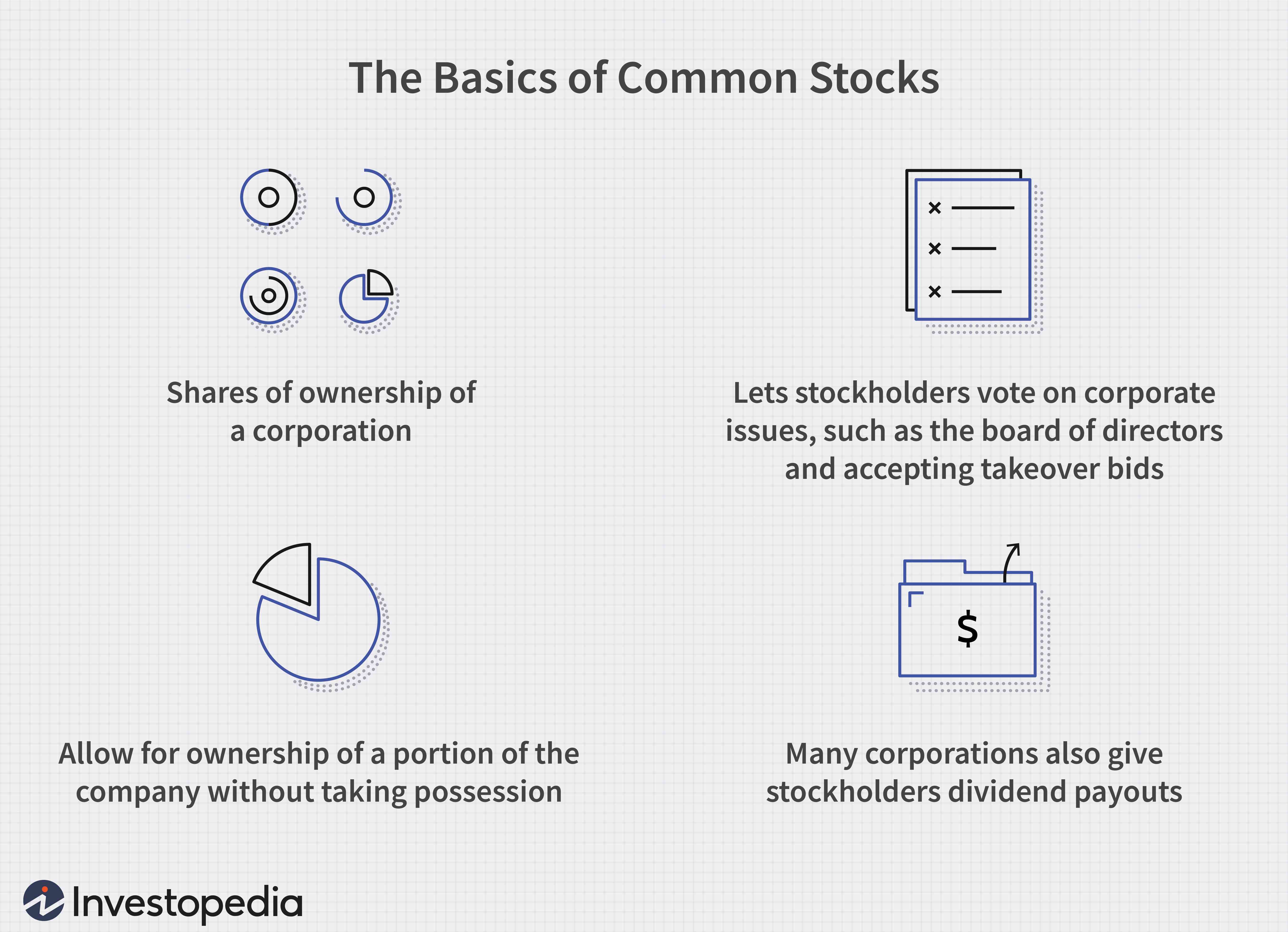
Common stock is a security that represents ownership in a corporation. Holders of common stock elect the board of directors and vote on corporate policies. This form of equity ownership typically yields higher rates of return long term. However, in the event of liquidation, common shareholders have rights to a company's assets only after bondholders, preferred shareholders, and other debtholders are paid in full. Common stock is reported in the stockholder's equity section of a company's balance sheet.
Key Takeaways
- Common stock is a security that represents ownership in a corporation.
- In a liquidation, common stockholders receive whatever assets remain after creditors, bondholders, and preferred stockholders are paid.
- There are different varieties of stocks traded in the market. For example, value stocks are stocks that are lower in price in relation to their fundamentals. Growth stocks are companies that tend to increase in value due to growing earnings.
- Investors should diversify their portfolio by putting money into different securities based on their appetite for risk.
What Is The Difference Between Preferred Stock And Common Stock?
Understanding Common Stock
With common stock, if a company goes bankrupt, the common stockholders do not receive their money until the creditors, bondholders, and preferred shareholders have received their respective share. This makes common stock riskier than debt or preferred shares. The upside to common shares is they usually outperform bonds and preferred shares in the long run. Many companies issue all three types of securities. For example, Wells Fargo & Company has several bonds available on the secondary market. It also has preferred stock, such as its Series L (NYSE: WFC-L), and common stock (NYSE: WFC).
The first-ever common stock was established in 1602 by the Dutch East India Company and introduced on the Amsterdam Stock Exchange. Larger US-based stocks are traded on a public exchange, such as the New York Stock Exchange (NYSE) or NASDAQ. As of 2019, the former has 2800 stocks listed on its bourses, while the latter has 3300 stocks listed. NYSE had a market capitalization of $28.5 trillion in June 2018, making it the biggest stock exchange in the world by market cap.
There are also several international exchanges for foreign stocks, such as the London Stock Exchange and the Tokyo Stock Exchange. Companies that are smaller in size and unable to meet an exchange’s listing requirements are considered unlisted. These unlisted stocks are traded on the Over-The-Counter Bulletin Board (OTCBB) or pink sheets.
For a company to issue stock, it must begin by having an initial public offering (IPO). An IPO is a great way for a company, seeking additional capital, to expand. To begin the IPO process, a company must work with an underwriting investment banking firm, which helps determine both the type and pricing of the stock. After the IPO phase is completed, the general public is allowed to purchase the new stock on the secondary market.
Special Considerations
Stocks should be considered an important part of any investor’s portfolio. They bear a greater amount of risk when compared to CDs, preferred stock, and bonds. However, with the greater risk comes the greater potential for reward. Over the long term, stocks tend to outperform other investments but are more exposed to volatility over the short term.
There are also several types of stocks. Growth stocks are companies that tend to increase in value due to growing earnings. Value stocks are companies lower in price in relation to their fundamentals. Value stocks offer a dividend, unlike growth stocks. Stocks are categorized by market capitalization - either large, mid, or small. Large-cap stocks are much more heavily traded and are generally an indication of a more stable company. Small-cap stocks are usually newer companies looking to grow; so, they can be much more volatile compared to large caps.
-

Common Stock vs. Preferred Stock: Understanding the Key Differences
Those looking to invest in publicly traded companies can easily do so by purchasing shares of stock on the open market. Broadly speaking, stock grants the investor a fractional ownership stake in the
-

Understanding Common & Preferred Stock: A Beginner's Guide
When dealing with common or preferred stock, there are several different features that you will want to be aware of. There are several different types of stock that you could potentially invest
Stock basis
- Calculating Common Equity: A Comprehensive Guide
- Common Stock: Benefits & Risks for Investors
- Understanding Common Stock: Ownership and Basics
- Diversified Common Stock Funds: Investing Basics & Benefits
- Understanding Puttable Common Stock: Benefits & Investment Strategy
- Understanding Stock Options: A Comprehensive Guide
- Common Stock vs. Preferred Stock: Understanding the Differences
- Common vs. Preferred Stock: A Beginner's Guide
- Understanding Common Shares: A Beginner's Guide to Stock Ownership
-
Preferred Stock: Understanding Investor Rights & Benefits
What Is a Preferred Stock? The term stock refers to ownership or equity in a firm. There are two types of equity—common stock and preferred stock. Preferred stockholders have a higher claim to ...
-
Understanding Stock Swaps: A Comprehensive Guide
What Is a Stock Swap? A stock swap is the exchange of one equity-based asset for another and is often associated with the payment for a merger or acquisition. A stock swap occurs when shar...