
Understanding Common Stock: Ownership and Basics
Common stock is a type of security that represents ownership of equity in a companyCorporationA corporation is a legal entity created by individuals, stockholders, or shareholders, with the purpose of operating for profit. Corporations are allowed to enter into contracts, sue and be sued, own assets, remit federal and state taxes, and borrow money from financial institutions.. There are other terms – such as common share, ordinary share, or voting share – that are equivalent to common stock.
Holders of common stock own the rights to claim a share in the company’s profits and exercise control over it by participating in the elections of the board of directorsBoard of DirectorsA board of directors is a panel of people elected to represent shareholders. Every public company is required to install a board of directors., as well as in voting regarding important corporate policies.
Common stock owners can profit from the capital appreciation of the securitiesMarketable SecuritiesMarketable securities are unrestricted short-term financial instruments that are issued either for equity securities or for debt securities of a publicly listed company. The issuing company creates these instruments for the express purpose of raising funds to further finance business activities and expansion.. On average, common shares offer a higher return relative to preferred stock or bonds. However, the higher returns come with the higher risks associated with such securities.
Shareholder rights
The main sources of shareholder rights are legislation in the company’s incorporation, corporate charter, and governance documents. Therefore, the rights of shareholders can vary from one jurisdiction to another and from one corporation to another.
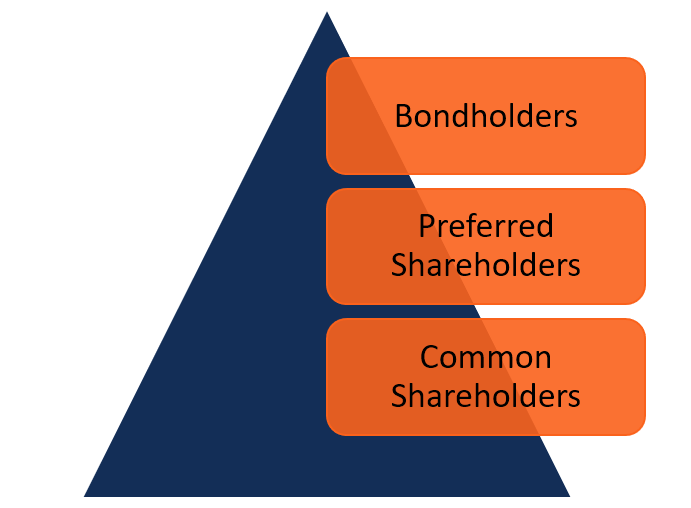
Nevertheless, there are a few shareholder rights that are almost uniform for every corporation. First, the right of shareholders to claim a portion of the company’s profits. The shareholders usually receive a portion of profits through dividendsDividendA dividend is a share of profits and retained earnings that a company pays out to its shareholders. When a company generates a profit and accumulates retained earnings, those earnings can be either reinvested in the business or paid out to shareholders as a dividend.. In addition, in case of a company’s liquidation, holders of common stock own rights to the company’s assets. However, since common shareholders are at the bottom of the priority ladder, it is very unlikely that they would receive compensation in the event of liquidation.
Moreover, common shareholders can participate in important corporate decisions through voting. They can participate in the election of the board of directors and vote on different corporate matters such as corporate objectives, policies, and stock splits.
Classifications of common stock
There is no unified classification of common stock. However, some companies may issue two classes of common stock. In most cases, a company will issue one class of voting shares and another class of non-voting (or with less voting power) shares. The main rationale for using dual classification is to preserve control over the company.
Despite the difference in voting rights, different classes usually enjoy the same rights to the company’s profits.
More resources
CFI is the official provider of the Financial Modeling and Valuation Analyst (FMVA)™Become a Certified Financial Modeling & Valuation Analyst (FMVA)®CFI's Financial Modeling and Valuation Analyst (FMVA)® certification will help you gain the confidence you need in your finance career. Enroll today! certification program, designed to transform anyone into a world-class financial analyst. To keep learning and developing your knowledge of financial analysis, we highly recommend the additional CFI resources below:
- Cost of Preferred StockCost of Preferred StockThe cost of preferred stock to a company is effectively the price it pays in return for the income it gets from issuing and selling the stock. They calculate the cost of preferred stock by dividing the annual preferred dividend by the market price per share.
- Stakeholder vs ShareholderStakeholder vs. ShareholderThe terms “stakeholder” and “shareholder” are often used interchangeably in the business environment. Looking closely at the meanings of stakeholder vs shareholder, there are key differences in usage. Generally, a shareholder is a stakeholder of the company while a stakeholder is not necessarily a shareholder.
- Stockholders EquityStockholders EquityStockholders Equity (also known as Shareholders Equity) is an account on a company's balance sheet that consists of share capital plus
- Share CapitalShare CapitalShare capital (shareholders' capital, equity capital, contributed capital, or paid-in capital) is the amount invested by a company’s
-
Leverage in Finance: Strategies, Types & Risks
In finance, leverage is a strategy that companies use to increase assets, cash flows, and returns, though it can also magnify losses. There are two main types of leverage: financial and operating. To
-

Parent Company Explained: Definition, Control & Examples
A parent company is a company that owns more than 50% of the outstanding voting shares of another company. Therefore, it controls the other company or companies and can directly influence the business
finance
- Return on Common Equity (ROCE): Definition & Importance
- Share Repurchase: Definition, Benefits & How It Works
- Shareholders: Understanding Ownership and Dividends
- Understanding Stocks: A Beginner's Guide to Share Ownership
- Stock Splits Explained: Understanding Share Division & Impact
- Allotment Explained: Resource & Equity Distribution in Business
- Stock Analysis: A Comprehensive Guide for Investors
- Understanding Stock Prices: A Comprehensive Guide
- Stock Buybacks: Understanding Share Repurchases and Their Impact
-
 Founders Stock: Definition, Vesting, and Key Differences
Founders stock refers to the equity that is given to the early founders of an organization. This type of stock differs in a few important ways from common stock sold in the secondary marketSecondary M...
-
 Understanding Financial Gearing: Debt & Leverage Explained
Gearing is the amount of debtNet DebtNet debt = total debt - cash. Net debt is a financial liquidity metric that measures a company’s ability to pay all its debts if they were due today. Compare...