
Stock Market Surge Amid Economic Crisis: Understanding the Disconnect
The number of new COVID-19 cases in the U.S. is still climbing rapidly, over 20 million Americans remain unemployed, dozens of major companies have reportedly filed for bankruptcy, the country is officially in a recession and there’s still no vaccine in sight. Yet America’s main stock market index has surged as much as 44% since hitting a three-year low on March 23, erasing most of its coronavirus losses.
What’s going on?
As an economist who closely follows financial markets, I believe the short answer is the Fed.
On March 22, just before the Standard & Poor’s 500 bottomed out, the U.S. Federal Reserve announced it would begin buying an unprecedented array of assets, including corporate bonds, for the first time. The Fed, which later committed to buying up to US$2.3 trillion in assets, also said it would increase funding to its Exchange Stabilization Fund – which helps regulate the foreign currencies trade – and would purchase more U.S. government bonds and mortgage-backed securities.
The Fed’s decision to begin buying corporate bonds matters to stock investors because it ensures corporations can access credit markets and borrow at very low rates, which ultimately leads to higher profits down the road. Borrowing costs, or yields, on top-rated corporate bonds are about the lowest in at least a century.
This had a second positive impact on stock investors by signaling that the Fed’s unprecedented firepower will eventually be able to restore economic stability, mitigating concerns that the economic and health crises would cause a financial crisis. In just the past few weeks, the amount of securities held by the central bank has swelled from under $4 trillion to $5.96 trillion as of June 3 because of its massive purchases of various securities.
So in a nutshell, despite the dire economic situation still sharply felt by so many, particularly consumers, investors have been fueling and experiencing a sudden bull market, built on optimism that the Fed has put a bottom under the economy – just as it did during the Great Recession in 2008.
Will it last? A sharp crash on June 11, over concerns of a second wave of coronavirus infections, suggests that day traders should tread carefully. Dr. Anthony Fauci’s “worst nightmare” isn’t over yet.
[You’re too busy to read everything. We get it. That’s why we’ve got a weekly newsletter. Sign up for good Sunday reading. ]
-

Understanding Penny Stocks: Trading, Risks, and Where to Buy
Penny stocks are small companies whose shares trade for a relatively low price and often on thin volume. They are considered speculative investments and can be highly volatile, appealing to traders t
-
Navigating Market Volatility: Investor Insights During Coronavirus Uncertainty
After the markets got off to a strong start in 2020, a highly contagious coronavirus centered in Wuhan, China, has many investors running for the exits. Despite swift action from Chinese authorities
stock market
- Stocks vs. Bonds: Understanding Key Similarities
- Stock Market Surge Amid Economic Crisis: Understanding the Disconnect
- Coronavirus & Recession Risk: Analyzing the Impact on the U.S. Economy
- Stocks, Bonds & Mutual Funds: A Beginner's Guide to Investment
- Stocks & Bonds: A Beginner's Guide to Investment Securities
- Resilient Stocks: Which Companies Weathered the 2008 Recession?
- India Power & Energy Stocks Surge: Analyzing the Recent Rally
- Stock Market Surge: Understanding Recent Growth Drivers
- Stocks vs. Bonds: Understanding the Key Differences for Investors
-
 Top Stocks to Buy & Sell: Current Market Insights
One of the unique features of the rally has been the millions of new retail investors out there, using apps to trade and invest, even in fractional shares. More than a few times, these folks have le...
-
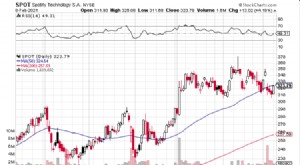 Spotify Stock: Analyzing the Post-Earnings Dip & Future Outlook
Spotify (NYSE: SPOT) reported its year-end earnings last week, and grew its user base faster than the average expectations. Paid subs increased 24% yoy to 155 million, while guidance cal...