
Understanding Amortization of Intangible Assets: A Comprehensive Guide
In this article, we will discuss the amortization of intangible assets. Intangible assets refer to assets of a company that are not physical in nature. They include trademarks, customer lists, goodwillGoodwillIn accounting, goodwill is an intangible asset. The concept of goodwill comes into play when a company looking to acquire another company is, etc. Hence, they are not composed of parts or materials with a defined benefit or life span, which can be objectively determined.
This creates difficulties in properly estimating a periodic charge for these intangible assets. To such an end, the International Accounting Standards Board’s IAS 38 sets out rules on how intangibles should be amortized.
Classification of Intangibles
Intangible assets can be broadly classified into two categories:
1. Definite life
They refer to assets with a finite life. For example, a license to produce a certain product for ten years. Here, the asset is given an identifiable contract life of ten years.
2. Indefinite life
The life of such assets is unknown at inception. They may generate or contribute to revenue in perpetuity – for example, broadcasting rights that may be continuously renewed without much cost to the holder.
Determination of Life
The IAS 38 underlines certain factors that can be used to determine the life of an intangible asset, such as:
1. Expected usage
The length that the asset is expected to produce benefits for the business. it can also be the length of the contract that allows for the use of the intangible asset. For example, a copyright will take on a legal life of 50 years, but it is expected to be useful only for 10 years. The appropriate useful life for amortization then is 10 years.
2. Product life cycleProduct Life CycleThe Product Life Cycle (PLC) defines the stages that a product moves through in the marketplace as it enters, becomes established, and exits the marketplace
Some intangibles may be product-specific and should not have a life longer than that of the associated products.
3. Technical obsolescence
Any intangible asset associated with a product that is now technically obsolete should be considered impaired and amortized accordingly. For example, a patent on a mechanical watch would be considered obsolete, but a trademark might still possess some value due to the unique quality of the brand.
4. Competitor action
Some competitor actions can make the incumbent product obsolete, in which case IAS 38 requires that the incumbent business impair and amortize associated intangibles. For example, any intangibles related to the manufacturing or distribution of old-style tungsten light bulbs are rendered worthless in the accounting sense with the introduction of more efficient forms of lighting like LEDs.
5. Maintenance expenditure
Some intangibles require an amount of expenditure, such as a renewal fee, to keep them operational. If the maintenance expenditure is high enough that a business can no longer afford to pay, then the business may be required to write down or write off the asset.
The most common example of such an intangible is broadcasting rights. If broadcasting rights can be renewed easily, then they can be reported as an intangible asset with an indefinite life.
Amortization Methods
General Guidelines
IAS 38 provides general guidelines as to how intangible assets should be amortized:
1. The amortization of an asset should only start when the asset is brought into actual use, and not before, even if the requisite intangible asset has been acquired.
2. The level amortization should be appropriate so that the book value of an asset is not under or overstated.
The method of amortization used should commensurate with the use of the asset. If no method is determinable, then the asset must be amortized on a straight-line basis.
Revenue-Based Amortization
In line with the guidelines, revenue-based amortization aims to amortize the intangible in accordance with its contributions to the revenue. It leads to a variable amortization schedule. However, IAS 38 argues against the use of revenue-based methods because it is hard to quantify the contribution of an intangible to revenue. The standard recommends the use of the straight-line method in place of revenue-based amortization.
Indefinite Life Assets
Assets with an indefinite life cannot be amortized in regular fashion as finite life assets. Instead, every year, a test for impairment is conducted on indefinite life assets. If the asset is found to be impaired, then its useful life is estimated, and it is amortized over the remainder of its useful life like a finite life intangible.
Straight-Line Method
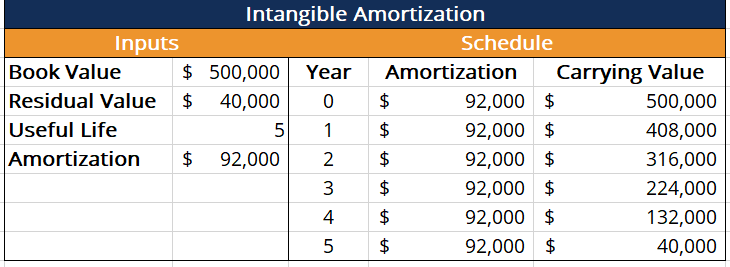
Under the straight-line method (SLM), an asset is amortized to zero or its residual value. The amount of amortization every year is given by:
Amortization = (Book Value – Residual Value) / Useful Life
The following table illustrates the straight-line method:
Related Readings
CFI is the official provider of the Commercial Banking & Credit Analyst (CBCA)®Program Page - CBCAGet CFI's CBCA™ certification and become a Commercial Banking & Credit Analyst. Enroll and advance your career with our certification programs and courses. certification program, designed to transform anyone into a world-class financial analyst.
To keep learning and developing your knowledge of financial analysis, we highly recommend the additional resources below:
- Amortization ScheduleAmortization ScheduleAn amortization schedule is a table that provides the details of the periodic payments for an amortizing loan. The principal of an amortizing loan is paid
- Functional ObsolescenceFunctional Obsolescence (Real Estate)In real estate, functional obsolescence refers to the diminishing of the usefulness of an architecture design such that changing it to suit current real
- Goodwill Impairment AccountingGoodwill Impairment AccountingGoodwill is acquired and recorded on the books when an entity purchases another entity for more than the fair market value of its assets.
- Tangible AssetsTangible AssetsTangible assets are assets with a physical form and that hold value. Examples include property, plant, and equipment. Tangible assets are
-
Amortization Explained: Understanding Debt Repayment & Schedules
Amortization refers to the process of paying off a debt through scheduled, pre-determined installments that include principal and interestDebt ScheduleA debt schedule lays out all of the debt a busine
-

Intangible Asset Amortization: A Comprehensive Guide
Accountants amortize intangible assets just like
Accounting
- Asset Dissipation: Financing Your Home with Liquid Assets
- Amortization Explained: Definition, Calculation & Impact
- Asset Management: Definition, Types & Importance
- Asset Turnover Ratio: Definition & Importance
- Understanding Amortization of Intangible Assets: A Comprehensive Guide
- Understanding Intangible Assets: Definition & Importance
- Non-Current Assets: Definition, Examples & Accounting
- Non-Financial Assets: Definition, Examples & Value
- Understanding Stranded Assets: Risks and Impacts
-
 Understanding Assets: Types, Examples & Importance in Business Accounting
“Asset” is one of those words that has both a casual meaning and a specific definition. As part of everyday speech, asset is used favorably: “He’s a real asset to the community...
-
 Amortization vs. Impairment of Intangible Assets: Key Differences Explained
What Is Amortization vs. Impairment of Intangible Assets? Amortization and impairment relate to the value of a companys intangible assets, which are reported on the balance sheet. Intangible as...