
Backup Withholding: Understanding IRS Tax Collection
Backup withholding is a federal taxation method used by the Internal Revenue Service (IRS). The backup withholding method is used to collect taxes on income payments that are not subject to tax withholding. It is applied to income where the person or business making the payment does not withhold taxes from the person receiving the payment.

In such cases, it is the responsibility of the person receiving the income to accurately report and pay taxes when filing his or her annual tax return. Backup withholding taxes most commonly apply to investment income. In some cases, the taxes also apply to gambling winnings; however, it varies by country and jurisdiction. For example, no taxes are withheld on gambling winnings in Canada.
Summary
- Backup withholding is a federal taxation method to collect taxes on income that is not subject to tax withholding.
- The method is most commonly applied to interest and dividend income but is also applied to certain other types of income, including gambling winnings, rents, royalties, and commissions.
- Most individuals are not subject to backup withholding as long as they properly report their names and Social Security number and their information matches the records with the relevant tax-collecting body.
The Need for Backup Withholding
Investors earn investment income throughout the year in the form of capital gainsCapital GainA capital gain is an increase in the value of an asset or investment resulting from the price appreciation of the asset or investment. In other words, the gain occurs when the current or sale price of an asset or investment exceeds its purchase price., dividends, and interest. Even though investors receive such types of income throughout the year, taxes are not withheld when the income is received.
Taxes owed throughout the year only come due annually. It means that the person earning investment income could potentially spend it all before taxes come due. Due to such problems, the IRS faces the risk of losing substantial amounts of tax revenue.
To protect themselves from this risk, government bodies such as the Internal Revenue Service (IRS) and Canada Revenue Agency (CRA) apply backup withholding taxes in certain cases. Backup withholding taxes are applied in cases where the above-mentioned risk is high.
How Does Backup Withholding Work?
Taxpayers are responsible for accurately reporting their investment earnings in their annual tax return. Most individuals are not subject to backup withholding, as long as they properly report their names and Social Security number and their information matches the records with the relevant tax collecting body. Backup withholding will not apply to taxpayers who accurately report their investment income and comply with regulatory standards.
For 2020 and 2021, the backup withholding tax is 24%. The tax will apply under the following circumstances:
- The individual failed to provide an accurate tax identification number (TIN) or Social SecuritySocial SecuritySocial Security is a US federal government program that provides social insurance and benefits to people with inadequate or no income. The first Social number (SSN) to the payer.
- The tax collecting body notifies the individual that the TIN provided was incorrect.
- The individual underreported interest and/or dividend income; the IRS provides four warnings before applying a withholding tax.
- The individual failed to certify that they are not subject to backup withholding due to unreported interest or dividends.
In addition to investment income and gambling winnings, other types of income commonly subject to backup withholding include rents, royalty payments, commissionsCommissionCommission refers to the compensation paid to an employee after completing a task, which is, often, selling a certain number of products or services, and certain government payments.
In cases where applicable, tax collecting agencies would require financial institutions to deduct backup withholding taxes when the investor withdraws the investment income. At such time, the amount stipulated by the backup withholding tax would be deducted from the investor’s income and remitted to the government tax-collecting body.
If individuals want to stop backup withholding, they will need to rectify why they became subject to it in the first place. If the backup withholding was applied due to the submission of incorrect information (name or TIN), it could be corrected by providing the payer with the corrected information on a W-9 form. In the case of underreported income, one can ask the IRS not to start backup withholding or to stop it. However, one must establish one of the four circumstances:
- Income was not underreported.
- The individual reached out to the IRS regarding the underreporting, but the matter was not resolved.
- The individual made an honest error and already filed an amended return.
- The individual will face undue hardship due to backup withholding and will file an amended return.
Related Readings
CFI is the official provider of the global Commercial Banking & Credit Analyst (CBCA)™Program Page - CBCAGet CFI's CBCA™ certification and become a Commercial Banking & Credit Analyst. Enroll and advance your career with our certification programs and courses. certification program, designed to help anyone become a world-class financial analyst. To keep advancing your career, the additional CFI resources below will be useful:
- Capital Gains TaxCapital Gains TaxCapital gains tax is a tax imposed on capital gains or the profits that an individual makes from selling assets. The tax is only imposed once the asset has been converted into cash, and not when it’s still in the hands of an investor.
- Deferred Income TaxDeferred Income TaxDeferred income tax is a liability that can be found on a balance sheet. This results from differences in income recognition between tax laws
- How to Use the IRS.gov WebsiteHow to Use the IRS.gov WebsiteIRS.gov is the official website of the Internal Revenue Service (IRS), the United States’ tax collection agency. The website is used by businesses and
- Taxable IncomeTaxable IncomeTaxable income refers to any individual's or business’ compensation that is used to determine tax liability. The total income amount or gross income is used as the basis to calculate how much the individual or organization owes the government for the specific tax period.
-

Accrued Interest Explained: Accounting & Financial Definition
Accrued interest refers to interest generated on an outstanding debt during a period of time, but the payment has not yet been made or received by the borrower or lender. SummaryUnder accru
-
Understanding Accumulated Depreciation: A Comprehensive Guide
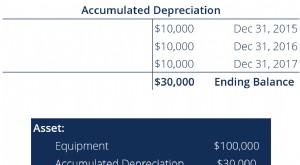
Accumulated depreciation is the total amount of depreciation expense allocated to a specific asset PP&E (Property, Plant and Equipment)PP&E (Property, Plant, and Equipment) is one of the core
Accounting
- What Does Exempt Payee Mean?
- PC Banking: A Comprehensive Guide to Online Banking Security & Features
- IRA CDs: Secure Retirement Savings with FDIC Insurance
- Understanding the DU: Your Mortgage Approval Explained
- Decentralized Finance (DeFi): A Comprehensive Overview
- Jumbo CDs: Higher Rates & Deposits Explained
- Backup Withholding: Understanding IRS Tax Collection
- Understanding Cryptocurrency: A Beginner's Guide to Digital Currency
- DB(k) Plans: A Hybrid Retirement Solution for Employers & Employees
-
 Understanding Accounting Methods: Cash vs. Accrual
An accounting method refers to a set of rules that a company adheres to when keeping its financial records and reporting financial transactions. The transactions are recorded in a manner that accurate...
-
 Accrued Income Explained: Definition & Accounting
Accrued income is income that a company will recognize and record in its journal entries when it has been earned – but before cash payment hast been received. There are times when a company will...