
Understanding Bad Debt Expense: Accounting & Methods
Bad debt expense is the way businesses account for a receivable account that will not be paid. Bad debt arises when a customer either cannot pay because of financial difficulties or chooses not to pay due to a disagreement over the product or service they were sold.
Summary
- Bad debt expense is used to reflect receivables that a company will be unable to collect.
- Bad debt can be reported on financial statements using the direct write-off method or the allowance method.
- The amount of bad debt expense can be estimated using the accounts receivable aging method or the percentage sales method.
Reporting Bad Debts
Bad debt can be reported on the financial statementsThree Financial StatementsThe three financial statements are the income statement, the balance sheet, and the statement of cash flows. These three core statements are using the direct write-off method or the allowance method.
1. Direct write-off method
The direct write-off method involves writing off a bad debt expense directly against the corresponding receivable account. Therefore, under the direct write-off method, a specific dollar amount from a customer account will be written off as a bad debt expense.
However, the direct write-off method can result in misstating the income between reporting periodsReporting PeriodA reporting period, also known as the accounting period, is a discrete and uniform span of time for which the financial performance and if the bad debt journal entry occurred in a different period from the sales entry. For such a reason, it is only permitted when writing off immaterial amounts. The journal entry for the direct write-off method is a debit to bad debt expense and a credit to accounts receivable.

2. Allowance method
The allowance method estimates bad debt expense at the end of the fiscal year, setting up a reserve account called allowance for doubtful accountsAllowance for Doubtful AccountsThe allowance for doubtful accounts is a contra-asset account that is associated with accounts receivable and serves to reflect the true value of accounts receivable. The amount represents the value of accounts receivable that a company does not expect to receive payment for.. Similar to its name, the allowance for doubtful accounts reports a prediction of receivables that are “doubtful” to be paid.
In contrast to the direct write-off method, the allowance method is only an estimation of money that won’t be collected and is based on the entire accounts receivable account. The amount of money written off with the allowance method is estimated through the accounts receivable aging method or the percentage of sales method. An example of an allowance method journal entry can be found below.
Entry 1: The amount of bad debt is estimated using the accounts receivable aging method or percentage of sales method and is recorded as follows:

Entry 2: When a specific receivables account is deemed to be uncollectible, allowance for doubtful accounts is debited and accounts receivable is credited.

Estimating the Bad Debt Expense
The amount of bad debt expense can be estimated using the accounts receivable aging method or the percentage sales method.
1. Accounts receivable aging method
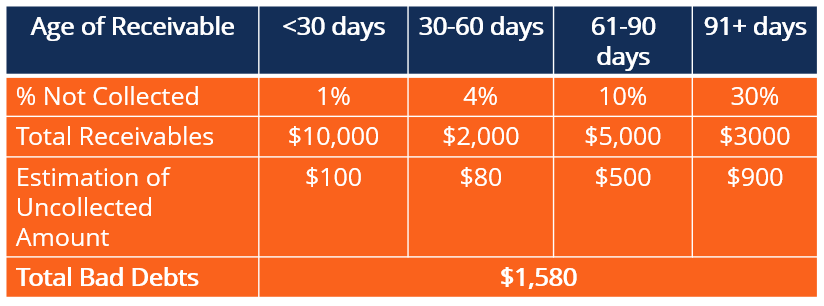
The accounts receivable aging method groups receivable accounts based on age and assigns a percentage based on the likelihood to collect. The percentages will be estimates based on a company’s previous history of collection.
The estimated percentages are then multiplied by the total amount of receivables in that date range and added together to determine the amount of bad debt expense. The table below shows how a company would use the accounts receivable aging method to estimate bad debts.
2. Percentage of sales method
The percentage of sales method simply takes the total sales for the period and multiplies that number by a percentage. Once again, the percentage is an estimate based on the company’s previous ability to collect receivables.
For example, if a company with sales of $2,000,000 estimates that 2% of sales will be uncollectible, their bad debt expense would be $40,000 ($2,000,000 * 0.02).
Example
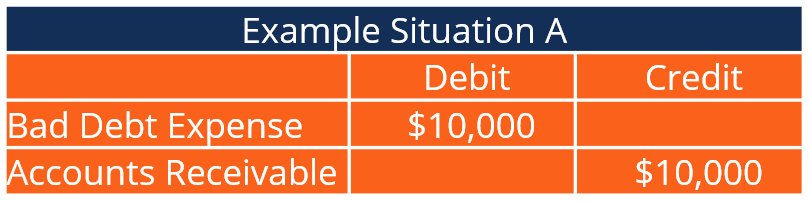
Consider a roofing business that agrees to replace a customer’s roof for $10,000 on credit. The project is completed; however, during the time between the start of the project and its completion, the customer fails to fulfill their financial obligation.
The original journal entry for the transaction would involve a debit to accounts receivable, and a credit to sales revenue. Once the company becomes aware that the customer will be unable to pay any of the $10,000, the change needs to be reflected in the financial statements.
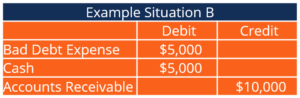
Therefore, the business would credit accounts receivable of $10,000 and debit bad debt expense of $10,000. If the customer is able to pay a partial amount of the balance (say $5,000), it will debit cash of $5,000, debit bad debt expense of $5,000, and credit accounts receivable of $10,000.
Significance of Bad Debt Expense
Fundamentally, like all accounting principles, bad debt expense allows companies to accurately and completely report their financial position. At some point in time, almost every company will deal with a customer who is unable to pay, and they will need to record a bad debt expense. A significant amount of bad debt expenses can change the way potential investors and company executives view the health of a company.
For the above-mentioned reasons, it is critical that bad debts are recorded timely and accurately. In addition, they help companies recognize customers who defaulted on payments to avoid similar situations in the future.
Additionally, bad debt expense does comes with tax implications. Reporting a bad debt expense will increase the total expenses and decrease net income. Therefore, the amount of bad debt expenses a company reports will ultimately change how much taxes they pay during a given fiscal period.
Related Readings
CFI is the official provider of the global Commercial Banking & Credit Analyst (CBCA)™Program Page - CBCAGet CFI's CBCA™ certification and become a Commercial Banking & Credit Analyst. Enroll and advance your career with our certification programs and courses. certification program, designed to help anyone become a world-class financial analyst. To keep advancing your career, the additional resources below will be useful:
- Accounts Payable vs. Accounts ReceivableAccounts Payable vs Accounts ReceivableIn accounting, accounts payable and accounts receivable are sometimes confused with the other. The two types of accounts are very similar in
- Journal Entry TemplateJournal Entry TemplateThis journal entry template will help you construct properly formatted journal entries and provide a guideline for what a general ledger should look like.
- Probability of DefaultProbability of DefaultProbability of Default (PD) is the probability of a borrower defaulting on loan repayments and is used to calculate the expected loss from an investment.
- Projecting Balance Sheet Line ItemsProjecting Balance Sheet Line ItemsProjecting balance sheet line items involves analyzing working capital, PP&E, debt share capital and net income. This guide breaks down how to calculate
-
Debt Restructuring: A Comprehensive Guide for Financial Distress
Debt restructuring is a process wherein a company or an entity experiencing financial distress and liquidityLiquidityIn financial markets, liquidity refers to how quickly an investment can be sold wit
-

Debt Settlement: Definition, How It Works & Is It Right For You?
A debt settlement refers to an agreement reached between a creditor and a borrower in which a reduced payment from the borrower is regarded as full payment. In other words, a debt settlement is a debt
Accounting
- Understanding Debt: Types, Impact & Management
- Understanding Accounting Methods: Cash vs. Accrual
- Understanding Bad Debt: Definition and Financial Statement Impact
- Understanding Insurance Expense: Definition & Accounting
- Understanding Rent Expense: Definition & Significance
- Understanding Wage Expense: Definition, Types & Accounting
- Debt Snowball Method: A Step-by-Step Guide to Debt Freedom
- Understanding Debt: Types, Impact & How to Manage It
- Understanding Bad Debt: Definition, Causes & Accounting
-
 Debt Financing: A Comprehensive Guide for Businesses
Debt financing occurs when a company raises money by selling debt instruments, most commonly in the form of bank loans or bonds. Such a type of financing is often referred to as financial leverage.&nb...
-
 Debt Refinancing: A Comprehensive Guide to Lowering Your Payments
Debt refinancing is the replacement of an existing debt by means of another debt with terms and/or conditions that are more favorable. In other words, debt refinancing refers to the replacement of exi...