
Customer Acquisition Cost (CAC): Definition & Calculation
Customer acquisition cost (CAC) is the cost related to acquiring a new customer. In other words, CAC refers to the resources and costs incurred to acquire an additional customer. Customer acquisition cost is a key business metric that is commonly used alongside the customer lifetime value (LTV)Lifetime Value CalculationLifetime Value Calculation is the process by which a business measures the value of a customer to the business through the customer’s full lifespan metric to measure value generated by a new customer.
Summary
- Customer acquisition cost is an important business metric used to evaluate the cost of acquiring a new customer.
- Calculated as sales and marketing expenses divided by the number of new customers, a thorough understanding of CAC can help improve a company’s marketing return on investment, profitability, and profit margin.
Formula for Customer Acquisition Cost
The formula for customer acquisition cost is as follows:

Where:
- Sales and marketing expenses are the advertising and marketing spend, commissions and bonuses paid, salaries of marketers and sales managers, and overhead costs related to sales and marketing over the measurement period.
- Number of new customers is the total number of acquired customers over the measurement period.
Example of Customer Acquisition Cost
Tim is the marketing manager of ABC Company and is due for a performance review in the coming weeks. Over the last year, he launched several marketing campaigns5 P's of MarketingThe 5 P's of Marketing – Product, Price, Promotion, Place, and People – are key marketing elements used to position a business strategically. The 5 P's of to attract new customers and would like to determine his customer acquisition cost prior to his performance review. Tim’s annual salary is $45,000. Below is information related to ABC Company’s marketing campaigns last year:
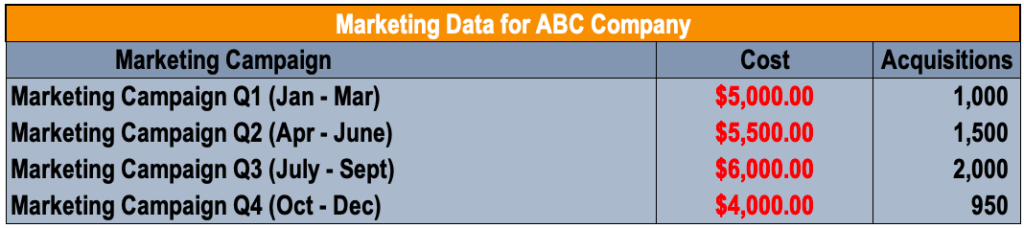
The CAC for ABC Company over the last year is calculated as follows:

Importance of Customer Acquisition Cost
CAC is a key business metric that many businesses and investors look at. In fact, many companies end up failing due to not fully understanding their customer acquisition cost.
1. Improving return on investment
Understanding the cost to acquire new customers is crucial to analyzing marketing return on investmentROAS (Return on Ad Spend)ROAS (Return on Ad Spend) is an important eCommerce metric. ROAS measures revenue generated per dollar of marketing spent. It is a similar and alternative profitability metric to ROI, or "Return on Investment". ROAS is commonly used in eCommerce businesses to evaluate the effectiveness of a marketing campaign.. For example, consider a company that uses several channels to acquire customers:

By using CAC, a company is able to determine the most cost-effective way to acquire customers. In the table above, we can see that Social Media provides the lowest acquisition cost while Social Events cost the most. A company presented with this data may consider using social media marketing more to generate more customers.
2. Improving profitability and profit margin
Understanding its CAC provides a business with the ability to fully analyze the value per customer and improve its profit margins. For example, assume that the value of each customer to a business is $60.
Relating it to the example above, which channel would you choose to use? A business that does not understand CAC would adversely affect profitability by choosing to use Social Events as a channel. The channels Social Media and Posters would improve profitability for the company as the CAC is lower than the value per customer.
More Resources
CFI offers the Financial Modeling & Valuation Analyst (FMVA)®Become a Certified Financial Modeling & Valuation Analyst (FMVA)®CFI's Financial Modeling and Valuation Analyst (FMVA)® certification will help you gain the confidence you need in your finance career. Enroll today! certification program for those looking to take their careers to the next level. To keep learning and advancing your career, the following CFI resources will be helpful:
- Advertising to Sales RatioAdvertising to Sales RatioThe advertising to sales ratio, also called the “A to S” for short, measures the effectiveness, or how successful, a company’s advertising strategies are. The advertising to sales ratio is used to determine how helpful the company’s resources and investments in advertising are in generating new sales
- Pull Marketing StrategyPull Marketing StrategyA pull marketing strategy, also called a pull promotional strategy, refers to a strategy in which a firm aims to increase demand for its products and draw
- Types of CustomersTypes of CustomersCustomers play a significant role in any business. By better understanding the different types of customers, businesses can be better equipped to develop
- Value PropositionValue PropositionValue proposition is a promise of value stated by a company that summarizes the benefit(s) of the company’s product or service and how they are delivered
-
Activity Cost Drivers: Definition & Importance for Profitability
An activity cost driver refers to actions that cause variable costsVariable CostsVariable costs are expenses that vary in proportion to the volume of goods or services that a business produces. In oth
-
Cost Behavior Analysis: Understanding Cost Relationships & Management
Cost behavior analysis refers to management’s attempt to understand how operating costs change in relation to a change in an organization’s level of activity. These costs may include direc
Accounting
- Customer Acquisition Cost (CAC): Definition & Optimization
- CRM: Understanding Customer Relationship Management - A Comprehensive Guide
- Understanding Acquisition Cost: Definitions & Applications
- Cost of Capital: Definition, Calculation & Importance
- Understanding Allowed Depreciation: Tax Deductions for Businesses
- Capitalized Costs Explained: Definition & Examples
- Cost Allocation: Definition, Methods & Importance
- Marginal Cost: Definition, Calculation & Examples
- Customer Acquisition Cost (CAC): A Comprehensive Guide
-
 Target Costing: A Comprehensive Guide to Value-Based Pricing
Target costing is not just a method of costing, but rather a management technique wherein prices are determined by market conditions, taking into account several factors, such as homogeneous products,...
-
 Unit Economics: A Comprehensive Guide for Business Success
Whether you’re a new business owner or a savvy veteran, having the appropriate information and business model in place is crucial for success. Since there are numerous models and methods you can us...