
Marginal Cost: Definition, Calculation & Examples
Marginal cost represents the incremental costs incurred when producing additional units of a good or service. It is calculated by taking the total change in the cost of producing more goods and dividing that by the change in the number of goods produced.
The usual variable costsVariable CostsVariable costs are expenses that vary in proportion to the volume of goods or services that a business produces. In other words, they are costs that vary included in the calculation are labor and materials, plus the estimated increases in fixed costs (if any), such as administration, overhead, and selling expenses. The marginal cost formula can be used in financial modelingWhat is Financial ModelingFinancial modeling is performed in Excel to forecast a company's financial performance. Overview of what is financial modeling, how & why to build a model. to optimize the generation of cash flowCash FlowCash Flow (CF) is the increase or decrease in the amount of money a business, institution, or individual has. In finance, the term is used to describe the amount of cash (currency) that is generated or consumed in a given time period. There are many types of CF.
Below we break down the various components of the marginal cost formula.

Image: CFI’s Budgeting & Forecasting Course.
What is the Formula for Marginal Cost?
The Marginal Cost Formula is:
Marginal Cost = (Change in Costs) / (Change in Quantity)
1. What is “Change in Costs”?
At each level of production and during each time period, costs of production may increase or decrease, especially when the need arises to produce more or less volume of output. If manufacturing additional units requires hiring one or two additional workers and increases the purchase cost of raw materials, then a change in the overall production costEconomics of ProductionProduction refers to the number of units a firm outputs over a given period of time. From a microeconomics standpoint, a firm that operates efficiently will result.
To determine the change in costs, simply deduct the production costs incurred during the first output run from the production costs in the next batch when output has increased.
2. What is “Change in Quantity”?
It’s inevitable that the volume of output will increase or decrease with varying levels of production. The quantities involved are usually significant enough to evaluate changes in cost. An increase or decrease in the volume of goods produced translates to costs of goods manufactured (COGM)Cost of Goods Manufactured (COGM)Cost of Goods Manufactured (COGM) is a term used in managerial accounting that refers to a schedule or statement that shows the total.
To determine the changes in quantity, the number of goods made in the first production run is deducted from the volume of output made in the following production run.
Download the Marginal Cost Calculator
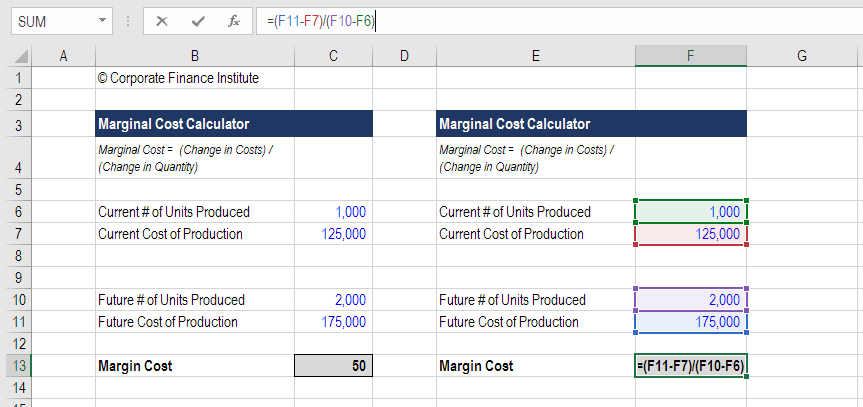
How do you calculate the marginal costMarginal CostThe Marginal Cost of Production is the cost to provide one additional unit of a product or service. It is a fundamental principle that is? Download CFI’s free Marginal Cost CalculatorMarginal Cost CalculatorThis marginal cost calculator allows you to calculate the additional cost of producing more units using the formula: Marginal Cost = Change in Costs / Change in Quantity Marginal cost represents the incremental costs incurred when producing additional units of a good or service. It is calculated by taking the total cha. If you want to calculate the additional cost of producing more units, simply enter your numbers into our Excel-based calculator and you’ll immediately have the answer.
Begin by entering the starting number of units produced and the total cost, then enter the future number of units produced and their total cost. The output of that equation is the marginal cost. Below is a screenshot of the calculator.
Download the Free Template
Enter your name and email in the form below and download the free template now!
An Example of the Marginal Cost Formula
Johnson Tires, a public company, consistently manufactures 10,000 units of truck tires each year, incurring production costs of $5 million. However, one year finds the market demand for tires significantly higher, requiring the additional production of units, which prompts management to purchase more raw materials and spare parts, as well as to hire more manpower.
This demand results in overall production costs of $7.5 million to produce 15,000 units in that year. As a financial analystFinancial Analyst Role, you determine that the marginal cost for each additional unit produced is $500 ($2,500,000 / 5,000).
How Important is Marginal Cost in Business Operations?
When performing financial analysisTypes of Financial AnalysisFinancial analysis involves using financial data to assess a company’s performance and make recommendations about how it can improve going forward. Financial Analysts primarily carry out their work in Excel, using a spreadsheet to analyze historical data and make projections Types of Financial Analysis, it is important for management to evaluate the price of each good or service being offered to consumers, and marginal cost analysis is one factor to consider.
If the selling price for a product is greater than the marginal cost, then earnings will still be greater than the added cost – a valid reason to continue production. If, however, the price tag is less than the marginal cost, losses will be incurred and therefore additional production should not be pursued – or perhaps prices should be increased. This is an important piece of analysis to consider for business operations.
Learn more in CFI’s Financial Analysis Courses.
What Jobs Use the Marginal Cost Formula?
Professionals working in a wide range of corporate financeCorporate Finance OverviewCorporate finance deals with the capital structure of a corporation, including its funding and the actions that management takes to increase the value of roles calculate the incremental cost of production as part of routine financial analysis. Accountants working in the valuations groupValuations Analyst Career ProfileA valuations analyst provides valuation services for public and private companies. They typically focus on the identification and valuation of intangible assets and, more specifically, with goodwill impairment and purchase price allocation (PPA). A career as an analyst on the valuation team can require significant financial modeling and analysis. may perform this exercise calculation for a client, while analysts in investment bankingInvestment Banking Career PathInvestment banking career guide - plan your IB career path. Learn about investment banking salaries, how to get hired, and what to do after a career in IB. The investment banking division (IBD) helps governments, corporations, and institutions raise capital and complete mergers and acquisitions (M&A). may include it as part of the output in their financial modelTypes of Financial ModelsThe most common types of financial models include: 3 statement model, DCF model, M&A model, LBO model, budget model. Discover the top 10 types.
Explore CFI’s Career Map to learn more!
Video Explanation of Marginal Cost
Below is a short video tutorial that explains what marginal cost is, the formula to calculate it, and why it’s important in financial analysis.
Video: CFI’s Financial Analysis Courses.
Economies of Scale (or Not)
Businesses may experience lower costs of producing more goods if they have what are known as economies of scaleEconomies of ScaleEconomies of scale refer to the cost advantage experienced by a firm when it increases its level of output.The advantage arises due to the. For a business with economies of scale, producing each additional unit becomes cheaper and the company is incentivized to reach the point where marginal revenueMarginal RevenueMarginal Revenue is the revenue that is gained from the sale of an additional unit. It is the revenue that a company can generate for each additional unit sold equals marginal costMarginal CostThe Marginal Cost of Production is the cost to provide one additional unit of a product or service. It is a fundamental principle that is.
An example would be a production factory that has a lot of space capacity and becomes more efficient as more volume is produced. In addition, the business is able to negotiate lower material costs with suppliers at higher volumes, which makes variable costs lower over time.
For some businesses, per unit costs actually rise as more goods or services are produced. These companies are said to have diseconomies of scaleDiseconomies of ScaleDiseconomies of scale occur when an additional production unit of output increases marginal costs, which results in reduced profitability. Imagine a company that has reached its maximum limit of production volume. If it wants to produce more units, the marginal cost would be very high as major investments would be required to expand the factory’s capacity or lease space from another factory at a high cost.
Where to Learn More about Marginal Cost?
We hope this has been a helpful guide to the marginal cost formula and how to calculate the incremental cost of producing more goods. For more learning, CFI offers a wide range of courses on financial analysis, as well as accounting, and financial modeling, which includes examples of the marginal cost equation in action.
More learning: Browse many of our FREE Finance courses.
Additional Resources
CFI offers the Financial Modeling & Valuation Analyst (FMVA)® Become a Certified Financial Modeling & Valuation Analyst (FMVA)®CFI's Financial Modeling and Valuation Analyst (FMVA)® certification will help you gain the confidence you need in your finance career. Enroll today!certification program for those looking to take their careers to the next level. To keep learning and advancing your career, the following resources will be helpful:
- Operating MarginOperating MarginOperating margin is equal to operating income divided by revenue. It is a profitability ratio measuring revenue after covering operating and
- EBITDA MarginEBITDA MarginEBITDA margin = EBITDA / Revenue. It is a profitability ratio that measures earnings a company is generating before taxes, interest, depreciation, and amortization. This guide has examples and a downloadable template
- Profit MarginNet Profit MarginNet Profit Margin (also known as "Profit Margin" or "Net Profit Margin Ratio") is a financial ratio used to calculate the percentage of profit a company produces from its total revenue. It measures the amount of net profit a company obtains per dollar of revenue gained.
- Contribution MarginContribution Margin RatioThe Contribution Margin Ratio is a company's revenue, minus variable costs, divided by its revenue. The ratio can be used for breakeven analysis and it+It represents the marginal benefit of producing one more unit.
-
Understanding Cost Structure: Fixed vs. Variable Costs
Cost structure refers to the various types of expenses a business incurs and is typically composed of fixed and variable costsFixed and Variable CostsCost is something that can be classified in severa
-

Economic Order Quantity (EOQ): Definition & Importance
EOQ stands for Economic Order Quantity. It is a measurement used in the field of Operations, Logistics, and Supply Management. In essence, EOQ is a tool used to determine the volume and frequency of o
Accounting
- Cost of Capital: Definition, Calculation & Importance
- Understanding Allowed Depreciation: Tax Deductions for Businesses
- Capitalized Costs Explained: Definition & Examples
- Cost Allocation: Definition, Methods & Importance
- Cost Drivers: Understanding What Impacts Your Business Expenses
- Depreciated Cost Explained: Calculation & Importance
- Marginal Cost of Production: Definition & Economic Significance
- Marginal Profit: Definition, Calculation & Maximization
- Marginal Revenue: Definition, Calculation & Importance
-
 Cost of Equity: Definition, Calculation & Importance
Cost of Equity is the rate of return a company pays out to equity investors. A firm uses cost of equity to assess the relative attractiveness of investments, including both internal projects and exter...
-
 Understanding Cost of Production: A Comprehensive Guide
Cost of production refers to the total cost incurred by a business to produce a specific quantity of a product or offer a service. Production costs may include things such as labor, raw materials, or ...