
Understanding Equity Accounts: A Comprehensive Guide for Investors
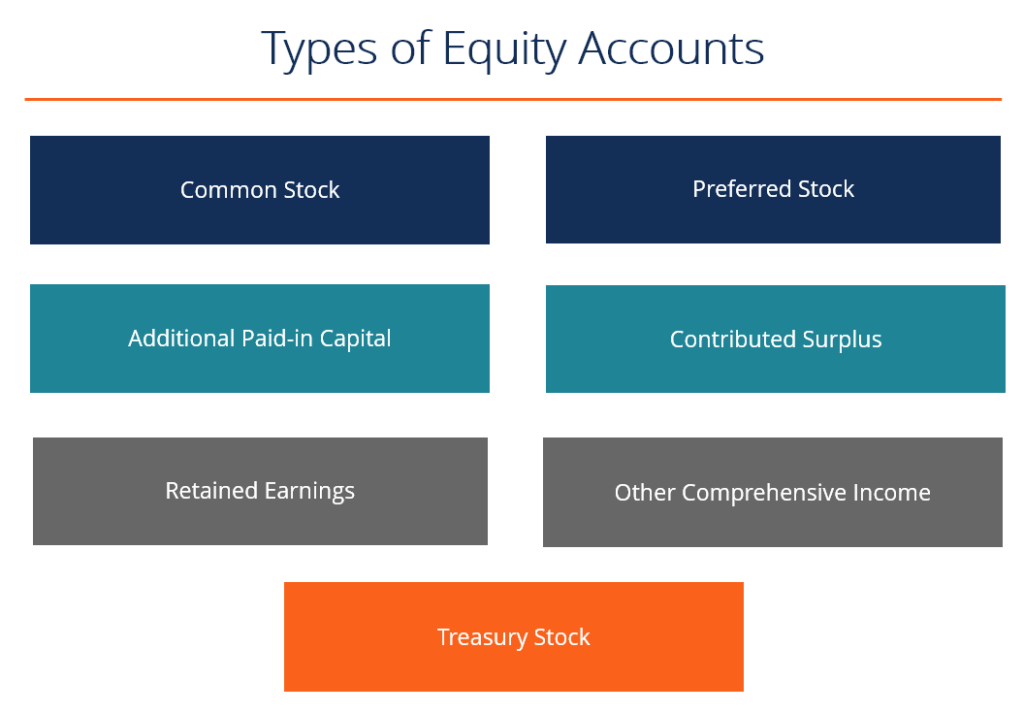
There are several types of equity accounts that combine to make up total shareholders’ equityStockholders EquityStockholders Equity (also known as Shareholders Equity) is an account on a company's balance sheet that consists of share capital plus. These accounts include common stock, preferred stock, contributed surplus, additional paid-in capital, retained earnings, other comprehensive earnings, and treasury stock.
Equity is the amount funded by the owners or shareholders of a company for the initial start-up and continuous operation of a business. Total equity also represents the residual value left in assets after all liabilities have been paid off, and is recorded on the company’s balance sheetBalance SheetThe balance sheet is one of the three fundamental financial statements. The financial statements are key to both financial modeling and accounting.. To calculate total equity, simply deduct total liabilities from total assets.
Learn more in CFI’s Free Accounting Fundamentals Course!
Types of Equity Accounts
The seven main equity accounts are:
#1 Common Stock
Common stockShare CapitalShare capital (shareholders' capital, equity capital, contributed capital, or paid-in capital) is the amount invested by a company’s represents the owners’ or shareholder’s investment in the business as a capital contribution. This account represents the shares that entitle the shareowners to vote and their residual claim on the company’s assets. The value of common stock is equal to the par value of the shares times the number of shares outstanding. For example, 1 million shares with $1 of par value would result in $1 million of common share capital on the balance sheet.
#2 Preferred Stock
Preferred stockCost of Preferred StockThe cost of preferred stock to a company is effectively the price it pays in return for the income it gets from issuing and selling the stock. They calculate the cost of preferred stock by dividing the annual preferred dividend by the market price per share. is quite similar to common stock. The preferred stock is a type of share that often has no voting rights, but is guaranteed a cumulative dividend. If the dividend is not paid in one year, then it will accumulate until paid off.
Example: A preferred share of a company is entitled to $5 in cumulative dividends in a year. The company has declared a dividend this year but has not paid dividends for the past two years. The shareholder will receive $15 ($5/year x 3 years) in dividends this year.
#3 Contributed Surplus
Contributed SurplusContributed SurplusContributed surplus is an account in the shareholders’ equity section of the balance sheet that reflects excess amounts collected from the represents any amount paid over the par value paid by investors for stocks purchases that have a par value. This account also holds different types of gains and losses resulting in the sale of shares or other complex financial instruments.
Example: The company issues 100,000 $1 par value shares for $10 per share. $100,000 (100,000 shares x $1/share) goes to common stock, and the excess $900,000 (100,000 shares x ($10-$1)) goes to Contributed Surplus.
#4 Additional Paid-In Capital
Additional Paid-In CapitalAdditional Paid In CapitalAdditional Paid In Capital (APIC) is the value of share capital above its stated par value and is listed under Shareholders' Equity on the balance sheet. is another term for contributed surplus, the same as described above.
#5 Retained Earnings
Retained EarningsRetained EarningsThe Retained Earnings formula represents all accumulated net income netted by all dividends paid to shareholders. Retained Earnings are part is the portion of net income that is not paid out as dividends to shareholders. It is instead retained for reinvesting in the business or to pay off future obligations.
#6 Other Comprehensive Income
Other comprehensive income is excluded from net income on the income statement because it consists of income that has not been realized yet. For example, unrealized gains or losses on securities that have not yet been sold are reflected in other comprehensive income. Once the securities are sold, then the realized gain/loss is moved into net income on the income statement.
#7 Treasury Stock (Contra-Equity Account)
Treasury stockTreasury StockTreasury stock, or reacquired stock, is a portion of previously issued, outstanding shares of stock that a company repurchased from shareholders. is a contra-equity account. It represents the amount of common stock that the company has purchased back from investors. This is reflected in the books as a deduction from total equity.
Additional Resources
Thank you for reading this guide to the various types of equity accounts on a company’s balance sheet. To help you on your path to becoming a Certified Financial AnalystDesignationsGuides to financial services designations. This section covers all the major designations in finance ranging from CPA to FMVA. These prominent designations cover careers in accounting, finance, investment banking, FP&A, treasury, IR, corporate development and skills like financial modeling,, CFI has many additional resources to help you on your way:
- Analysis of Financial StatementsAnalysis of Financial StatementsHow to perform Analysis of Financial Statements. This guide will teach you to perform financial statement analysis of the income statement,
- Ratio AnalysisComparable Company AnalysisThis guide shows you step-by-step how to build comparable company analysis ("Comps") and includes a free template and many examples.
- What is Financial Modeling?What is Financial ModelingFinancial modeling is performed in Excel to forecast a company's financial performance. Overview of what is financial modeling, how & why to build a model.
- Financial Modeling GuideFree Financial Modeling GuideThis financial modeling guide covers Excel tips and best practices on assumptions, drivers, forecasting, linking the three statements, DCF analysis, more
-

Stocks Explained: A Beginner's Guide to Investing
What are stocks?A stock is born when a company decides that it in order to grow even bigger, it will need a fat injection of cash. Unless the owner is lucky enough to have 10,000 rich uncles, the meth
-
Mid-Cap Equity Funds: Understanding Risk, Returns & Investment
The right equilibrium between risk and returns is best achieved with the help of mid-cap equity funds. Check out this post to know what they are, how they work, and whether or not you should invest in
Accounting
- Signaling Effects in Capital Structure: How Financial Decisions Influence Investors
- Understanding Domestic Stocks: A Guide for Investors
- Understanding Accounts Expenses: A Comprehensive Guide
- Capital Expenditures (CAPEX): Definition & Examples
- Understanding Equity Issuance Fees: Costs of Raising Capital
- Share Capital: Definition, Types & Importance for Businesses
- Understanding T-Accounts: A Guide for Accounting Professionals
- Understanding Stock Warrants: A Comprehensive Guide
- Stock Options Explained: A Beginner's Guide to Understanding Equity Contracts
-
Understanding Ordinary Shares: A Beginner's Guide to Common Stock
When investing in the stock market, you need to understand what ordinary shares are. There are a few different types of stock available, and you need to understand which type you are purchasing....
-
Restricted Stock Units (RSUs): A Comprehensive Guide
With news of big IPOs like Lyft hitting the headlines, the value of your own equity compensation is likely top of mind. A common type of equity that companies offer their employees as part of their co...