
Understanding T-Accounts: A Guide for Accounting Professionals
If you want a career in accountingAccountingPublic accounting firms consist of accountants whose job is serving business, individuals, governments & nonprofit by preparing financial statements, taxes, T Accounts may be your new best friend. The T Account is a visual representation of individual accounts in the form of a “T,” making it so that all additions and subtractions (debits and credits) to the account can be easily tracked and represented visually.
Each account will have its own individual T Account, which looks like the following:
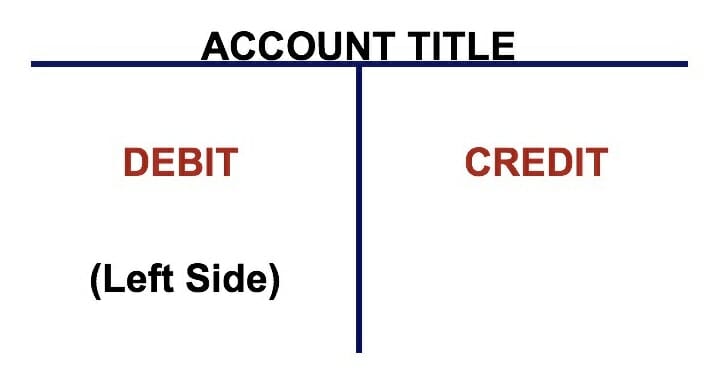
Image: CFI’s Accounting Courses.
Download the Free Template
Enter your name and email in the form below and download the free template now!
Debits and Credits for T Accounts
When most people hear the term debits and credits, they think of debit cards and credit cards. In accounting, however, debits and credits refer to completely different things.
Debits and Credits are simply accounting terminologies that can be traced back hundreds of years, which are still used in today’s double-entry accounting system. A double-entry accounting system means that every transaction that a company makes is recorded in at least two accounts, where one account gets a “debit” entry while another account gets a “credit” entry.
These entries are recorded as journal entriesJournal Entries GuideJournal Entries are the building blocks of accounting, from reporting to auditing journal entries (which consist of Debits and Credits) in the company’s books.
Debits and credits can mean either increasing or decreasing for different accounts, but their T Account representations look the same in terms of left and right positioning in relation to the “T”.
Learn more in CFI’s Free Accounting Courses.
T Accounts Explained
The left side of the Account is always the debit side and the right side is always the credit side, no matter what the account is.
For different accounts, debits and credits can mean either an increase or a decrease, but in a T Account, the debit is always on the left side and credit on the right side, by convention.
Let’s take a more in-depth look at the T accounts for different accounts namely, assets, liabilities, and shareholder’s equity, the major components of the balance sheetBalance SheetThe balance sheet is one of the three fundamental financial statements. The financial statements are key to both financial modeling and accounting. or statement of financial position.
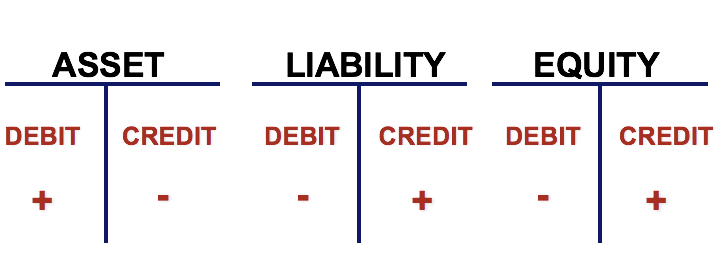
For asset accounts, which include cash, accounts receivableAccounts ReceivableAccounts Receivable (AR) represents the credit sales of a business, which have not yet been collected from its customers. Companies allow, inventoryInventoryInventory is a current asset account found on the balance sheet, consisting of all raw materials, work-in-progress, and finished goods that a, PP&EPP&E (Property, Plant and Equipment)PP&E (Property, Plant, and Equipment) is one of the core non-current assets found on the balance sheet. PP&E is impacted by Capex,, and others, the left side of the T Account (debit side) is always an increase to the account. The right side (credit side) is conversely, a decrease to the asset account. For liabilities and equity accounts, however, debits always signify a decrease to the account, while credits always signify an increase to the account.
T Accounts for the Income Statement
T Accounts are also used for income statementIncome StatementThe Income Statement is one of a company's core financial statements that shows their profit and loss over a period of time. The profit or accounts as well, which include revenuesRevenueRevenue is the value of all sales of goods and services recognized by a company in a period. Revenue (also referred to as Sales or Income), expenses, gains, and losses.
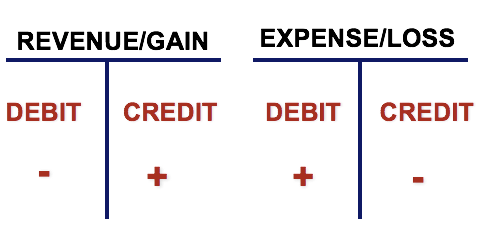
Once again, debits to revenue/gain decrease the account while credits increase the account. The opposite is true for expenses and losses. Putting all the accounts together, we can examine the following.
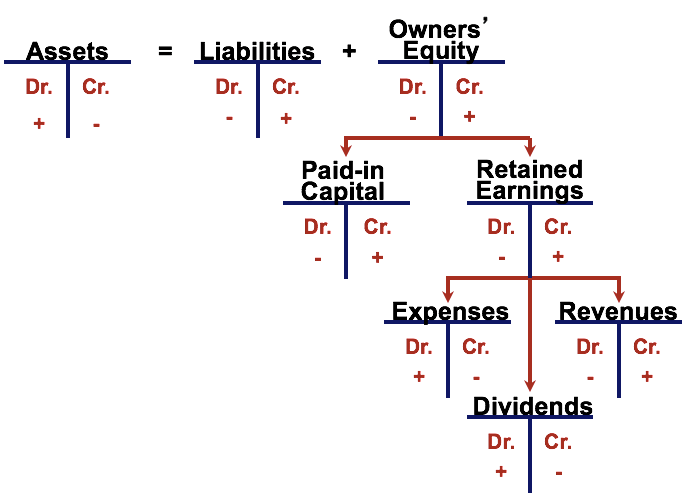
Using T Accounts, tracking multiple journal entries within a certain period of time becomes much easier. Every journal entry is posted to its respective T Account, on the correct side, by the correct amount.
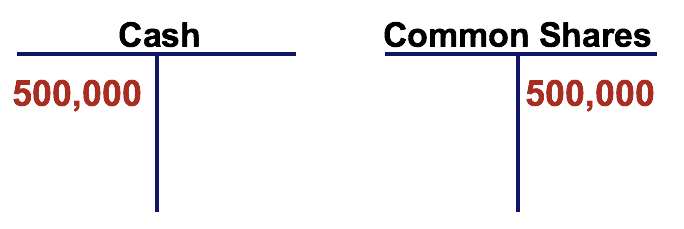
For example, if a company issued equity sharesWeighted Average Shares OutstandingWeighted average shares outstanding refers to the number of shares of a company calculated after adjusting for changes in the share capital over a reporting period. The number of weighted average shares outstanding is used in calculating metrics such as Earnings per Share (EPS) on a company's financial statements for $500,000, the journal entry would be composed of a Debit to Cash and a Credit to Common SharesCommon StockCommon stock is a type of security that represents ownership of equity in a company. There are other terms – such as common share, ordinary share, or voting share – that are equivalent to common stock..
Video Explanation of T Accounts
Below is a short video that will help explain how T Accounts are used to keep track of revenues and expenses on the income statement. Learn more in CFI’s free Accounting Fundamentals Course.
Video: CFI’s Accounting Courses.
More Resources
CFI offers the Financial Modeling & Valuation Analyst (FMVA)®Become a Certified Financial Modeling & Valuation Analyst (FMVA)®CFI's Financial Modeling and Valuation Analyst (FMVA)® certification will help you gain the confidence you need in your finance career. Enroll today! certification program for those looking to take their careers to the next level. To keep learning and advancing your career, the following resources will be helpful:
- Journal EntriesJournal Entries GuideJournal Entries are the building blocks of accounting, from reporting to auditing journal entries (which consist of Debits and Credits)
- Balance SheetBalance SheetThe balance sheet is one of the three fundamental financial statements. The financial statements are key to both financial modeling and accounting.
- Income StatementIncome StatementThe Income Statement is one of a company's core financial statements that shows their profit and loss over a period of time. The profit or
- Financial Modeling GuideFree Financial Modeling GuideThis financial modeling guide covers Excel tips and best practices on assumptions, drivers, forecasting, linking the three statements, DCF analysis, more
-
![Understanding Deposits: Bank Accounts & Security Funds | [Your Brand/Company Name]](https://www.etffin.com/article/uploadfiles/202110/2021100815141020_S.jpeg)
Understanding Deposits: Bank Accounts & Security Funds | [Your Brand/Company Name]
Deposit is a term used to denote the money kept or held in any bank account, especially to accumulate interest. The fund used as a security to get the goods delivered can also be called a deposit. Any
-

Understanding Dormant Accounts: Definition, Implications, and State Regulations
A dormant account refers to an account that has shown no activities – such as deposits and withdrawals – for a long period of time. Financial institutions need to make attempts to contact
Accounting
- Understanding EBT Cash Accounts: Benefits & How They Work
- Liquid Bank Accounts: Understanding Accessibility & Options
- Understanding Open Credit Accounts: What You Need to Know
- Accounts Payable (AP): Definition, Function & Importance
- Checking vs. Savings Accounts: Which is Right for You?
- Understanding Accounts Expenses: A Comprehensive Guide
- Understanding Due to Account: A Comprehensive Guide
- Understanding Equity Accounts: A Comprehensive Guide for Investors
- High-Yield Checking Accounts: Earn More Interest on Your Balance
-
 Understanding Appropriation Accounts: Distribution of Funds & Profits
An appropriation account shows how an organization’s funds are distributed among partners, shareholders, and departments. For companies, an appropriation account shows how the company’s pr...
-
 Understanding Checking Accounts: A Comprehensive Guide
A checking account is a type of deposit account that individuals open at financial institutionsTop Banks in the USAAccording to the US Federal Deposit Insurance Corporation, there were 6,799 FDIC...