
Understanding Inventory: Definition & Importance in Financial Statements
Inventory is a current asset account found on the balance sheet,Balance SheetThe balance sheet is one of the three fundamental financial statements. The financial statements are key to both financial modeling and accounting. consisting of all raw materials, work-in-progress, and finished goods that a company has accumulated. It is often deemed the most illiquid of all current assets and, thus, it is excluded from the numerator in the quick ratio calculation.
There is an interplay between the inventory account and the cost of goods sold in the income statementIncome StatementThe Income Statement is one of a company's core financial statements that shows their profit and loss over a period of time. The profit or – this is discussed in more detail below.

Determining the balance of Inventory
The ending balance of inventory for a period depends on the volume of salesSales RevenueSales revenue is the income received by a company from its sales of goods or the provision of services. In accounting, the terms "sales" and a company makes in each period.
The formula for this is as follows:
Ending Inventory = Beginning Balance + Purchases – Cost of Goods Sold
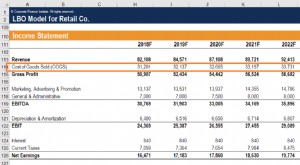
Higher sales (and thus higher cost of goods sold) leads to draining the inventory account. The conceptual explanation for this is that raw materials, work-in-progress, and finished goods (current assets) are turned into revenue. The cost of goods flows to the income statement via the Cost of Goods Sold (COGS) account.
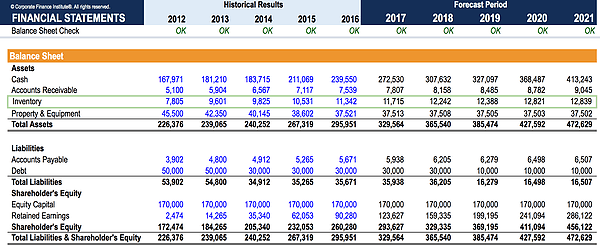
Inventory and COGS
Ending inventory is also determined by the accounting method for Cost of Goods Sold. There are four main methods of inventory calculation: namely FIFO (“First in, First out”), LIFO (“Last in, First out”), Weighted-Average, and the Specific Identification method. These all have certain criteria to be applied and some methods may be prohibited in certain countries, under certain accounting standards.
In an inflationary period, LIFO will generate higher Cost of Goods Sold than the FIFO method. As such, using the LIFO method would generate a lower inventory balance than the FIFO method. This must be kept in mind when an analyst is analyzing the inventory account.
Periodic and Perpetual Inventory Systems
The type of accountingAccountingPublic accounting firms consist of accountants whose job is serving business, individuals, governments & nonprofit by preparing financial statements, taxes system used affects the value of the account on the balance sheet. Periodic inventory systems determine the LIFO, FIFO, or Weighted Average value at the end of every period, whereas perpetual systems determine the value after every transaction.
Because of the varying time horizons and the possibility of differing costs, using a different system will result in a different value. Analysts must account for this difference when analyzing companies that use different inventory systems.
Turnover and Accounts Payable
The average inventory balance between two periods is needed to find the turnover ratio, as well as for determining the average number of days required for inventory turnover. In these calculations, either net sales or cost of goods sold can be used as the numerator, although the latter is generally preferred, as it is a more direct representation of the value of the raw materials, work-in-progress, and goods ready for sale.
Accounts payable turnover requires the value for purchases as the numerator. This is indirectly linked to the inventory account, as purchases of raw materials and work-in-progress may be made on credit – thus, the accounts payable account is impacted.
Additional Resources
CFI is the official provider of the Financial Modeling and Valuation Analyst (FMVA)®Become a Certified Financial Modeling & Valuation Analyst (FMVA)®CFI's Financial Modeling and Valuation Analyst (FMVA)® certification will help you gain the confidence you need in your finance career. Enroll today! certification program, designed to transform anyone into a world-class financial analyst.
To keep learning and developing your knowledge of financial analysis, we highly recommend the additional CFI resources below:
- WritedownInventory Write DownAn inventory write down is an accounting process used to record the reduction of an inventory’s value, and is required when the inventory's
- Accounts ReceivablesAccounts ReceivableAccounts Receivable (AR) represents the credit sales of a business, which have not yet been collected from its customers. Companies allow
- Three Statement Model3 Statement ModelA 3 statement model links the income statement, balance sheet, and cash flow statement into one dynamically connected financial model. Examples, guide
- Financial ModelingWhat is Financial ModelingFinancial modeling is performed in Excel to forecast a company's financial performance. Overview of what is financial modeling, how & why to build a model.
-

Understanding Inventory Age: A Key Metric for Business Efficiency
The average age of inventory represents the average number of days that pass before a company sells its inventory balance. It is an important working capital efficiency metric that is also referred to
-
Cost of Goods Sold (COGS): Definition, Calculation & Importance
Cost of Goods Sold (COGS) measures the “direct cost” incurred in the production of any goods or services. It includes material cost, direct labor cost, and direct factory overheads, and is
Accounting
- Inventory Management: Optimizing Supply Chain & Financial Health
- Inventory Turnover Ratio: Definition & Calculation | AccountingTools
- Understanding Shadow Inventory: What Banks Hold & What It Means for the Market
- Understanding Throughput: A Key Metric for Business Efficiency
- Understanding Cost of Goods Manufactured (COGM): A Managerial Accounting Guide
- Inventory Shrinkage: Causes, Impact & Reconciliation
- Inventory Write-Downs: Understanding & Accounting for Value Reduction
- Periodic Inventory System: Definition, Pros & Cons
- Understanding Inflation: Causes, Effects & How It Impacts You
-
 Beginning Inventory: Definition & Calculation Formula
What is beginning inventory? Beginning inventory is the dollar value of all inventory held by a business at the start of an accounting period, and represents all the goods a business can put toward ge...
-
 SKU: Understanding Stock Keeping Units for Inventory Management
SKU (Stock Keeping Unit) is a product code that you can use to search and identify stock on hand from lists, invoices, or order forms. It is a term that is typically used when talking about inventory ...