
NOPLAT Explained: Understanding Adjusted Operating Profit
NOPLAT stands for Net Operating Profit Less Adjusted Taxes. It represents a company’s operating profit after adjusting to normalize for the impact of capital structure and deferred taxes.

The NOPLAT metric represents the earnings generated by a company after subtracting income taxes related to core operations and adding back overpaid taxes over the course of an accounting period. Both management and investors commonly use NOPLAT to calculate unlevered free cash flowUnlevered Free Cash FlowUnlevered Free Cash Flow is a theoretical cash flow figure for a business, assuming the company is completely debt free with no interest expense. or profit after taxes.
How to Calculate NOPLAT
The calculation of net operating profit less adjusted taxes can be done in various ways. For reference, some common formulas are seen below:

Uses of NOPLAT
NOPLAT is broadly used in corporate finance as an adjustment to the net income to represent the after-tax cash flows available to all capital providers of a company. NOPLAT is preferred instead of net income in discounted cash flow (DCF) models and leveraged buyout (LBO) modelsLeveraged Buyout (LBO)A leveraged buyout (LBO) is a transaction where a business is acquired using debt as the main source of consideration. because it normalizes the effects of capital structure.
NOPLAT is an essential component of calculating free cash flows for DCF valuations in merger analysis. Especially when valuing target companies. Since it is a before-interest and after-tax metric, NOPLAT is an income measure that excludes the impact of debt financing, incorporating the cost of debt and the tax-shield benefit. As a result, it can be seen as a better measure of operating efficiency than net income. Simply put, NOPLAT represents how a company’s core operations performed, net of adjusted taxes.
Using NOPLAT, earnings can be measured without the impact of debt servicing or leverage on a company. In other words, the performance of different companies can be compared without being clouded by different capital structures. It makes NOPLAT useful in deriving the unlevered free cash flows of a company and allows the valuation of target companies without the impact of capital structure.
Also, using NOPLAT is beneficial in merger analysis, since the capital structure of target companies is irrelevant, especially if the entire company is being acquired. It should be noted that the nature of some industries involves higher operating costs, so comparing NOPLAT between companies is more meaningful among companies within the same industry.
NOPAT vs. NOPLAT
Net operating profit after tax (NOPAT) and net operating profit less adjusted taxes (NOPLAT) are similar and are easily confused with one another, but they are not exactly the same. NOPAT is equivalent to the after-tax operating profit referred to earlier. It is a measure of profit that excludes tax benefits. NOPAT is commonly used in economic value added (EVA)Economic Value Added (EVA)Economic Value Added (EVA) shows that real value creation occurs when projects earn rates of return above their cost of capital and this increases value for shareholders. The Residual Income technique that serves as an indicator of the profitability on the premise that real profitability occurs when wealth is calculations.
The key difference between the two profitability measures is that NOPLAT includes changes in deferred taxes so that NOPAT is essentially NOPLAT without the deferred taxes. Where deferred taxes are present, NOPLAT uses the actual tax paid to tax authorities and leaves out deferred tax.
Deferred taxes are essentially either taxes owed or overpaid that represent either an asset or liability on a company’s balance sheet. NOPLAT can give a clearer picture of operating earnings than NOPAT, as it adjusts for non-operating tax expenses as well.
In many cases, both NOPAT and NOPLAT may turn out to be very similar for many companies but will differ in companies that incur significant deferred taxes.
To summarize, NOPLAT does not include capital structure impact and adjusts for changes in deferred taxes.
Practical Example
Consider a company with the following income statement:
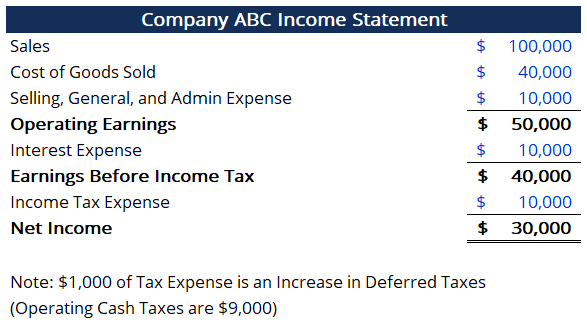
Find the NOPLAT given the income statement. The calculation is shown below:
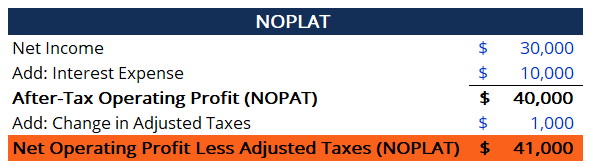
In the example above, not all of the tax expenses come as a result of operations. $1,000 of the tax expense is attributed to an increase in deferred taxes. So, the $1,000 was essentially overaccrued taxes.
In calculating NOPAT, the increase in deferred taxes can be ignored. However, when calculating net operating profit less adjusted taxes, the change in deferred taxes must be added to arrive at the correct amount.
From the calculation above, ABC Company realized $41,000 in operating profit in the accounting period, after adjusting for capital structure impact and changes in deferred taxes.
Additional Resources
CFI offers the Commercial Banking & Credit Analyst (CBCA)™Program Page - CBCAGet CFI's CBCA™ certification and become a Commercial Banking & Credit Analyst. Enroll and advance your career with our certification programs and courses. certification program for those looking to take their careers to the next level. To keep learning and developing your knowledge base, please explore the additional relevant resources below:
- Cost of DebtCost of DebtThe cost of debt is the return that a company provides to its debtholders and creditors. Cost of debt is used in WACC calculations for valuation analysis.
- DCF Model TemplateDCF Model TemplateThis DCF model template provides you with a foundation to build your own discounted cash flow model with different assumptions
- Deferred Tax Liability/AssetDeferred Tax Liability/AssetA deferred tax liability or asset is created when there are temporary differences between book tax and actual income tax.
- M&A Considerations and ImplicationsM&A Considerations and ImplicationsWhen conducting M&A a company must acknowledge & review all factors and complexities that go into mergers and acquisitions. This guide outlines important
-

DeFi Explained: A Beginner's Guide to Decentralized Finance
The Beginner’s Guide to Decentralized FinanceIf you’re diving deep into the world of cryptocurrency, you have probably heard the term “DeFi” used to describe a variety of new protocols and assets. Fi
-
0x: A Comprehensive Guide to Decentralized Ethereum Trading
What Is 0x? 0x is a decentralized exchange for trading ERC 20 tokens. (See also: What Is ERC 20 And What Does It Mean For Ethereum?). It is among the most high-profile examples of decentra
Accounting
- California Paycheck Deductions: What's Being Withheld?
- PC Banking: A Comprehensive Guide to Online Banking Security & Features
- 401(k) Tax Advantages: What's Excluded from Taxes?
- IRA CDs: Secure Retirement Savings with FDIC Insurance
- Understanding Income: Definition, Types & Uses
- Understanding After-Tax Income: A Comprehensive Guide
- Understanding Earnings Before Tax (EBT): Definition & Importance
- Understanding Pension Taxes: A Retirement Planning Guide
- FICA Taxes Explained: Social Security & Medicare – Credit Karma Tax
-
 Federal Income Tax Filing Requirements: Minimum Income Thresholds
This article was fact-checked by our editors and Tolla Tu, tax specialist with Credit Karma Tax®. It has been updated for the 2020 tax year. The tax code has specific rules about w...
-
 Understanding Regulation Z: Your Rights as a Borrower
Regulation Z is a consumer-protection regulation that compels lenders to disclose the cost of credit in a clear way for consumers. Whether you’re applying for a mortgage or dealing...