
Understanding Earnings Before Tax (EBT): Definition & Importance
Earnings before tax, or pre-tax income, is the last subtotal found in the income statement Income StatementThe Income Statement is one of a company's core financial statements that shows their profit and loss over a period of time. The profit orbefore the net incomeNet IncomeNet Income is a key line item, not only in the income statement, but in all three core financial statements. While it is arrived at through line item. The EBT metric is found after all deductions – except taxes – that have been made against sales revenueSales RevenueSales revenue is the income received by a company from its sales of goods or the provision of services. In accounting, the terms "sales" and. These deductions include COGS, SG&ASG&ASG&A includes all non-production expenses incurred by a company in any given period. It includes expenses such as rent, advertising, marketing, depreciation and amortization, and interest expense.Interest ExpenseInterest expense arises out of a company that finances through debt or capital leases. Interest is found in the income statement, but can also
As the name implies, the last item to be deducted from EBT is taxes.
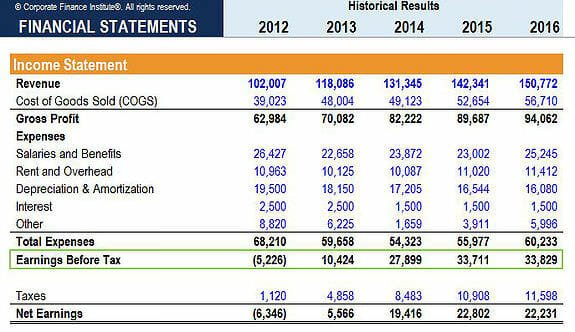
Source: CFI financial modeling courses.
Earnings Before Tax Formula
There are three formulas that can be used to calculate Earnings Before Tax (EBT):
EBT = Sales Revenue – COGS – SG&A – Depreciation and Amortization
EBT = EBIT – Interest Expense
and, EBT = Net Income + Taxes
Download the Free Template
Enter your name and email in the form below and download the free template now!
Relation to Taxes
Pre-tax income is the denominator involved when trying to find the effective tax rate a company is paying in any given period. The effective tax rate is found by dividing taxes paid by the pre-tax income. It is then used in conjunction with forecasted EBT to find forecasted taxes in projected income statements.
EBT vs EBIT vs EBITDA
In the world of financial analysis, there are frequent references to EBT, EBIT, and EBITDA. It’s important to know the difference between the three metrics, as well as when and why you would look at each one.
Earnings Before Tax is used for analyzing the profitability of a company without the impact of its tax regime. It makes companies in different states or countries more comparable, as tax rates may differ significantly across borders. Analysts often prefer to add back taxes to net income, so that they can have an apples-to-apples comparison of earning power across a broad range of companies.
Earnings before interest and taxes (EBITEBIT GuideEBIT stands for Earnings Before Interest and Taxes and is one of the last subtotals in the income statement before net income. EBIT is also sometimes referred to as operating income and is called this because it's found by deducting all operating expenses (production and non-production costs) from sales revenue.) is also popular with analysts because it adds one additional level of comparability, which is to add back interest expense as well. While EBT normalizes for taxes, EBIT normalizes for both taxes and interest expense. It means the capital structure of the company does not impact the evaluation of its profitability.
Earnings Before Interest, Taxes, Depreciation & Amortization (EBITDAEBITDAEBITDA or Earnings Before Interest, Tax, Depreciation, Amortization is a company's profits before any of these net deductions are made. EBITDA focuses on the operating decisions of a business because it looks at the business’ profitability from core operations before the impact of capital structure. Formula, examples) has the most add-backs and is, therefore, the furthest away from net income of the three metrics. EBITDA also adds back depreciation and amortization because they are non-cash expensesNon-Cash ExpensesNon cash expenses appear on an income statement because accounting principles require them to be recorded despite not actually being paid for with cash. , which, therefore, do not impact a company’s cash flow. To learn more about EBITDA and cash flow, read our Ultimate Cash Flow GuideValuationFree valuation guides to learn the most important concepts at your own pace. These articles will teach you business valuation best practices and how to value a company using comparable company analysis, discounted cash flow (DCF) modeling, and precedent transactions, as used in investment banking, equity research,.
Additional Resources
Thank you for reading this guide to Earnings Before Tax (EBT). CFI’s mission is to help you become a world-class financial analystThe Analyst Trifecta® GuideThe ultimate guide on how to be a world-class financial analyst. Do you want to be a world-class financial analyst? Are you looking to follow industry-leading best practices and stand out from the crowd? Our process, called The Analyst Trifecta® consists of analytics, presentation & soft skills. With that goal in mind, these additional CFI resources will help you advance your career:
- Income Statement Template
- What is Financial Modeling?What is Financial ModelingFinancial modeling is performed in Excel to forecast a company's financial performance. Overview of what is financial modeling, how & why to build a model.
- Balance Sheet OverviewBalance SheetThe balance sheet is one of the three fundamental financial statements. The financial statements are key to both financial modeling and accounting.
- Financial Modeling GuideFree Financial Modeling GuideThis financial modeling guide covers Excel tips and best practices on assumptions, drivers, forecasting, linking the three statements, DCF analysis, more
-

Understanding Net Operating Loss (NOL) Deductions | IRS.gov
A net operating loss (NOL) for income tax purposes is when a company’s allowable deductions exceed the taxable income in a tax period. When a company’s deductibles are greater than its act
-

Understanding Canadian Income Tax: A Comprehensive Guide
Benjamin Franklin’s infamous quote certainly holds true in Canada.“In this world nothing can be said to be certain, except death and taxes,”Canada’s taxes are as abundant as our lakes. First there are
Accounting
- Understanding Income: Definition, Types & Uses
- Understanding Income Tax: A Comprehensive Guide for Individuals & Businesses
- Objectives of Income Tax Accounting: A Comprehensive Overview
- Understanding After-Tax Income: A Comprehensive Guide
- Annualized Income: Definition, Calculation & Tax Implications
- Understanding Deferred Income Tax: A Comprehensive Guide
- EBT vs. Pretax Income: Understanding the Difference
- Negative Income Tax: A Comprehensive Explanation
- Understanding Pretax Income: Definition & Calculation
-
 Corporate vs. Personal Income Tax: Key Differences Explained
In this article, we will discuss corporate vs personal income tax. Corporate tax is an expense of a business (cash outflow) levied by the government that represents a country’s main source of in...
-
 Profit Before Tax (PBT): Definition, Calculation & Importance
Profit before tax (PBT) is a measure of a company’s profitability that looks at the profits made before any tax is paid. It matches all the company’s expenses, which include operating and ...