
Understanding Sequential Service Constraints in Banking
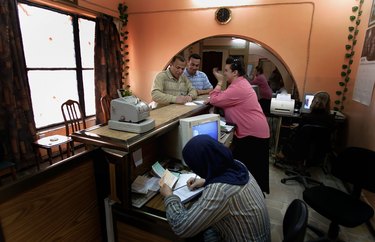
If a bank has 1,000 customers who have open checking accounts, and many of its depositors request withdrawals at the same time, the bank may not hold enough money to immediately reimburse all of these depositors. If the bank only has enough cash available to hand out to the first 500 people in line, the 501st depositor does not receive his cash back immediately, which is the sequential service constraint.
Time Value
A sequential service constraint can affect the value a depositor receives from a bank because of the time value of money. If a depositor wants to repair her car, but she can't withdraw money today because other customers already withdrew their money from the bank, the sequential service constraint creates an additional cost for her. She might need to use her credit card so she can pay for the car repair today.
Early Withdrawal
A sequential service constraint can encourage a depositor to take money out of his account, even if he doesn't need to spend it today. Another depositor may plan to take his truck to the shop next week. Even though he doesn't plan on paying for truck repair today, he might still take money out of the bank now if he believes that the bank might have a shortage on the day that he has to pay the repair shop.
Bailouts
Bank bailouts reduce the effects of a sequential service constraint. If a depositor knows that a government agency is willing to loan the bank more money if many depositors take their money out of the bank during a short period, he doesn't have to worry about arriving after other depositors and not receiving his deposit back immediately.
Bank Runs
A financial regulator can use a sequential service constraint to detect a potential bank run. The regulator predicts that a certain percentage of withdrawals includes people who need cash immediately, and the remaining withdrawals involve depositors who are taking out their cash because they are scared that the bank will run out of money. If the percentage of people who withdraw money exceeds the percentage of people who the regulator believes intend to spend this cash immediately, this warns the regulator that a bank run may occur.
-
Understanding Bank Ratings: A Guide to Financial Stability
Bank rating is a measure of financial soundness for banks. Just like credit agencies such as Standard & Poor’s (S&P)S&P – Standard and PoorsStandard & Poor’s is an Am
-

Understanding Money: Definitions and Types (Narrow vs. Broad)
The definitions of money vary by country but generally include at least a measure for narrow money and one for broad money. Money is a medium of exchange and, more generally, any medium that can be us
budgeting
- Venmo: A Comprehensive Guide to Peer-to-Peer Payments
- Understanding Bank Adjustments: What They Are & Why They Happen
- Original Bank Statement: Definition & How to Obtain
- Liquid Bank Accounts: Understanding Accessibility & Options
- Understanding Budget Constraints: A Comprehensive Guide
- Benefits of a Bank Account: Security, Convenience & Financial Growth
- Understanding Incoming Wire Transfers: A Comprehensive Guide
- Money Center Banks: Definition, Services & Key Players
- Understanding Interest Rates: A Simple Explanation
-
 Understanding Bank Loans: Types, Terms & How They Work
Banks don't make money by taking your deposits and holding onto them until you need the cash. They make money largely through loans. A bank loan is an arrangement in which a bank gives you money t...
-
 Bank Drafts: Definition, How They Work & Usage
A bank draft is a convenient and secure instrument for making large payments without having to withdraw cash from one’s account. Bank drafts are guaranteed by financial institutions and can be u...