
Amazon SEO Mastery: Rank Higher & Boost Sales in 2024
Looking back on the past few years, I’m still amazed at the river of money Amazon has provided for so many people – from stay-at-home moms to major household brands due to Amazon’s growth.
And while it’s not always good news (nothing ever is in business), the opportunity is still very real and I believe will continue to get even better.
However, as more competition has entered the marketplace, it means sellers must bring their best cards to the table if they’re going to win.
When asked to write this chapter, I was thrilled.
I wanted to write a comprehensive guide that not only explained how Amazon’s search engine works, but the specific methods and tools my team is using today to help our clients optimize their listings and crush it on Amazon.
The type of guide that can turn you into an Amazon SEO expert in 15 minutes just didn’t exist… until now.
The beauty and burden of Amazon’s search engine – aka A9 – is its simplicity.
Amazon provides a very simple-to-use interface where sellers can populate all the data relevant to their product.
Once you know what to put in these fields, it makes it very easy to implement any changes.
However, because A9 is a maturing algorithm, frequent and unpredictable updates are a common point of frustration for many sellers on Amazon.
In turn, I’ve done my best to include the most up-to-date recommendations and tips based on both Amazon’s documentation and our own observations after managing 1000s of Amazon listings.
However, the observations and recommendations I make in this guide are subject to change as A9 evolves.
Even the best SEO software and tools can’t predict the future.
Therefore, I encourage you to revisit this guide frequently and check the comments section often.
Amazon Optimizations That Get a 320% Increase in Sales in Less Than 10 Minutes
One of my favorite clients in the entire world is Debbie.
In one word, she’s awesome.
She has passion and truly believes in her products and how they can improve people’s lives.
Unfortunately, that passion didn’t translate into many sales because she wasn’t into all that “technical stuff” and she had done a poor job of building a solid listing.
In fact, she had done a very poor job – like “how have you even sold a unit?” poor job.
So, on day one my team decided to focus on three parts of her listing: images, title and backend search terms.
You’ll learn why these are so important in a bit.
She made the changes and, within 10 minutes, they were updated and live. Then, we waited.
Before working together, Debbie was selling about five units per day, give or take a unit or two.
The next morning, I woke up to four missed text messages.
- She made two sales before 7 a.m. – this had never happened.
- By the end of that day, she had made 16 sales. This has been the new normal ever since.
While I can’t guarantee a 320% increase in sales, I can assure you this chapter will help you bring your absolute best to Amazon so you’re ready to compete and get your products onto the first page of search results.
I’ll first cover a bit about Amazon, A9 and ranking factors in the algorithm.
Then, I’ll dive deep into how to create killer listings optimized for the right search terms that help us to compete with and crush our competition.
The One Thing to Remember for Amazon SEO
If you only get one thing from this chapter, it should be this:
Amazon cares about buyers and selling stuff to those buyers.
That’s it.
Yes, that is quite possibly the most obvious statement made by anyone ever.
But, if you can remember this anytime you are making Amazon product listing optimizations,amand balance that with your own interests, you’ll quickly start making decisions that will help your products sell on Amazon.
What differentiates A9 from Google Search or other top search engines is Amazon is a buying platform.
As consumers, we rarely hop on Amazon just for product research.
We are usually very close to the point of purchase. Amazon knows this.
In turn, Amazon will continually make changes to test what makes shoppers buy more frequently.
Therefore, we need to make changes that will help shoppers convert more frequently.
This includes making our products more visible than our competitors’, so shoppers find us more often.
Additionally, we need to make changes that turn browsers to buyer while keeping in mind the goal of the Amazon search algorithm.
Some things to think about when optimizing your Amazon listing include:
- Should you have more images?
- What should you put in the title?
- What price should you sell at?
Just remember, Amazon cares about buyers and selling stuff to those buyers. Help Amazon and you’ll help yourself.
Say Hello to A9, Amazon’s Ranking Algorithm
I’m going to talk a bit about Amazon’s search engine, but only if you promise not to start using “A9” in every other sentence when you’re talking to other sellers.
A9 is the name of the algorithm Amazon uses for product search.
As mentioned earlier, it’s definitely a maturing algorithm and will continue to become more complex over time.
A9.com, a subsidiary of Amazon, develops the company’s search engine advertising technology.
However, for the time being, it operates on what appears to be a very simple keyword search method without much, if any, regard for how closely a product matches the query.
Examples of the A9 Algorithm in action:
Let me show you an example of an Amazon product search below.
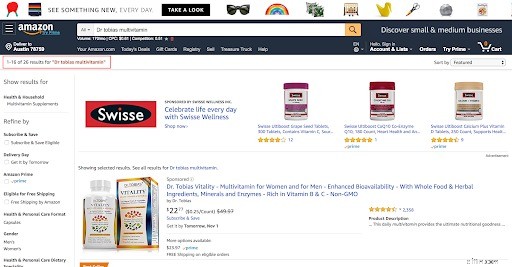
I’ve used the customer search term “Dr tobias multivitamin” and you can see there are 3 results:
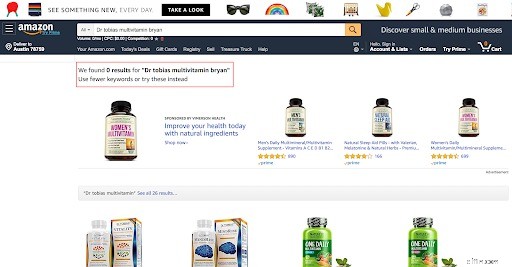
When I simply add my name “Bryan” to the search, there are no exact results because Dr. Tobias doesn’t have my name anywhere in their product listing – which is nice to know, I guess.
However, over the last year, improvements to the A9 algorithm have allowed for misspellings like this to still produce related results, as you can see below.
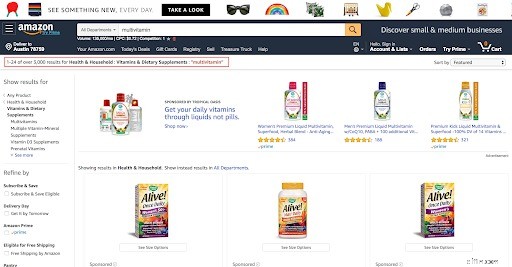
In a more relevant example, look at the search results for “multivitamin” and the number of results that appear:
Historically, if you used a simple variation of a term, it would result in a very different search result. Over the last year, Amazon has improved their algorithm to include variations. So, now, if I do a simple variation, I should get very similar if not the exact same results.
Here, I test it out with “multi vitamin”:”
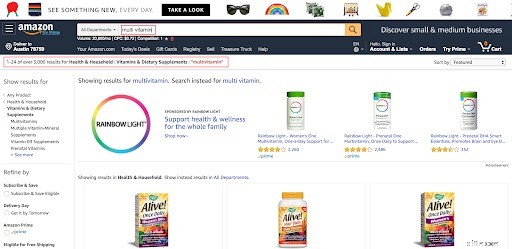
What does that tell you?
First, that the A9 algorithm is getting smarter.
Second, that you still want to populate as many relevant terms as possible for your listing to show up despite variations and misspellings to increase your visibility, sales and overall rank in the search results.
Essentially there are three things you need to optimize for:
- Visibility.
- Relevance.
- Conversions.
More simply, you want to make sure customers will see, click and buy your product. According to Amazon:
So, let’s have a look at the different pieces of the listing and how we can start optimizing each of them.
I’ll cover the different ranking factors in the categories:
- Product.
- Performance.
- Anecdotal.
For anecdotal, there’s no supporting Amazon documentation; however, we’ve seen a strong correlation between Amazon Search Engine Ranking Position (SERP) and these factors.
The recommendations I’m going to make below are just that, recommendations.
I highly encourage you to understand your contract with Amazon and their terms of service.
In particular, the documentation on listing optimization.
-

Best & Worst Cities for Retirement: A Data-Driven Analysis
Maria Teijeiro/GettyImagesEvery year, millions of us decide we’ve had enough of the grind and that it’s time to figure out where to kick back in retirement. While many Americans ultimat
-
Chapter 7 Bankruptcy & Asset Protection: What You Need to Know
Chapter 7 bankruptcy helps you start over financially by paying off the creditors that you can and discharging your debts to the ones that you cannot. Before you file for Chapter 7 bankruptcy, i
Business
- Cash Envelope System: A Step-by-Step Guide to Budgeting & Saving
- Scale Your Side Hustle: Proven Strategies for 2024
- Amazon Buy Box: A Comprehensive Guide for Sellers
- Amazon Advertising & PPC: A Comprehensive Guide for Beginners
- Holiday Fulfillment Optimization: Expert Strategies for 2020
- Social Media Advertising 2024: Platform Selection & Effective Ad Strategies
- Holiday Giving: Share Your Brand Mission & Make a Difference
- Ecommerce Product Sourcing: A Beginner's Guide to Finding Unique & Profitable Inventory
- Chapter 7 Bankruptcy: Understanding the Means Test & Its Impact
-
 Future of Ecommerce: Top Trends Shaping Online Retail (2024 & Beyond)
The numbers are clear: We’ve passed an inflection point, and ecommerce is now mainstream for people of all ages. From books to clothing to groceries, we can get almost anything delivered to our ...
-
Is Amazon Right for Your Business? A Comprehensive Guide for New Sellers
Amazon has made its marketplace welcoming for newcomers. New sellers will find a platform where it takes only minutes to sign up, and a few more minutes beyond that to get product listings live ...