
Amazon Advertising & PPC: A Comprehensive Guide for Beginners
If I asked you to name the biggest Amazon story of the last year, what would you say?
- Perhaps you’d answer with “Alexa, Echo, AI, and in-home assistants.”
- Or maybe you’d say “The acquisition of Whole Foods and the move into grocery delivery.”
- Or maybe “HQ2 and cities vying for Amazon’s arrival.”
- Or “Amazon’s big private-label push, especially with Amazon Basics and apparel.”
Good cases can be made for why any of those Amazon endeavors (and others) might be contenders for the biggest Amazon story of the last year.
But for me, as someone who’s done Amazon-related work for a decade and who writes about Amazon as my job, I’d argue that the biggest Amazon story of the last year is the rise of Amazon Advertising.
In fact, I’d argue that it’s an even-bigger, more-important story because of what it isn’t — namely a consumer-facing retail product or a service such as Prime.
But if you didn’t see this coming, you’re not alone.
What Amazon Advertising actually is turns out to be far more sophisticated than many thought. It is essentially a double sale.
Here is what I mean:
- The first part of the sale is the PPC element, the part where Amazon merchants bid on keywords that can win them premium position of their products (a banner on the top of search results, called out in a box in the sidebar, placed amongst high-ranking products in search results, etc.). This makes Amazon money.
- The second is when shoppers buy the displayed products because what they were seeking appeared in that key spot and got their impression, click, and conversion into a sale. Those sales take place on Amazon, and make Amazon money.
So, Amazon Advertising is a double sale (as explained above) and a triple win for Amazon that goes like this:
- The buyer finds the product that is theoretically the best match.
- The seller with the best-matching product sells more and moves up in rankings.
- Amazon captures the ad fees and a part of the sale.
Needless to say, if you are an Amazon shopper – and really, who isn’t now? – you’ve likely bought one of these promoted products.
Amazon does an incredibly good job making the products appear like organic search results while also calling them out as “Sponsored.”
And if you are an Amazon merchant, you’ve likely dabbled with Amazon Advertising in Seller Central or Vendor Central.
For merchants, the question now is not: “Are you using Amazon Advertising?” That ship has sailed.
Now it’s a question of: “How good are you at using Amazon Advertising?”
If you’re merely average, you’re going to get beaten by competitors who:
- Find keyword opportunities.
- Bid smarter.
- Manage their budgets better.
- And/or who outsource their Amazon Advertising to experts.
It’s not enough to run ads on Amazon, merchants have to work those ads so that the ads work well for them.
And like any advertising marketplace, as popularity increases, so does price and competition.
Here’s where we stand as of December 2018 with Amazon Advertising:
- Amazon consolidated all of its advertising offerings into one umbrella program at Advertising.Amazon.com, making the options available to 1P vendors and 3P sellers more plentiful and accessible (and thus more competitive) than ever before. In short, many sellers and vendors are already participating in advertising, with more jumping in every day.
- Sponsored Products Ads are available to all sellers on both Seller Central and Vendor Central and have become the PPC go-to for Amazon advertisers.
- Sponsored Brands Ads (formerly Headline Search Ads) are rising in popularity as they are now available to all brand-registered sellers and they offer placement opportunities differing from Sponsored Products Ads as well as a link to a brand’s Amazon Store.
- Product Display Ads have gained traction given that they appear on competitors’ product detail pages.
- And of course, bid values get more expensive as more sellers partake in ads.
How do you stay competitive at Amazon Advertising?
The answer is by being like Amazon itself: Not relying on the status quo.
Here’s how:
- Find keyword opportunities that aren’t already played out in terms of usage and bid escalation. If everyone is bidding on the same keywords, no one wins save for Amazon who collects the ever-increasing auction price. Look for not-necessarily top-ten or high-price keywords but those which show up enough and convert well for you and your competitors. Where can you find these? In the User Search Term Report (literally a list of words that shoppers are using to find products) and via reverse ASIN look-up where you’ll find keywords associated with any ASIN and how they rank. You’ll quickly train yourself to recognize opportunities others have missed.
- Don’t be afraid to spend money to make money. If a keyword is a true winner, it’s probably worth those extra cents on the bid. Don’t lose it over pennies. And feel free to use Bid+ if you really want to be covered in the event a bidding war heats up. Also remember that while you want to keep your ACoS manageable, the lowest ACoS isn’t always desirable. You’re looking for the sweet spot for ROI so don’t cheap out.
- Don’t just rely on Sponsored Products Ads (if you can help it).
- If you’re a 3P brand-registered seller on Seller Central or you’re a vendor on Vendor Central, you have access to Sponsored Brands Ads (the new version of Headline Search Ads), which means there’s less competition than there is with Sponsored Products Ads. SBA placement is great for both sales and branding as it can take shoppers to your whole Amazon Store or brand page.
- As Product Display Ads aren’t available within Seller Central (even to brand owners), there is even less competition there as they are entirely for 1P vendors.
Mix it up and see what works. Just like with stocks, think diversification.
Experiment and let the data dictate which kinds of ads are best for your products.
- Run automatic SPA campaigns as well as manual ones. Again, strength in diversity. Sure, with manual campaigns you have more control over Ad Groups and negative keywords, but don’t dismiss auto campaigns as useless. Run them and let the Amazon algorithm work its magic. As well, check your auto campaigns and I guarantee that you’ll find that they’ve pulled in keywords that you hadn’t considered before (not to mention competitors’ ASINs where you can view their product listings and find even more keywords).
- Go beyond the tools available in Seller Central and Vendor Central. Both of these hubs are essential, but they’re jam-packed and they serve hundreds of purposes and they offer no competitive edge. If you’re serious about Amazon Advertising, try an application or platform that is strictly for Amazon Advertising.
- That’s why we made Ignite (including Ignite Plus for ad agencies and PPC consultants, as well as Ignite Managed Services for sellers who’d prefer to turn their Amazon Advertising over to our PPC experts). The amazing thing about Ignite is that when it comes to everything discussed above, Ignite helps with all (and so much more such as providing data-driven keyword and bid suggestions). And it does it all from within one scalable, easy-to-use platform. That means that you get the advantages you need for effective Amazon Advertising and you save time by doing it all from one app.
Finally, and most importantly: stay curious and hungry.
Look for opportunities, however small, and leverage those to differentiate your ad campaigns from those of your competitors.
The differences add up quickly and they are the very stuff that will help you win more top spots that lead to sales (not to mention brand awareness and organic ranking and sales).
Never stop learning about advertising and never stop testing and optimizing. Read about Amazon PPC, attend webinars, and stay involved in your campaigns.
Amazon Advertising is a living organism, which means that it changes. What worked yesterday won’t work tomorrow, so you need to keep up with education and campaign adjustments.
This is not a set-it-and-forget-it sort of thing, at least not if you want to drive revenue and build a brand.
Treat Amazon Advertising like you treat your product listings and never ever stop optimizing and looking for opportunities.
Wherever you are in your Amazon Advertising journey, I hope that this chapter provides you with:
- A solid understanding of the many moving parts that make up Amazon PPC
- Clarity and knowledge that informs, educates, and empowers you to level up as a seller
- Practical tips and techniques that give you the edge over your competition
Let’s get started.
Welcome to Amazon Sponsored Products… Now What?
Amazon states that:
That tells us what they allow and what the do, but what exactly are they?
The question is really twofold:
- What is Amazon Sponsored Ads? Broadly speaking, Amazon Sponsored Ads is the Pay Per Click (PPC)/Cost Per Click (CPC) division of Amazon Advertising (Advertising.Amazon.com). Amazon currently has six divisions within its advertising umbrella. Sponsored Ads is the most accessible and available, and thus, the most widely used.
- What are Amazon Sponsored Ads? More specifically, these are ads that occupy premium auction-won positions wherein a product or brand is advertised in spot deemed preferable to organic search results (while also being included in the organic results).
Thus, when we talk about Amazon Sponsored Ads, we are talking about an advertising offering wherein products are displayed prominently because the merchant has won premium position by outbidding competitors vying for the same keywords.
And every time a potential buyer clicks on that sponsored ad, the seller pays for the click (hence, PPC).
What kinds of ads are available and to whom?
In keeping with what is know as “Amazon’s Virtuous Cycle,” the more a merchant does for Amazon and customers, the more the merchant is rewarded with options and opportunities, and in turn, the better able the merchant is to sell more, which benefits both the merchant and Amazon.
And of course, the more money that Amazon makes from a brand or a product, the better the product does in relevance and ranking, which perpetuates the winning cycle. Selection increases prices drop, customers also win.
And customers winning is Amazon winning.
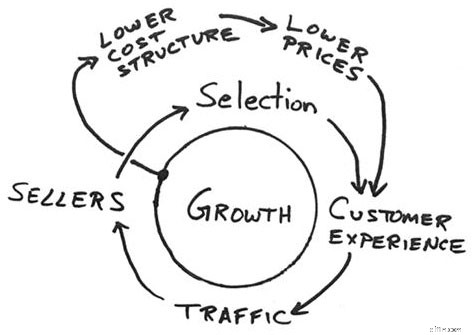
Amazon’s Virtuous Cycle (AKA The Bezos Napkin Sketch)
In terms of advertising, this means that Amazon offers the most (and best) offerings to 1P vendors with whom Amazon has a direct supply relationship and can negotiate large-volume orders.
These 1P vendors may use the full suite of Amazon Sponsored Ads, which includes:
- Sponsored Products Ads.
- Sponsored Brands Ads (formerly known as Headline Search Ads).
- Product Display Ads.
3P sellers who own their brands and have registered those brands with Amazon’s Brand Registry may partake in Sponsored Products Ads and Sponsored Brands Ads.
Being able to utilize SBAs is one of the many perks of being Amazon brand registered. Another big perk is brand protection in the fight against counterfeiters and other usurpers.
Because 3P sellers who resell products or otherwise do not own their brands or have them registered with Amazon are less connected with Amazon’s direct interests (and often compete with Amazon), they are limited to Sponsored Products Ads.
However, Sponsored Products Ads are still a powerful vehicle for driving sales, overtaking competitors, and expanding. And that, along with their availability to the largest number of sellers, is why we will focus most on them.
Amazon PPC Advertising: Who Gets to Use Which Tools
| Sponsored Products Ads (SPAs) | Sponsored Brands Ads (SBAs), formerly Headline Search Ads (HSAs) | Product Display Ads | |
|---|---|---|---|
| 1P Vendors | Available | Available | Available |
| 3P Sellers | Available | Only Available to Brand-Registered Sellers | Not Available |
-

Cartonization: Optimizing Shipping for Cost & Efficiency
Anyone who has ever moved knows firsthand the challenges of packing. Is this box the best size for that large,
-
Amazon Buy Box: A Comprehensive Guide for Sellers
There are two types of sellers on Amazon: Amazon itself, which sells a vast range of products. Third-party retailers, who typically specialize in one or more categories. Since there is no limi
Business
- Car Loans & Auto Insurance: Understanding the Connection
- Micro-Investing: Start Investing with Small Amounts - A Beginner's Guide
- Quantitative Easing & Inflation: A Historical Perspective
- Optimize Your Insurance Coverage: A Guide to Smart Policy Choices
- Asset Protection Planning: Safeguarding Your Wealth
- Cryptocurrency Mining Explained: A Beginner's Guide to Getting Started
- Forbearance Steering: Understanding the Issue & Your Options
- Amazon Selling Strategies: A Beginner's Guide to Launching Your Business
- Launch Your Online Store: A Comprehensive Guide for Beginners
-
 Chapter 7 Bankruptcy: A Comprehensive Guide to Debt Relief
What is chapter 7 bankruptcy? Filing Chapter 7 bankruptcy releases or “discharges” individual debtors from having to pay certain outstanding debts while allowing them to keep exempt ass...
-
 Financial Coaches: What They Do & Are You Ready for One?
...