
Chatbots for Business: Enhance Customer Service & Automate Tasks
Chatbots are the newest ecommerce trend.
Everyone is talking about them and every business wants to figure out how to use one.
But as with all trends, there are a lot of questions left unanswered:
- What exactly are chatbots?
- What types of chatbots are there?
- What is their intended purpose?
- Just how “smart” are they?
- Should you invest in chatbots for your business?
As much as we want to believe we live in a world full of intelligent automation the likes of Google Assistant and Amazon Alexa, there are limits to what today’s chatbots can actually offer.
That said, chatbots are here to stay – and to make our lives as ecommerce marketers easier.
Of course, that comes with a few caveats.
What is a Chatbot?
Chatbots are tiny programs that help simulate interactions with customers automatically based on a set of predefined conditions, triggers, and/or events.
There are several advantages to using chatbots:
- They can be proactive or reactive.
- Their responses are consistent every time.
- They can respond to customers immediately.
- They can help you collect important data and also learn from the data collected.
- They can be used through a variety of different mediums like SMS, live chat, or even social media.
The concept of a chatbot itself is nothing new. In fact, they’ve been around since the 1960s.
In fact, if you want a crash course on the history of the chatbot, check out this infographic from Futurism.
However, applying chatbots to help businesses grow is only a recent phenomenon.
Applying chatbots to business use cases is the result of democratized technology in recent years.
As customers become more demanding not just in the way they choose to buy, but also in the ways they wish to communicate with businesses, many traditional online experiences simply aren’t capable enough.
Chatbots Now and In Our Future
Business applications of chatbots for consumer-facing goods are growing rapidly.
In fact, over 59% of millennials and 60% of Gen Xers in the United States have interacted with chatbots.
And according to a Facebook survey, more than 50% of customers say they’re more likely to shop with a business that they can connect with via chat.
According to Gartner,
Additionally, according to an Oracle survey,
Customers expect to be able to find the information they’re looking for in a click of a button and in the blink of an eye.
When this isn’t possible, frustration brews, and this can lead to you losing a sale or even losing a potential customer forever.
To understand how chatbots can mitigate some of these frustrations and improve the user experience, we need to first look at how customers are choosing to interact with businesses today.
In the 2017 Global State of Customer Service Report by Microsoft, we can see how email and telephone are still the dominant communication channels for many customers.
And while live chat, self-service, social media, and chatbots are relatively lower in terms of raw volume, the growth of these channels are staggering.
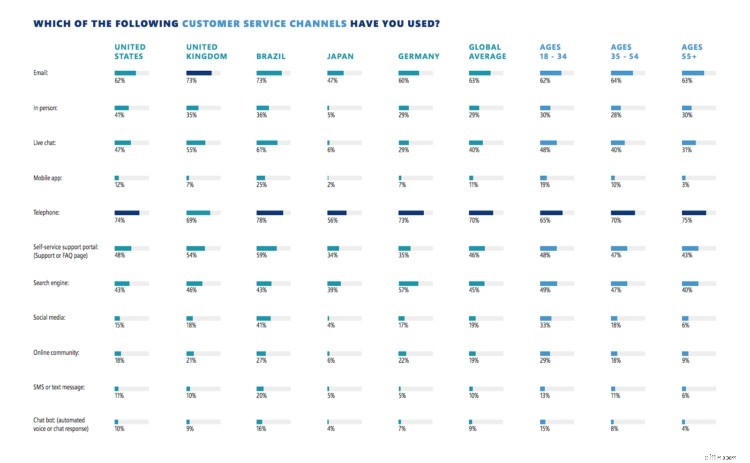
2017 Global State of Customer Service by Microsoft
The common themes among these four specific channels are speed and accessibility.
Keep these in the back of your mind as we go.
In a recent survey conducted by Audience, MyClever, and Drift in order to better understand where the opportunity lies for chatbots, they asked thousands of customers to evaluate their online experience with businesses and to detail their frustrations.
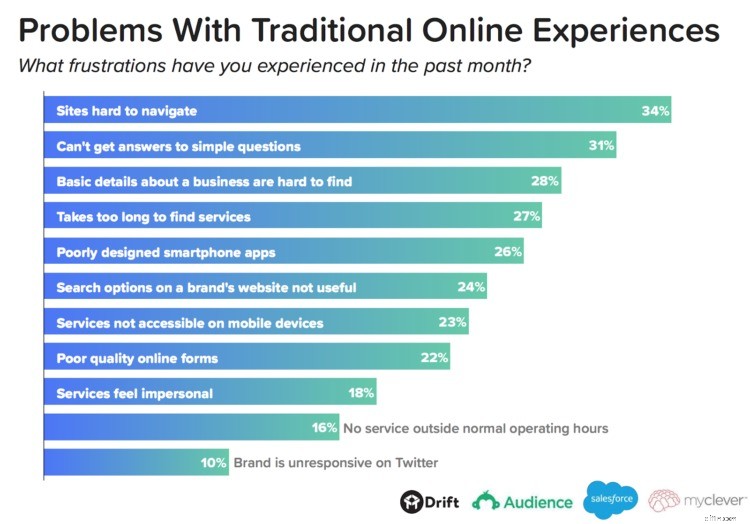
The top 4 most frustrating things about any given online experience are:
- Sites hard to navigate (34%).
- Can’t get answers to simple questions (31%)
- Basic details about a business hard to find (28%).
- Takes too long to find services (27%).
And when businesses were asked what benefits they could potentially see by leveraging a robust chatbot platform for their online business, they found the following:
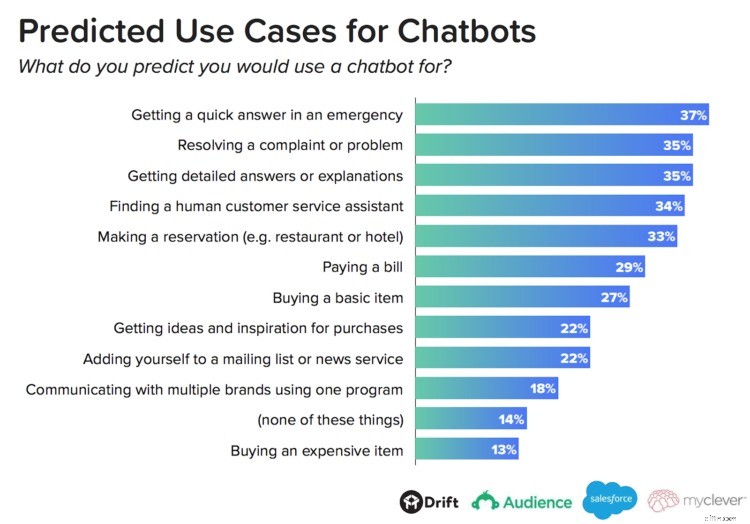
From these results, we can gather a few key takeaways:
- Without some sort of live interaction with customers, traditional online experiences are falling short.
- Consumers have a high expectation from businesses when it comes to the speed and accuracy in which they can obtain answers to common questions.
- There’s a clear match between what chatbots can offer businesses and how they can help alleviate the top 4 most common frustrations.
It’s important to understand that while chatbots are helpful in many ways, customers still vary in all shapes and sizes.
Before diving head first into adopting a chatbot for your business, you should first understand why individuals might want to converse with chatbots rather than a real human being.
Crafting a chatbot user interface will vary based on your industry, business, and target audience.
Chatbots & Customer Service
How you choose to implement chatbots alongside other channels like live chat, email, and social media can still impact how to best help customers:
- Get a quick answer to questions.
- Get a resolution to a complaint or problem.
- Get a more detailed answer to a question.
- Find the best way to communicate with your business.
Instead, when people think of chatbots, they most often think of their use in customer service across channels.
Why Chatbots & Customer Service Go Hand-in-Hand
- Advances in AI: smart AI capabilities mean chatbots can help predict what customers will need or want to buy based on past purchase history and additional machine learning capabilities. Some of the top AI chatbot tools can then begin to take a proactive approach other than a reactive upselling approach outside of email.
- Chat apps are one of the most popular on the web: And multiple social media channels (the other most popular apps) are integrating chat functionality in to their platforms – along with chatbot capabilities. This gives businesses a new way to get in front of their customers where their customers already are.
- Little to no development costs: There are tons of apps and tools out there you can use to launch a chatbot strategy and begin testing its effectiveness. There is no huge up-front cost – just conversation mapping work you need to do on your end.
- Growing conversation APIs: These APIs allow machines to speak to human using natural language processing – which means you don’t feel like you are talking to a chatbot, though most folks know they are. That matters.
-

Financial Forecasting: Drive Growth & Resilience
Business leaders who adopt and maintain financial forecasting best practices are better positioned to grow — and to weather unexpected setbacks. While it’s impossible to predict the future, as the COV
-

Unlock Efficiency: 10 Key Benefits of Business Process Automation
To ensure employees don’t skip steps in workflows, overlook details, repeat tasks unnecessarily or abando
Business
- Retiring Early & Traveling the World: The FIRE Movement's Latest Trend
- Financial Exclusion: The Challenges Faced by Black Canadians in Banking
- ACATS Explained: Seamless Account Transfers for Investors
- Bitcoin's Impact: Transforming Finance and the Future of Money
- Social Media Customer Service: Best Practices & Modern Strategies
- Scaling Your Business in a Hybrid Retail World: Insights from LARQ's Success
- Boost Customer Satisfaction: 8 Benefits of Customer Service Automation
- Voice of the Customer (VoC): Improve CX & Drive Business Growth
- Business Fraud: Risks, Impacts & Proactive Strategies
-
 Measuring Customer Relationships: Key Metrics & Strategies
Customers are the most important part of business. There cannot be any business without them. Only satisfied customers will be interested in buying and they will also refer other customers to buy. By ...
-
Understanding the Customer Lifecycle: Stages & Strategies
If in an organization, many customers diverge their way to other organizations and customer acquisition program shows less aggressiveness then the organization faces terrible cash flow problems. This ...