
Mastering Onboarding: A Comprehensive 30-60-90 Day Plan Guide
The 30-60-90 day plan lays out the actions that an individual intends to take during their first three months on the job. Setting clear objectives and a vision for their skillsNetworking and Building Relationships (Part 1)This article is part of a series of useful tips to help you find success in networking within your company. Networking plays an important part in our professional lives, starting from our job search, contiuing to joining and working in a company, and finally, advancing our careers. in each phase of the plan, they make their transition to the new role smooth and easy.
Putting a 30-60-90 plan together requires a bit of research. However, investing one’s time and effort into it pays off big time for the individual.
When to Write a 30-60-90 Day Plan
There are two situations that would call for a 30-60-90 day plan:
1. During a Job Interview
If there’s one thing that can help a candidate stand out from other job seekers, it’s creating a 30-60-90 day plan. The plan doesn’t need to be perfect. The simple gesture that the interviewee took time to learn more about the company and create the strategy speaks volumes!
The good thing is that job seekers are free to present their plan as they see fit. They can write down their course of action on paper or give a PowerPoint presentation.
During the job interview, an HR managerHuman Resource ManagementHuman Resource Management (HRM) is a collective term for all the formal systems created to help in managing employees and other stakeholders within a looks for responses to questions such as:
- Does the candidate understand what the new role entails?
- Can they perform well on the job?
- Will they exceed the company’s expectations?
When the job seeker prepares a realistic 30-60-90 day plan for the recruiter, they answer all three questions at once. They demonstrate to the hiring managers that they are self-driven, possess a strong work ethic, and are devoted to success on the job.
2. During the First Week of a New Job
Another situation that warrants writing a 30-60-90 day plan is when an individual gets hired.
With such a plan, the hiring manager will get to learn how you conduct yourself and address any problems he sees. Ultimately, the plan helps the employee transition better into his new role.
How to Write a 30-60-90 Day Plan
Ideally, the individual should aim to write a page for every 30-day section. It should contain the specific actions that he or she plans to take while in their new position.
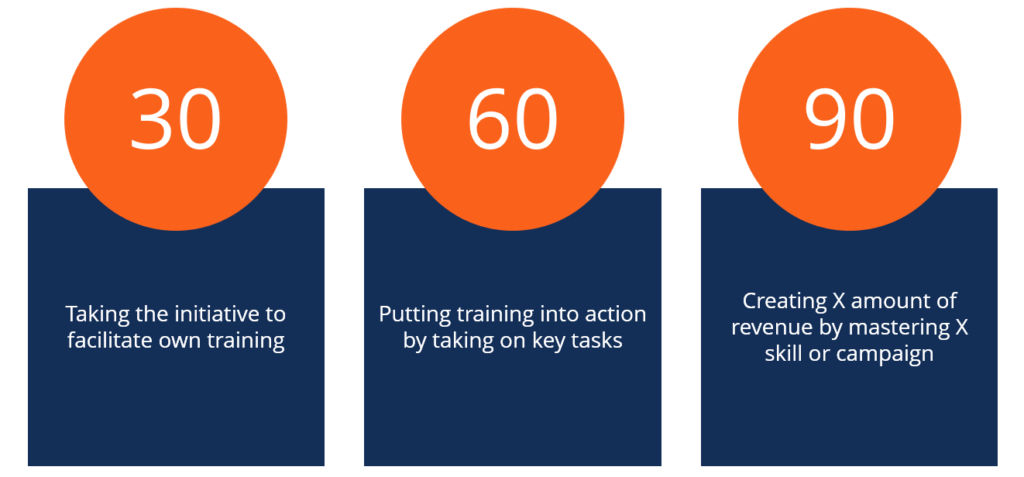
First 30 Days
For the first month or so, the employee should focus on training and learning the basics of the company. This includes the company’s systems, procedures that should be adhered to, products and servicesProducts and ServicesA product is a tangible item that is put on the market for acquisition, attention, or consumption while a service is an intangible item, which arises from, software, vendors, and/or clients.
This then means that the majority of the things-to-do should fall along the lines of attending training sessions, gaining and mastering product knowledge, learning major corporate systems, meeting the members of his team, and reviewing company accounts. Essentially, it entails doing all the things one needs to do to get his bearings on the job.
Not every company is able to provide orientationNew Employee OrientationNew employee orientation is an assimilation process in which new recruits are introduced to their jobs and work environment. Through orientation, new employees become acclimatized to the company, their department, fellow workers, and job requirements. to new employees. So, if the new worker demonstrates his ability to get up to speed all on his own, all the better.
Second 30 Days
With a good grasp of his/her working environment, the employee can now move onto more advanced tasks. They can start studying the best practices in the industry, create goals, meet up with their supervisor and get feedback on their performance, and build meaningful relationships with their co-workers.
The 60-day plan should also include items such as identifying potential mentors, evaluating the efficiency of the company’s processes and procedures, and continuing training. Generally, the second 30 days are about putting what the worker learned (during the first 30 days) into action.
Last 30 Days
At this point, the plan should demonstrate the employee’s firm grasp of the company and confidence in his abilities. Thus, he/she should be preparing to make breakthrough contributions to his team or department. The contributions may include finding new ways to improve customer retention rates or coming up with ideas to save the company money.
Instead of only identifying problems in the company, the worker should be at the forefront of brainstorming possible solutions. By now, the employee should be able to spearhead new initiatives and collaborate with other teams for the good of the company.
When they start to take on new projects, it won’t be long before they catch the attention of the company’s top executives.
Details are Key
The more details an individual can incorporate in his 30-60-90 day plan, the better. Specifics are important, especially if it’s a job seeker trying to impress a hiring manager.
So, whenever possible, the person writing the plan should find out the name of the software the company uses. Or, if they know the kind of orientation that new workers are put through, then that information should be included in the 30-60-90 day plan.
Final Word
If a candidate wants to excel in an interview, he should be prepared to do both the expected and unexpected. One way to do the unexpected is to formulate their 30-60-90 day plan. The plan shows that they are ambitious and ready to start on their new role.
New employees should also consider preparing a similar plan during their first week on the job. It helps them to transition smoothly and learn the basics of the company.
More Resources
CFI is the official provider of the Financial Modeling and Valuation Analyst (FMVA)™Become a Certified Financial Modeling & Valuation Analyst (FMVA)®CFI's Financial Modeling and Valuation Analyst (FMVA)® certification will help you gain the confidence you need in your finance career. Enroll today! certification program, designed to transform anyone into a world-class financial analyst.
To keep learning and developing your knowledge of financial analysis, we highly recommend the additional CFI resources below:
- Corporate DevelopmentCorporate DevelopmentCorporate development is the group at a corporation responsible for strategic decisions to grow and restructure its business, establish strategic partnerships, engage in mergers & acquisitions (M&A), and/or achieve organizational excellence. Corp Dev also pursues opportunities that leverage the value of the company’s business platform.
- Key Performance Indicators (KPIs)Key Performance Indicators (KPIs)Key Performance Indicators (KPIs) are metrics used to periodically track and evaluate the performance of an organization toward the achievement of specific goals. They are also used to gauge the overall performance of a company
- Sense of Purpose at WorkSense of Purpose at WorkFind your sense of purpose at work. Whether you enjoy your job or not often comes down to how well it supports your sense of purpose. Where you work, the role you hold, and your broader sense of your purpose are subject to change, therefore, if you want to have a balance between these three, you must be open to change
- Time ManagementTime ManagementTime management is the process of planning and controlling how much time to spend on specific activities. Good time management enables an individual to complete more in a shorter period of time, lowers stress, and leads to career success. This guide provides a list of the top tips for managing time well
-

529 Savings Plans: Maximum Contribution Limits & Tax Benefits
Contributions to 529 college savings plans create tax advantages. Choosing how to set money aside for future tuition bills involves comparing qualified savings plans, or 529s, against other i
-

Understanding Business Insurance Coverage: What You Need to Know
The average business insurance plan is usually adequate to meet the needs of most smaller businesses. 90% of all businesses in the United States have and are generally pleased with the average bu
Business strategy
- COVID-19 and Workplace: Your Rights and What to Do If You Test Positive
- Comprehensive Financial Planning: Your Path to Financial Security
- Day Trading Explained: Strategies, Risks & How It Works
- Business Plan: Definition, Importance & Funding Options
- Contingency Planning: Understanding & Managing Risk
- Understanding the Experience Curve: Cost Reduction & Efficiency
- Comprehensive Marketing Plan: Definition, Elements & Strategy
- Non-Profit Business Plan: A Comprehensive Guide
- DB(k) Plans: A Hybrid Retirement Solution for Employers & Employees
-
 529 Plans: Your Guide to Tax-Advantaged College Savings
How can they help pay for higher education? A 529 plan is an education savings plan that offers tax benefits and financial aid benefits. A college savings plan is...
-
Understanding 401(k) Plans: A Comprehensive Guide
For most people, retirement is the most expensive financial goal they’ll save for in their life. According to the U.S. Department of Labor, you’ll need around 70% to 90% of your pre-retirement income ...