
5C Analysis: A Comprehensive Framework for Business Strategy
5C Analysis is a marketing framework to analyze the environment in which a company operates. It can provide insight into the key drivers of success, as well as the risk exposureSystemic RiskSystemic risk can be defined as the risk associated with the collapse or failure of a company, industry, financial institution or an entire economy. It is the risk of a major failure of a financial system, whereby a crisis occurs when providers of capital lose trust in the users of capital to various environmental factors. The 5Cs are Company, Collaborators, Customers, Competitors, and Context.
Company
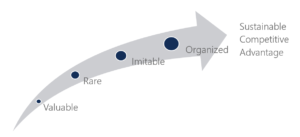
When analyzing a company using the 5C marketing framework, the key issue is to identify the Sustainable Competitive AdvantageCertification Frameworks that belongs to the focal company. It can be in the form of brand equity, economies of scale,Economies of ScaleEconomies of scale refer to the cost advantage experienced by a firm when it increases its level of output.The advantage arises due to the technological development, etc. To identify if the focal company has a sustainable competitive advantage, the VRIO (Variable Rare Imitable Organized) model can be utilized to distinguish if a company’s assets offer a temporary or sustainable advantage.
Collaborators
Collaborators are entities that allow or enhance a company’s ability to provide its particular good or service in the way that it does. This factor primarily revolves around a company’s supply chain, that ranges from spot contracts up to quasi-vertical integration. The direction of integration can only be upstream, as downstream collaborators are more specifically defined as customers in the 5C Analysis framework.
Customers
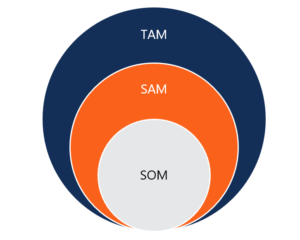
The group of potential customers a company can reach with its products or services can be broken down into three main sizes: Total Available Market, Serviceable Available Market, and the Serviceable Obtainable Market. The market segments may be further segmented through demographics, psychographics, geography, and other distinguishing factors.
The Total Available Market (TAM) is the most generalized customer segment that includes every possible customer that demands a particular product or service. The Serviceable Available Market (SAM) would be a subset of the TAM that is categorized by the potential use of a company’s product or service. The Serviceable Obtainable Market (SOM) sub-segment of the market is the narrowest definition that specifies the segment of a market that a company could realistically aim to capture.
Competitors
Competition can be found in the form of other companies operating in the same industry as the focal company. To determine the industry, industry classification systems such as the North American Industry Classification System exist to provide a standardized method of defining an industry.
One common metric to identify players of interest is to examine their market share within the industry. It is typically stated through the concentration ratio CR4, which shows the percentage of the market share held by the four largest firms in the industry.
Note, however, that industry classification systems may not provide a sufficiently thorough industry definition for certain companies. This can occur because a firm may operate across multiple industries or it may serve a niche market that differs from the traditional industry definition.
Context
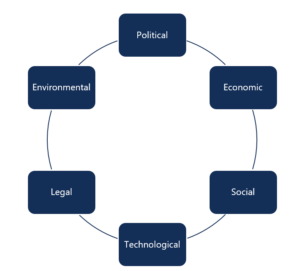
The context in which a business operates is most often analyzed with the use of PESTEL analysis. It provides coverage into the areas that may affect a business, but where the business exercises either no or limited control. Changes to contextual factors may impact the industry as a whole rather than a particular company. As such, an advantage experienced by such changes may not translate into a competitive advantage for the focal company or vice versa.
Related Reading
Thank you for reading this guide to performing 5C Analysis. CFI is a global provider of the Financial Modeling & Valuation Analyst (FMVA)™Become a Certified Financial Modeling & Valuation Analyst (FMVA)®CFI's Financial Modeling and Valuation Analyst (FMVA)® certification will help you gain the confidence you need in your finance career. Enroll today! certification program and several other courses for finance professionals. To help you keep learning and advancing your career, check out the additional CFI resources below:
- Law of SupplyLaw of SupplyThe law of supply is a basic principle in economics that asserts that, assuming all else being constant, an increase in the price of goods
- Absolute AdvantageAbsolute AdvantageIn economics, absolute advantage refers to the capacity of any economic agent, either an individual or a group, to produce a larger quantity
- Market EconomyMarket EconomyMarket economy is defined as a system where the production of goods and services are set according to the changing desires and abilities of
- Fiscal PolicyFiscal PolicyFiscal Policy refers to the budgetary policy of the government, which involves the government controlling its level of spending and tax rates
-
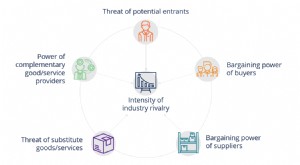
Porter's Five Forces: A Comprehensive Guide to Competitive Analysis
The Competitive Forces Model is an important tool used in strategic analysisStrategic AnalysisStrategic analysis refers to the process of conducting research on a company and its operating environment
-

Holding Companies: Definition, Purpose & How They Work
A holding company is a company that doesn’t conduct any operations, ventures, or other active tasks for itself. Instead, it exists for the purpose of owning assets. In other words, the company d
Business strategy
- Acid-Test Ratio: Understanding Your Company's Short-Term Liquidity
- DuPont Analysis: A Comprehensive Guide to Profitability Assessment
- Understanding the Earnings Multiplier (P/E Ratio): A Comprehensive Guide
- Understanding the IPO Process: A Comprehensive Guide
- Modigliani-Miller Theorem: Understanding Capital Structure & Firm Value
- Stock Analysis: A Comprehensive Guide for Investors
- Industry Analysis: A Comprehensive Guide for Business Insights
- McKinsey 7S Model: Understanding Organizational Effectiveness
- SWOT Analysis: A Comprehensive Guide for Strategic Planning
-
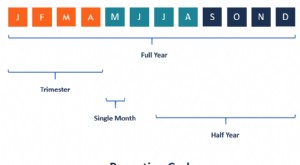 Understanding the Accounting Reporting Cycle: A Comprehensive Guide
The reporting cycle involves the running, managing, updating, and reporting of a company’s accounts. The cycle usually runs concurrently with the planning and budgeting cycles. It ensures that t...
-
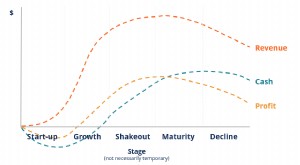 Understanding the Industry Life Cycle: Stages & Dynamics
An industry life cycle depicts the various stages where businesses operate, progress, and slump within an industry. An industry life cycle typically consists of five stages — startup, growth, sh...