
Day Trading Explained: Strategies, Risks & How It Works
The main attribute of day trading is that the purchasing and selling of securities occurs within the same trading day. It means that all trading positions are liquidated at the end of a trading day. The main goals of day trading are discovering and leveraging short-term market inefficiencies.
Unlike many investors, day traders do not concern themselves with the long-term value of securities. Day traders are only interested in short-term price movements.

Day trading is a risky trading strategy. Even if a trader can accurately predict the price movements of securities, gains from the price changes can be offset by transaction fees.
Day traders may be employees of financial services companies such as banksTop Banks in the USAAccording to the US Federal Deposit Insurance Corporation, there were 6,799 FDIC-insured commercial banks in the USA as of February 2014. and investment funds, as well as private individuals.
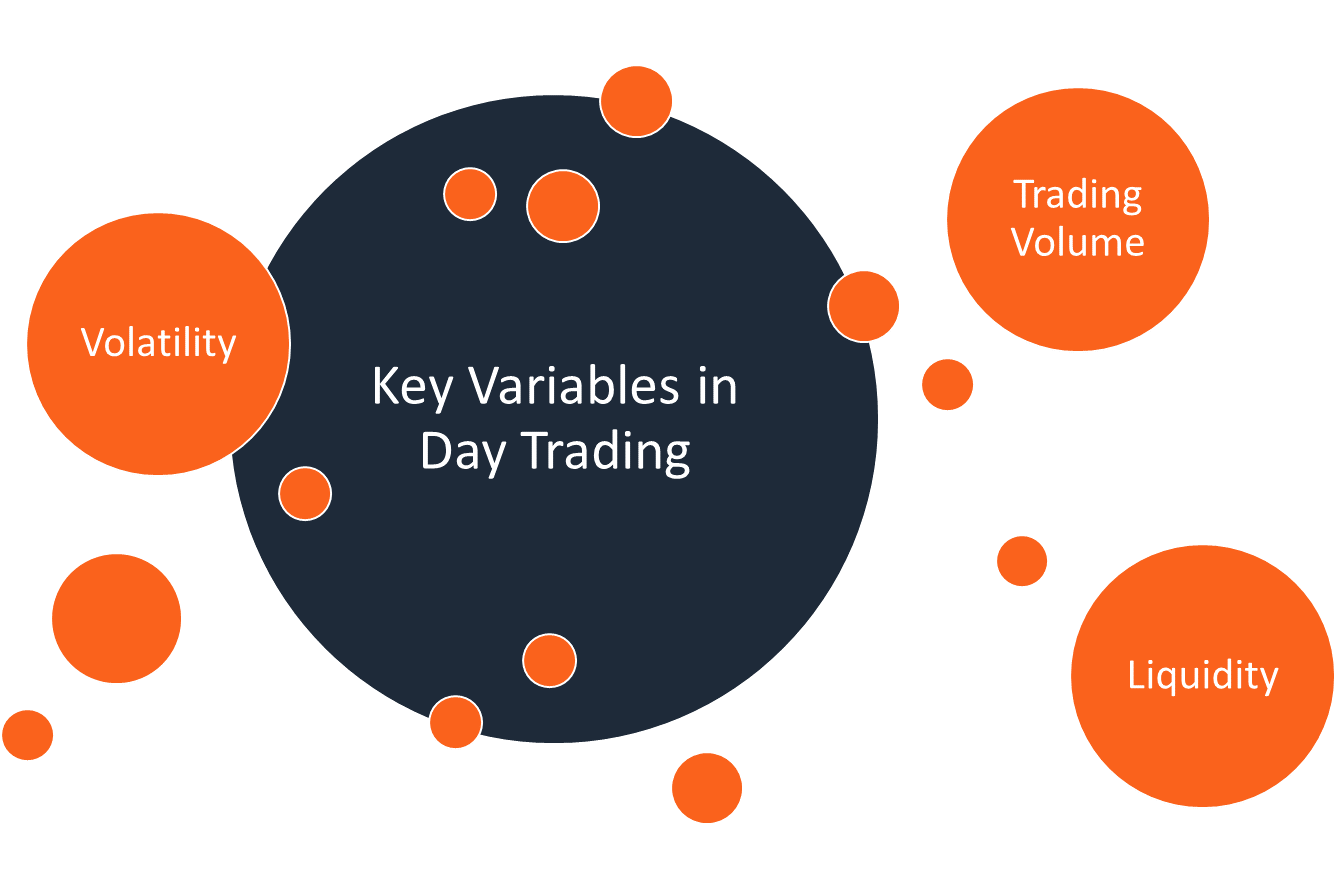
Key Parameters in Day Trading
The following parameters are essential for almost all day traders regardless of the trading strategy:
1. Volatility
This is a variable that measures the range of price fluctuations of a security. VolatilityVolatilityVolatility is a measure of the rate of fluctuations in the price of a security over time. It indicates the level of risk associated with the price changes of a security. Investors and traders calculate the volatility of a security to assess past variations in the prices is helpful for day traders, as it provides them with more opportunities to capture profits from short-term price changes.
2. Trading volume
This is a measure of how many times a security is bought and sold during a specified trading period. The trading volume provides insights to a trader regarding interest in a security. Like volatility, higher volume usually means increased opportunities for day trading.
3. Liquidity
Liquidity affects the bid-ask spreads in the prices of a security. Low bid-ask spreads are often critical for day trading success because they help to minimize transaction costs.
Essential Tools for Day Traders
Day traders use various tools to profit from their strategies:
1. Real-time market data and news
Access to real-time market information is essential for day trading. Real-time market data and news allow traders to grasp the latest information on the market and leverage it to make profits. Day traders often spend significant amounts of money on access to real-time market data. One of the most popular market information options among day traders is Bloomberg terminalsBloomberg TerminalThe Bloomberg Terminal (aka Bloomberg Professional Services) connects finance professionals to a dynamic network of information, people, and ideas. At the core of this network is the ability to deliver real-time data to finance professionals around the world..
2. Electronic Communication Network (ECN)
This is an electronic system that matches the buy and sell orders between institutional and individual market participants. The ECN displays the best available bid and ask quotes, so it can help day traders obtain favorable buy and sell prices.
3. Securities price charts
Charts are crucial for the technical analysis of securities, which is the form of analysis most commonly used for day trading. Day traders often favor using candlestick charts. Candlesticks provide a clear visual display of the high, low, opening, and closing prices for a specific time period.
Day Trading Strategies
There are different techniques used to make profits from day trading. Each trader chooses his or her own trading strategy based on their risk tolerance and current market conditions. Traders may rely on several strategies to quickly adjust to rapidly changing market conditions.
The following are some of the most popular day trading strategies:
1. Scalping
Scalping is one of the most popular day trading strategies that aims to minimize losses but also only provides minimum profits. The strategy involves immediately closing a trade once it shows a small profit. Scalping trades may only be held for a few minutes or even just a few seconds.
2. Momentum
MomentumMomentum InvestingMomentum investing is an investment strategy aimed at purchasing securities that have been showing an upward price trend or short-selling securities that is a measure of the strength or acceleration of a security’s price trend. For example, a positive news release may trigger a sharp price increase that is sustained for a period of time. A day trader who is expecting such a move might buy the security, looking to sell it for a profit after the strong move up in price.
3. Contrarian trading
Contrarian trading is based on the idea that a security whose price has been steadily rising or declining for a while is due for a correction. Using a contrarian strategy, a day trader will look for signs of an impending reversal in price direction and trade accordingly.
Related Readings
CFI offers the Capital Markets & Securities Analyst (CMSA)®Program Page - CMSAEnroll in CFI's CMSA® program and become a certified Capital Markets &Securities Analyst. Advance your career with our certification programs and courses. certification program for those looking to take their careers to the next level. To keep learning and advancing your career, the following resources will be helpful:
- Investing: A Beginner’s GuideInvesting: A Beginner's GuideCFI's Investing for Beginners guide will teach you the basics of investing and how to get started. Learn about different strategies and techniques for trading
- High-Frequency Trading (HFT)High-Frequency Trading (HFT)High-frequency trading (HFT) is algorithmic trading characterized by high speed trade execution, an extremely large number of transactions,
- Primary MarketPrimary MarketThe primary market is the financial market where new securities are issued and become available for trading by individuals and institutions. The trading activities of the capital markets are separated into the primary market and secondary market.
- Stock Investment StrategiesStock Investment StrategiesStock investment strategies pertain to the different types of stock investing. These strategies are namely value, growth and index investing. The strategy an investor chooses is affected by a number of factors, such as the investor’s financial situation, investing goals, and risk tolerance.
-

Circuit Breakers: Understanding Trading Halts & Market Stability
A circuit breaker is a regulatory instrument that halts the trading of a securityStockWhat is a stock? An individual who owns stock in a company is called a shareholder and is eligible to claim part o
-

Understanding Commodities: A Beginner's Guide to Investing
Commodities are another class of assets just like stocks and bondsBondsBonds are fixed-income securities that are issued by corporations and governments to raise capital. The bond issuer borrows capit
invest
- CFD Trading Explained: A Comprehensive Guide for Investors
- Proprietary Trading: A Comprehensive Guide for Investors
- Quantitative Trading: A Deep Dive into Models & Analysis
- Spread Trading: A Comprehensive Guide to Relative Value Trading
- Trading Authorization: Empowering Your Broker & Account Security
- Trading Channels: Understanding Uptrends & Downtrends
- Intraday Trading: A Comprehensive Guide for Short-Term Investors
- Day Trading Explained: A Beginner's Guide to Short-Term Stock Trading
- Pattern Day Trading: Definition, Rules & Requirements
-
 After Hours Trading Explained: A Comprehensive Guide
After hours trading refers to the time outside regular trading hours when an investor can buy and sell securities. The main exchanges in the United States, NASDAQ and NYSENew York Stock Exchange (NYSE...
-
 Basis Trading: Definition, Strategy & How It Works
Basis trading is a financial arbitrage trading strategy that involves the trading of a financial instrument, such as a financial derivative or a commodityCommoditiesCommodities are another class of as...