
PEST Analysis: Understanding Macro-Environmental Factors
Broad Factors Analysis, commonly called the PEST Analysis, is a key component of external analysisExternal AnalysisExternal analysis means examining the industry environment of the company, including factors such as competitive structure, competitive position, dynamics. A Broad Factors Analysis assesses and summarizes the four macro-environmental factors — political, economic, socio-demographic (social), and technological. These factors have significant impacts on a business’s operating environment, posing opportunities and threats to the company and all of its competitors. Broad Factors Analysis is widely used in strategic analysisStrategic AnalysisStrategic analysis refers to the process of conducting research on a company and its operating environment to formulate a strategy. The definition and planning because it helps companies determine the risks and opportunities in the marketplace. That, in turn, becomes an important consideration when companies are developing corporate and business strategies.
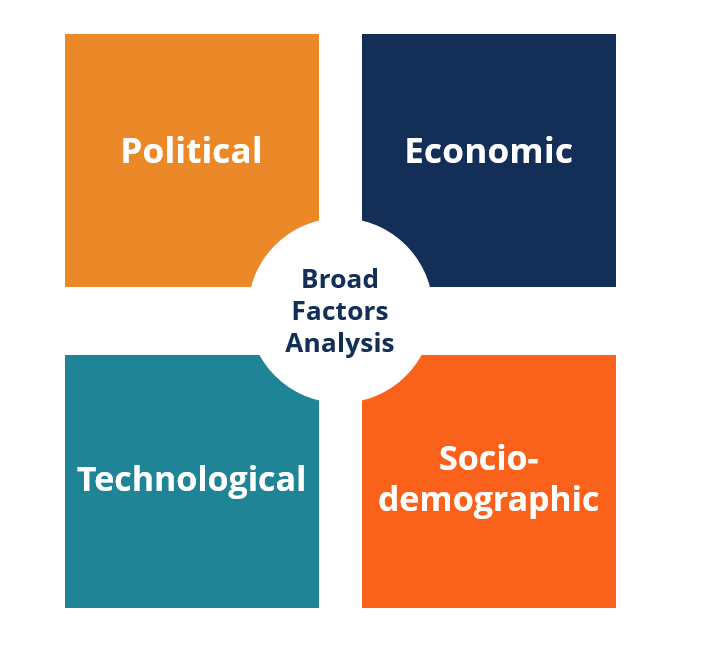
Political Factors
Political factors are factors within the regulatory environment of a particular industry or business.
Examples of political factors include:
- Barriers to international trade
- Changes in government regulation
- Tax policy
- Employment laws
- Country-specific political risk
Political factors in the macro-environment can constrain the operations of organizations and introduce opportunities and threats to companies. When a company chooses which industries to enter or which countries to expand their operations into, it might want to consider the complication of government regulatory policies in that specific industry or country and the associated risks.
Economic Factors
Economic factors are things that influence the macroeconomy, such as:
- Interest rates
- Foreign exchange rates
- Inflation
- Gross Domestic Product (GDP) growth rates
Each of these factors can have various impacts on businesses. For example, interest rates affect the cost of capital and a company’s ability to raise funds or invest in new assets. Low exchange rates reduce threats from foreign competitors and create overseas opportunities. When inflation happens, it destabilizes the economy and makes the future less predictable for companies. Lastly, the high growth rate of an economy increases customer expenditures and eases competitive pressures.
Socio-Demographic (Social) Factors
Socio-demographic factors are short for social and demographic factors, which concern population demographics and the characteristics of a company’s target customers.
Examples of social-demographic factors include:
- Population growth
- Education level
- Health consciousness and trends
- Nature and the environment
- Age cohort changes
Changing social morals and values can impact the business of an entire industry because they shift consumer preferences and demand for products/services. For example, if a majority of the popularity perceives smoking as an activity that is harmful to physical health, then demand for cigarettes and tobacco could significantly decline and, thus, impact the profitability of those businesses.
Technological Factors
Technological factors have become increasingly important for many businesses in recent years due to the prevalence of information technology and mobile devices.
Some examples of technological factors include:
- Research & development (R&D) investment
- Scientific advances
- emerging technologies
- Diffusion of technologies
These technological factors affect the height of the barrier to entry of an industry and reshape the industry structure.
Broad Factors Analysis helps a company arrive at an understanding of the net potential impact of these factors on a business, and the overall attractiveness, opportunities, and threats that exist for the company in a given market.
More Related Resources
Thank you for visiting our resource on broad factors analysis (PEST analysis). To learn more about external analysis and how to perform strategic analysis, enroll in our Corporate & Business Strategy course today!
Additional relevant CFI resources include:
- Industry AnalysisIndustry AnalysisIndustry analysis is a market assessment tool used by businesses and analysts to understand the complexity of an industry. There are three commonly used and
- SWOT AnalysisSWOT AnalysisA SWOT analysis is used to study the internal and external environments of a company and is part of a company’s strategic planning process. In addition, a
- External AnalysisExternal AnalysisExternal analysis means examining the industry environment of the company, including factors such as competitive structure, competitive position, dynamics
- All Strategy ResourcesStrategyCorporate and business strategy guides. Read all CFI articles and resources on business and corporate strategy, important concepts for financial analysts to incorporate in their financial modeling and analysis. First mover advantage, Porter's 5 Forces, SWOT, competitive advantage, bargaining power of suppliers
-

Technical Analysis: A Comprehensive Guide for Traders
What Is Technical Analysis? Technical analysis is the study of historical market data, including price and volume. Using insights from market psychology, behavioral economics, and quantitative
-
Break-Even Analysis: Calculate Your Profitability Threshold
What Is a Break-Even Analysis? Break-even analysis entails calculating and examining the margin of safety for an entity based on the revenues collected and associated costs. In other words, the
Business strategy
- Incremental Analysis: A Business Decision-Making Technique
- Broad Tape
- Trend Analysis: Predicting Stock Price Movements - A Technical Analysis Guide
- PEST Analysis: A Comprehensive Guide for Strategic Planning
- PESTEL Analysis: A Comprehensive Guide for Strategic Planning
- Fundamental Analysis: A Comprehensive Guide to Investment Valuation
- Factors of Production: Definition, Types & Importance
- Credit Analysis: Understanding Debt Risk & Issuer Ability
- Ex-Ante Analysis: Understanding Future Potential in Finance
-
Understanding Attribution Analysis: Performance & Return Evaluation
What Is Attribution Analysis? Attribution analysis is a sophisticated method for evaluating the performance of a portfolio or fund manager. Also known as “return attribution” or “performance at...
-
 Value Network Analysis: Understanding Business Value & Relationships
Value network analysis is a business methodology that sets the relationship between business activities and the value network by evaluating members of an organization. It is usually performed by ...