
PESTEL Analysis: A Comprehensive Guide for Strategic Planning
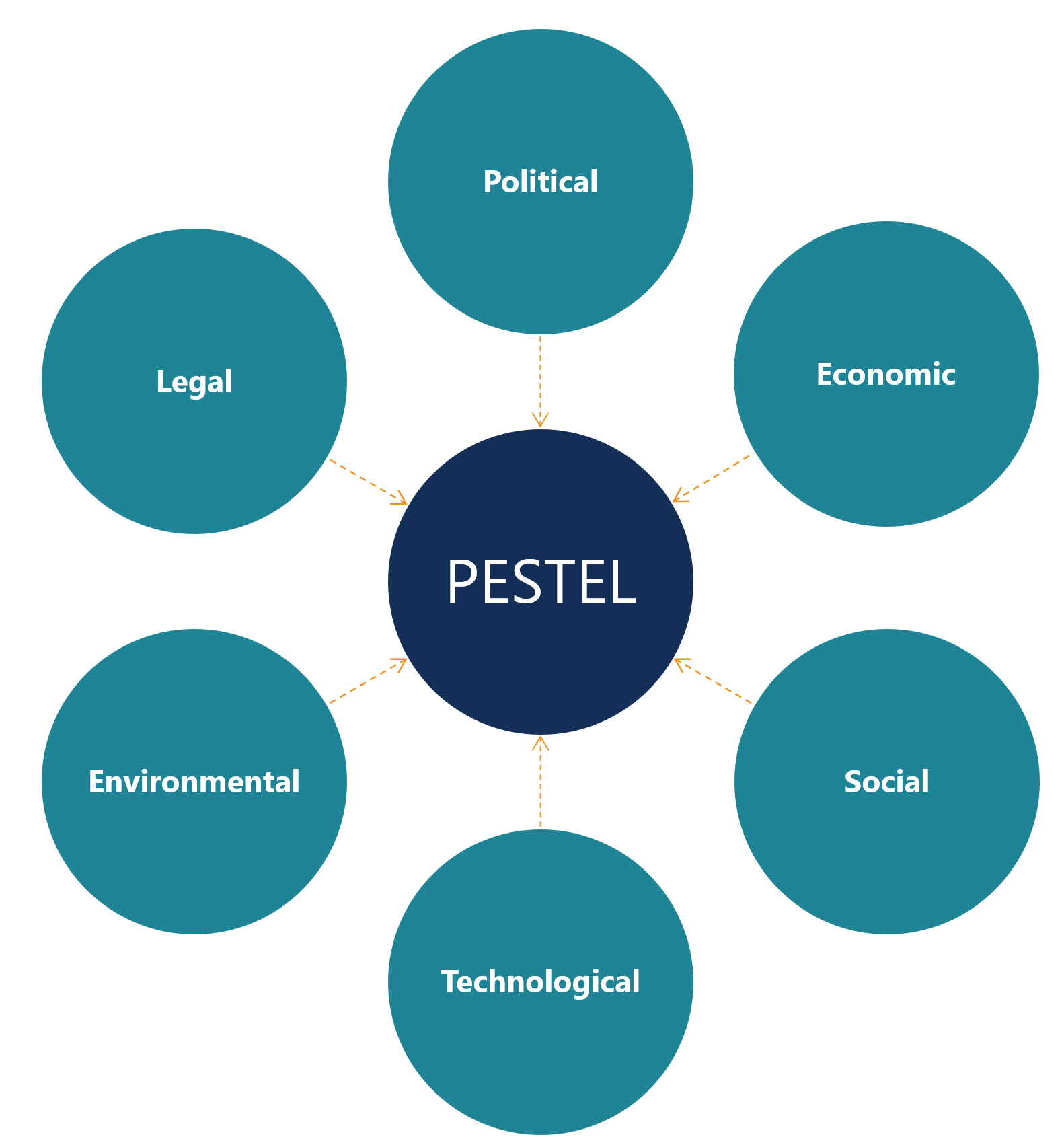
PESTEL Analysis is a strategicStrategyCorporate and business strategy guides. Read all CFI articles and resources on business and corporate strategy, important concepts for financial analysts to incorporate in their financial modeling and analysis. First mover advantage, Porter's 5 Forces, SWOT, competitive advantage, bargaining power of suppliers framework used to evaluate the external environment of a business by breaking down the opportunities and risks into Political, Economic, Social, Technological, Environmental, and Legal factors. PESTEL Analysis can be an effective framework to use in Corporate Strategy PlanningCorporate StrategyCorporate Strategy focuses on how to manage resources, risk and return across a firm, as opposed to looking at competitive advantages in business strategy and for identifying the pros and cons of a Business Strategy. The PESTEL framework is an extension of the PEST strategic framework,PEST AnalysisPEST Analysis is a strategy framework to evaluate the external environment of a business. It focuses on Political, Economic, Social, Technological factors one that includes additional assessment of the Environmental and Legal factors that can impact a business.
Below we break down the key items of each of the 6 Factors of the PESTEL framework (Political, Economic, Social, Technological, Environmental, and Legal). Points derived from PESTEL Analysis can be incorporated into other strategic frameworks, such as SWOT AnalysisSWOT AnalysisA SWOT analysis is used to study the internal and external environments of a company and is part of a company’s strategic planning process. In addition, a and Porter’s 5 Forces, where relevant.
Political Factors
When looking at political factors, you are looking at how government policy and actions intervene in the economy and other factors that can affect a business. These include the following:
- Tax PolicyAd Valorem TaxThe term “ad valorem” is Latin for “according to value,” which means that it is flexible and depends on the assessed value of an asset, product or service.
- Trade Restrictions Trade BarriersTrade barriers are legal measures put into place primarily to protect a nation's home economy. They typically reduce the quantity of goods and services that can be imported. Such trade barriers take the form of tariffs or taxes and
- TariffsTariffA tariff is a form of tax imposed on imported goods or services. Tariffs are a common element in international trading. The primary goals of imposing
- BureaucracyBureaucracyThe system to maintain uniform authority within and across institutions is known as bureaucracy. Bureaucracy essentially means to rule by the office.
One of the reasons that elections tend to be a period of uncertainty for a country is that different political parties have diverging views and strategies for policy on the items above.
Political Factor Example: A company decides to move its operations to a different state after a new government is elected on a campaign to implement policies that would adversely impact the company’s core operations.
Economic Factors
Economic Factors take into account the various aspects of the economy, and how the outlook on each area could impact your business. These economic indicators are usually measured and reported by Central BanksEuropean Central Bank (ECB)The European Central Bank (ECB) is one of the seven institutions of the EU and the central bank for the entire Eurozone. and other Government Agencies. They include the following:
- Economic Growth Rates Gross Domestic Product (GDP)Gross domestic product (GDP) is a standard measure of a country’s economic health and an indicator of its standard of living. Also, GDP can be used to compare the productivity levels between different countries.
- Interest Rates Interest RateAn interest rate refers to the amount charged by a lender to a borrower for any form of debt given, generally expressed as a percentage of the principal.
- Exchange Rates Fixed vs. Pegged Exchange RatesForeign currency exchange rates measure one currency's strength relative to another. The strength of a currency depends on a number of factors such as its inflation rate, prevailing interest rates in its home country, or the stability of the government, to name a few.
- InflationInflationInflation is an economic concept that refers to increases in the price level of goods over a set period of time. The rise in the price level signifies that the currency in a given economy loses purchasing power (i.e., less can be bought with the same amount of money).
- Unemployment RatesUnemploymentUnemployment is a term referring to individuals who are employable and actively seeking a job but are unable to find a job. Included in this
Often these are the focus of external environment analysis. The economic outlook is of extreme importance for a business, but the importance of the other PESTEL factors should not be overlooked.
Economic Factor Example: A company decides to refinance its debtDebt RefinancingDebt refinancing is the replacement of an existing debt by means of another debt with terms and/or conditions that are more favorable. In other words, debt refinancing refers to the replacement of existing debt with new debt. after an interest rate decrease is announced.
Social Factors
PESTEL analysis also takes into consideration social factors, which are related to the cultural and demographic trends of society. Social norms and pressures are key to determining consumer behavior. Factors to be considered are the following:
- Cultural Aspects & Perceptions
- Health Consciousness
- Populations Growth Rates
- Age Distribution
- CareerCareersSearch CFI's career resources library. We've compiled the most important career resources for any job in corporate finance. From interview prep to resumes and job descriptions, we've got you covered to land your dream job. Explore guides, templates, and a wide range of free resources and tools Attitudes
Social Factors Example: The percentage of the American population that smokes has decreased since the 1970s, due to changes in society’s perception of health and wellness.
Technological Factors
Technological factors are linked to innovation in the industry, as well as innovation in the overall economy. Not being up to date to the latest trends of a particular industry can be extremely harmful to operations. Technological factors include the following:
- R&DResearch and Development (R&D)Research and Development (R&D) is a process by which a company obtains new knowledge and uses it to improve existing products and introduce Activity
- Automation
- Technological Incentives
- The Rate of change in technology
Technological Factors Example: A company decides to digitize their physical data files to allow for quicker access to company information.
Environmental Factors
Environmental factors concern the ecological impacts on business. As weather extremes become more common, businesses need to plan how to adapt to these changes. Key environmental factors include the following:
- Weather Conditions
- Temperature
- Climate Change
- Pollution
- Natural disasters (tsunami, tornadoes, etc.)
Additionally, there is increasing importance for businesses to be environmentally friendly with their operations, as evidenced by the rise of Corporate Sustainability Responsibility (CSR) initiatives. Examples of CSR initiatives include carbon footprint reduction efforts and transitions into renewable material and energy sources.
Environmental Factors Example: An agricultural company has to adjust its harvest forecastsForecastingForecasting refers to the practice of predicting what will happen in the future by taking into consideration events in the past and present. Basically, it is a decision-making tool that helps businesses cope with the impact of the future’s uncertainty by examining historical data and trends. due to unexpectedly dry seasonal conditions that will prevent crop growth.
Legal Factors
There is often uncertainty regarding the difference between political and legal factors in the context of a PESTEL analysis. Legal factors pertain to any legal forces that define what a business can or cannot do. Political factors involve the relationship between business and the government. Political and legal factors can intersect when governmental bodies introduce legislature and policies that affect how businesses operate.
Legal factors include the following:
- Industry Regulation
- Licenses & Permits
- Labor Laws
- Intellectual Property
Legal Factors Example: A restaurant is forced to shut down after not meeting food safety standards set out in state law.
PESTEL Analysis in Business Valuation
PESTEL analysis provides important considerations for a DCF Valuation ModelDCF Analysis Pros & ConsThe discounted cash flow analysis is a powerful tool in a financial analyst’s belt. However, there are many important DCF Analysis Pros & Cons for analysts, discussed in CFI’s Business Valuation Modeling Course.
Combined, these six factors have a profound impact on the opportunities and risks for a business. Before creating a business valuation model – such as a DCF ModelDCF Model TemplateThis DCF model template provides you with a foundation to build your own discounted cash flow model with different assumptions – it’s important to understand how these factors may impact the company’s ability to generate cash flowCash FlowCash Flow (CF) is the increase or decrease in the amount of money a business, institution, or individual has. In finance, the term is used to describe the amount of cash (currency) that is generated or consumed in a given time period. There are many types of CF.
Breaking down the external environment helps identify key elements to be incorporated into your business valuation. PESTEL analysis is also useful for initial company screening, setting criteria that have to be fulfilled for analysis to be considered.
Learn more in CFI’s financial modeling courses.
Additional Resources
If you want to learn more about External Environment Analysis and how it applied to DCF Models and Valuation, take a look at the Business Valuation Model Course, part of the FMVA® Program! Become a Certified Financial Modeling & Valuation Analyst (FMVA)®CFI's Financial Modeling and Valuation Analyst (FMVA)® certification will help you gain the confidence you need in your finance career. Enroll today!
Also, see the following CFI resources:
- SWOT Analysis SWOT AnalysisA SWOT analysis is used to study the internal and external environments of a company and is part of a company’s strategic planning process. In addition, a
- DCF Model DCF Model Training Free GuideA DCF model is a specific type of financial model used to value a business. The model is simply a forecast of a company’s unlevered free cash flow
- Strategy Course
- Economic IndicatorsEconomic IndicatorsAn economic indicator is a metric used to assess, measure, and evaluate the overall state of health of the macroeconomy. Economic indicators
-
![Corporate Strategy: A Comprehensive Overview | [Your Company Name]](https://www.etffin.com/article/uploadfiles/202110/2021100815410409_S.png)
Corporate Strategy: A Comprehensive Overview | [Your Company Name]
Corporate Strategy takes a portfolio approach to strategic decision making by looking across all of a firm’s businesses to determine how to create the most value. In order to develop a cor
-

Executive Summary: A Concise Guide for Business & Non-Profits
An executive summary is the first section of a business planNon-Profit Business PlanA non-profit business plan is simply a roadmap of the non-profit organization that outlines its goals and objectives
Business strategy
- Bootstrapping: How to Build a Business with Minimal Funding
- PEST Analysis: Understanding Macro-Environmental Factors
- Business Plan: Definition, Importance & Funding Options
- Understanding Business Structures: A Comprehensive Guide
- Understanding Business Entities: Types & Legal Structures
- Industry Analysis: A Comprehensive Guide for Business Insights
- Pareto Analysis: The 80/20 Rule Explained | [Your Brand/Website Name]
- PEST Analysis: A Comprehensive Guide for Strategic Planning
- Top-Down Analysis: A Comprehensive Guide for Investors
-
 Horizon Analysis: Predicting Portfolio Returns & Investment Strategies
Horizon analysis is a method used to estimate a portfolio’s expected total return over a given investment horizon. It uses scenario analysisScenario AnalysisScenario analysis is a process of exa...
-
 Business Strategy vs. Business Model: Understanding the Difference
Setting up and successfully running a business involves differentiating between business strategy vs business model. To reach their goals and achieve success, owners need to adopt the right strategy f...