
Brownfield Investment: Definition, Benefits & Examples
In economics, a brownfield investment (BI) is a type of foreign direct investment (FDI)Foreign Direct Investment (FDI)Foreign direct investment (FDI) is an investment from a party in one country into a business or corporation in another country with the intention of establishing a lasting interest. Lasting interest differentiates FDI from foreign portfolio investments, where investors passively hold securities from a foreign country. where a company invests in an existing facility to start its operations in the foreign country. In other words, a brownfield investment is the lease or purchase of a pre-existing facility in a foreign country.
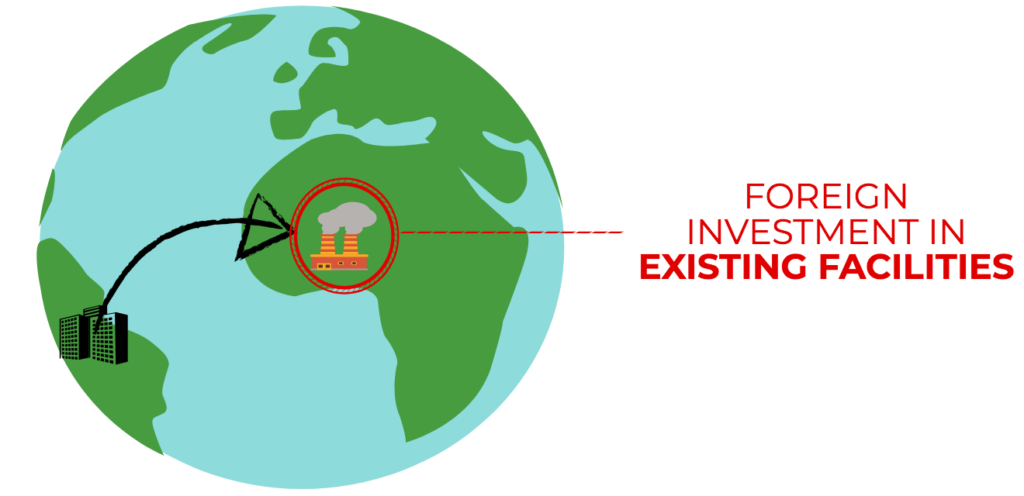
Understanding a Brownfield Investment
A brownfield investment is often undertaken when a company wants to invest and start operations in a new country but does not want to incur the high start-up costs associated with a greenfield investmentGreenfield InvestmentIn economics, a greenfield investment (GI) refers to a type of foreign direct investment where a company establishes new operations in a foreign country (a greenfield investment is a foreign direct investment where, instead of using existing businesses in the foreign country, the investor opens their own new business there – basically, a “from the ground up” approach). The underlying rationale behind a brownfield investment is to enter into a new foreign market through businesses that already have a presence there.
In a brownfield investment, the company either invests in existing facilities and infrastructure through a merger and acquisition (M&A) dealMergers Acquisitions M&A ProcessThis guide takes you through all the steps in the M&A process. Learn how mergers and acquisitions and deals are completed. In this guide, we'll outline the acquisition process from start to finish, the various types of acquirers (strategic vs. financial buys), the importance of synergies, and transaction costs or leases existing facilities in the foreign country.
Advantages of a Brownfield Investment
A brownfield investment offers several advantages, including the following:
- The ability to gain access to a new foreign market swiftly
- Lower fixed costsFixed and Variable CostsCost is something that can be classified in several ways depending on its nature. One of the most popular methods is classification according due to using already established facilities, infrastructure, and network
- Lower staffing and training costs, due to the presence of already-employed workers at the facility
- May include existing approvals and licenses from the government or regulators
- Depending if the facility is made to fit, whether modifications exist, or if the facility can be utilized without major alterations and upgrades, a brownfield investment can be a very cost-effective option when compared to a greenfield investment
Disadvantages of a Brownfield Investment
A brownfield investment comes with a few potential disadvantages as well, among them, the following:
- The facility or infrastructure may require major upgrades, which would increase the foreign investment cost
- The facility may be old and, therefore, require high maintenance and upkeep cost
- There may be operational inefficiencies if the facility cannot be adapted to new production needs
- There may be scalabilityScalabilityScalability can fall in both financial and business strategy contexts. In both cases, it stands for the ability of the entity to withstand pressure of and expansion issues related to using already constructed facilities
- Locational constraints
- There may be unforeseen tax and regulatory issues
Example of a Brownfield Investment
Company A is currently based in the United States and is looking to expand operations into India. Due to uncertainty in the overseas market for their product, the CEO decided to conduct a brownfield investment to “test the waters.”
In addition, there are numerous approvals and licenses to be acquired in India, and it’s been determined that such time-consuming activities can be eliminated by acquiring a local company with already-approved licenses.
Company A then identifies a potential target company in India. By making a brownfield investment by acquiring the target company, Company A is able to expand into the market quickly. In addition, through a brownfield investment, it is able to avoid significant foreign investment costs, such as building its own facilities or the cost of hiring and training new staff members.
Real World Examples of a Brownfield Investment
1. Vodafone in India
Vodafone is a telecommunications company headquartered in London and Newbury, Berkshire. In 2007, the telecom firm completed the acquisition of a majority stake in Mumbai, India-based Hutchison Essar for $10.9 billion in cash. Through the acquisition, Vodafone was able to penetrate into the fast-growing Indian telecommunications industry which, at that time, was adding nearly six million subscribers monthly.
2. Tata Motors in the United Kingdom
Tata Motors was the largest automobile company in India during 2007-08. At that time, the Indian automaker was the leader in the production of commercial vehicles and was the world’s second- and fourth-largest bus and truck manufacturer, respectively.
In June 2008, Tata acquired Jaguar Land Rover’s businesses in an all-cash transaction valued at $2.3 billion. Through the acquisition, the Indian automaker was able to obtain intellectual property rights, manufacturing plants, two design centers in the United Kingdom, and a world-renowned network of National Sales Companies.
Related Readings
CFI offers the Financial Modeling & Valuation Analyst (FMVA)™Become a Certified Financial Modeling & Valuation Analyst (FMVA)®CFI's Financial Modeling and Valuation Analyst (FMVA)® certification will help you gain the confidence you need in your finance career. Enroll today! certification program for those looking to take their careers to the next level. To keep learning and advancing your career, the following CFI resources will be helpful:
- Capital ExpendituresCapital ExpendituresCapital expenditures refer to funds that are used by a company for the purchase, improvement, or maintenance of long-term assets to improve
- PP&E (Property, Plant & Equipment)PP&E (Property, Plant and Equipment)PP&E (Property, Plant, and Equipment) is one of the core non-current assets found on the balance sheet. PP&E is impacted by Capex,
- Project FinanceProject Finance - A PrimerProject finance primer. Project finance is the financial analysis of the complete life-cycle of a project. Typically, a cost-benefit analysis is used to
- Regulatory RiskRegulatory RiskRegulatory risk is the risk that a change in regulations or legislation will affect a security, company, or industry. Regulations can increase costs of operations, introduce legal and administrative hurdles, and sometimes even restrict a company from doing business.
-

Loss Aversion: Understanding the Psychology of Financial Decisions
Loss aversion is a tendency in behavioral financeBehavioral FinanceBehavioral finance is the study of the influence of psychology on the behavior of investors or financial practitioners. It also inclu
-

Micro-Investing Platforms: A Beginner's Guide to Small Investments
A micro-investing platform is an application that eases the process of investment by enabling users to save and invest small amounts of money periodically. Micro-investing platforms are different from
Business strategy
- Understanding Investment Opportunities: A Comprehensive Guide
- Alternative Investments: A Comprehensive Guide to Tangible & Financial Assets
- Understanding Investments: A Beginner's Guide to Growth & Income
- Understanding Drawdowns: A Key Investment Risk
- Understanding Investment Horizon: A Comprehensive Guide
- Greenfield Investment: Definition, Advantages & Examples
- Investment Trusts Explained: A Comprehensive Guide
- Hedging Explained: Protect Your Investments from Risk
- Understanding Investment Alpha: A Guide for Investors
-
 Investment Explained: A Comprehensive Guide to Growing Your Wealth
Investment is the process of allocating capital to a financial instrument (e.g., stocksStockWhat is a stock? An individual who owns stock in a company is called a shareholder and is eligible to claim ...
-
 Investment Portfolio: Definition, Types & Building a Strong One
An investment portfolio is a set of financial assets owned by an investor that may include bondsBondsBonds are fixed-income securities that are issued by corporations and governments to raise capital....