
Understanding Car Accident Fault: Liability & Legal Processes
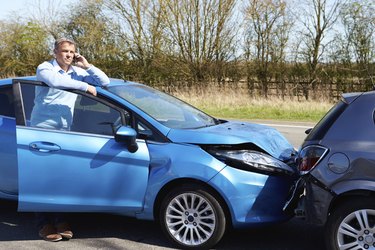
In car accidents, fault is a very big deal. If the evidence shows driver A was responsible, A's insurer may be on the hook for B's damages. In a "no fault" state, medical damages are covered without regard to fault -- but damage to the cars is still fault-based. State laws have specific guidelines for who's at fault in some accidents. In other cases, it's up to the insurance adjuster or maybe a court to decide.
What the Law Says
In some accidents, state law will tell you who's at fault. If you ram a car from behind, most states hold you responsible. Even if the driver in front threw on his brakes without warning and you couldn't help hitting him, you're probably stuck with the blame. If you hit someone while you're making a left turn, the law usually sees that as proof you're at fault. Then again, if you made a legal left turn and the other driver ran a red light, you may be off the hook.
Eyewitnesses and Evidence
If the police show up at the accident -- they don't always do so -- their assessment carries a lot of weight. A cop concluding from physical evidence that one driver was speeding or passing in a no-pass zone counts for more than an untrained observer's conclusions. Photographs taken after the accident may make it easier for an insurance adjuster or a court to assign blame. Eyewitnesses aren't always reliable but their testimony can still help determine responsibility.
What You Should Do
If the police do show up, get the officers' names, and ask how to get a copy of the accident report. Talk to any eyewitnesses, asking for their names and contact information. If they want to volunteer what they saw, write it down while their memory is fresh. Snap photos of the accident scene, your car, and the other car. The one thing you shouldn't do is declare you were at fault. If you're wrong about that, you could influence the police or the other driver's opinion, so stick to objective descriptions of your actions.
The End Result
Unlike a in criminal trial, insurers and judges can assign fault for a car crash based on convincing evidence. It doesn't have to be proof beyond a reasonable doubt. It doesn't have to be 100 percent, either: two drivers may be 50 percent at fault, or one 75 percent at fault, for instance. The effect of being partially responsible depends on state law. In some states, if you're 25 percent at fault, you can recover 75 percent of damages. In a few states, if you have any degree of responsibility, you have no claim against the other driver or his insurer.
-
Understanding Your Options for Canceling a Car Purchase Contract
If a dealership cannot match you up with a bank willing to finance your purchase, the dealer can void the contract you signed and ask that you return the vehicle. If you are the one who needs to get o
-

Free Used Car History Report: What You Need to Know
A car history report can be particularly useful when you're buying a used car. These reports contain important information such as accident history, whether the car was ever declared a lemon, main
car
- Sell Your Junk Car for Cash: A Step-by-Step Guide
- Breaking a Ford Car Lease: Your Rights and Options
- Fundraising Strategies for Car Purchase: A Comprehensive Guide
- Leasing a Car for a Teenager: Options & Considerations
- Car Sale Receipt: Template & Requirements for Buyers & Sellers
- Understanding Car Accident Fault: Liability & Legal Processes
- Obtaining a Car Title: A Step-by-Step Guide
- Smart Strategies for Saving Up for a Car | Financial Planning
- Saving for a New Car: A Step-by-Step Guide
-
 Quickly Access Your Car Insurance Policy: Online Retrieval Guide
When you are unable to locate or access your car insurance policy, one way to retrieve it is to contact your car insurance provider and request that a copy of your policy be mailed to you. If your pol...
-
Negotiating Car Repossession Debt: Minimize Losses & Protect Your Credit
The struggling economy has caused many people around the country to lose their jobs over the past few years. Many of the people who are now without work have car payments that they are struggling to m...