
Yield Farming Explained: A Beginner's Guide to DeFi Income
The process of yield farming involves several steps. Here is a simplified breakdown of the mechanics:
- Select a platform: Choose a DeFi platform that supports yield farming and offers the desired tokens for liquidity provision.
- Provide liquidity: Deposit a pair of crypto tokens into a liquidity pool.
- Receive LP tokens: Upon depositing, you'll receive LP tokens representing your share of the pool. You can stake these tokens on other platforms to generate a secondary yield.
- Staking and yielding: Stake your LP tokens on the same platform or another one offering yield farming. This strategy can yield staking rewards in the form of additional tokens. Yield farming platforms often display rates as annual percentage yield (APY).
- Claim and reinvest: Periodically, yield farmers claim rewards, which are credited to your connected Web3 wallet, and reinvest them to maximize returns.
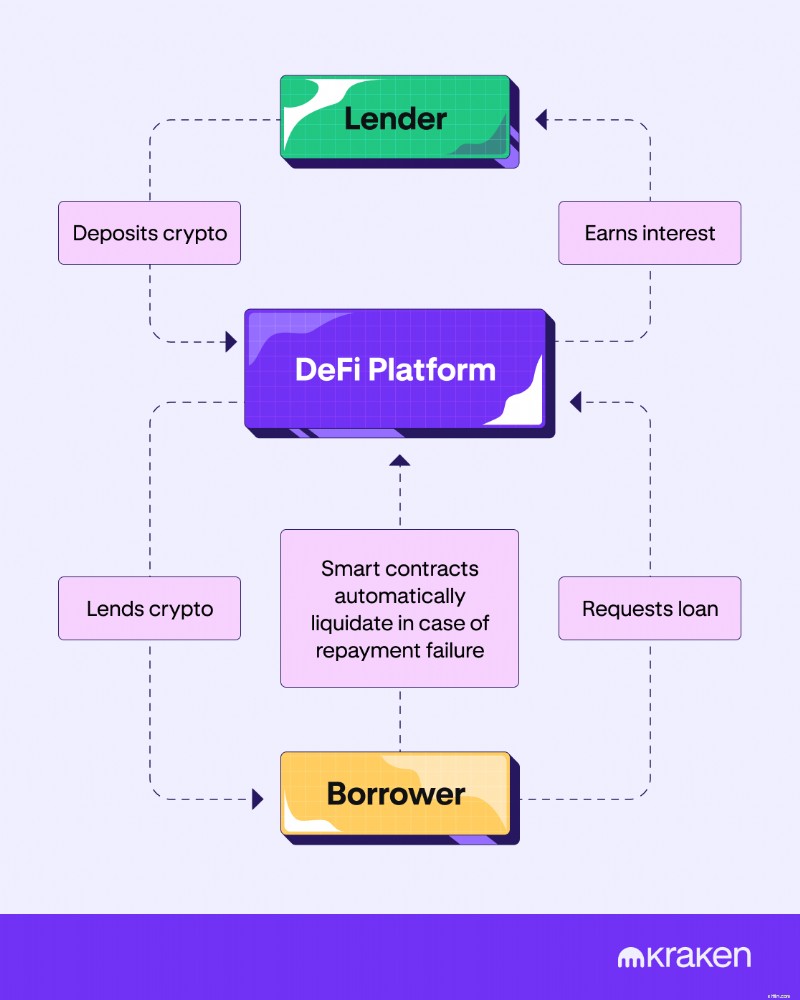
Certain platforms allow LPs to stake their LP tokens, generating secondary yield from their initial farming strategy. To collect earned yields, LP holders must unstake and redeem their tokens. Rewards are automatically credited to their connected crypto wallet.
Successful yield farming requires ongoing management, as rewards, risks and market conditions can change rapidly.
Kraken helps you get started in yield farming and the most exciting parts of DeFi. Get started by signing up for a Kraken account today.
- Unique differentiator: Aave introduced flash loans, which allow users to borrow funds without collateral, provided the loan is repaid within a single transaction.
- Cryptocurrency utility: The AAVE token is used for staking, governance and fee discounts, with holders voting on protocol changes.
- Yield farming benefit: Yield farmers can supply liquidity to Aave pools and earn interest, while some strategies involve borrowing assets to reinvest in higher-yield opportunities.
- Unique differentiator: Interest rates are set by an algorithm that dynamically adjusts supply and demand for each asset.
- Cryptocurrency utility: The COMP token grants governance rights, allowing holders to propose and vote on protocol changes.
- Yield farming benefit: Farmers can earn COMP tokens in addition to interest rewards by supplying or borrowing assets.
- Unique differentiator: Curve’s pools focus on low-volatility assets like stablecoins and wrapped tokens, minimizing risk while ensuring deep liquidity.
- Cryptocurrency utility: The CRV token is used for governance and staking, with holders earning additional rewards for locking tokens in the Curve DAO.
- Yield farming benefit: Liquidity providers earn trading fees and CRV incentives, with the ability to boost yields by locking CRV for veCRV (vote-escrowed CRV).
- Unique differentiator: Uniswap pioneered the AMM model, allowing permissionless token swaps without order books.
- Cryptocurrency utility: The UNI token is used for governance, giving holders a say in protocol upgrades and fee distributions.
- Yield farming benefit: Liquidity providers earn a share of swap fees and can stake LP tokens for additional yield opportunities.
- Unique differentiator: Yearn.finance automates yield farming through smart contract-based vaults, reducing the need for manual management.
- Cryptocurrency utility: The YFI token grants governance rights, allowing holders to vote on protocol changes and revenue distribution.
- Yield farming benefit: Users can deposit funds into Yearn vaults, which auto-compound rewards by reallocating capital to the highest-yield strategies.
Key differences between the two include:
- Management: Staking can be considered more passive, requiring little ongoing action after your crypto is staked. Yield farming needs active management to optimize returns, especially when rebalancing positions or identifying new platforms to earn yield on.
- Rewards: Yield farming typically offers higher rewards, especially from governance tokens and fees, but oftentimes come with a higher risk of loss. Staking rewards may be more predictable and consistent.
For those interested in staking instead of (or alongside) yield farming, staking may offer lower risks and more predictable returns, while yield farming has higher reward potential but greater risks like impermanent loss.
-

Section 199A Deduction & Retirement Accounts: Navigating Complex Tax Rules
If your small business qualifies for the Section 199A deduction, your financial life just became much, much more complicated. Im so sorry. If it makes you feel any better, Im in the same boat. There
-

Small Business Relief Programs & Resources: COVID-19 Support
If you own a small business, you’re probably worried about the effects of the COVID-19 pandemic. In fact, an April 2020 poll by the U.S. Chamber of Commerce and MetLife found 85% o
Digital currency exchange
- Bitcoin Adoption: Industries Driving Mainstream Acceptance
- Develop a Winning Cryptocurrency Trading Strategy: A Step-by-Step Guide
- MACD Indicator for Trading: 5 Strategies for Improved Decision-Making
- Bitcoin for Institutional Investors: Investment Potential in 2021
- Bitcoin Trend Analysis: Proven Methods for Cryptocurrency Investors
- Building a Cryptocurrency Portfolio in 2024: A Strategic Guide
- Global Cryptocurrency Adoption: Top 20 Countries Leading the Way
- Blockchain & Bitcoin: Understanding the Core Connection
- Bitcoin Mining Explained: A Comprehensive Guide to Blockchain Security
-
 Days Inventory Outstanding (DIO): Calculation & Significance
Days inventory outstanding (DIO) is the average number of days that a company holds its inventoryInventoryInventory is a current asset account found on the balance sheet, consisting of all raw ma...
-
 Bank Reconciliation: A Step-by-Step Guide for Businesses
One of the most overlooked steps in the accountin...