
Days Inventory Outstanding (DIO): Calculation & Significance
Days inventory outstanding (DIO) is the average number of days that a company holds its inventoryInventoryInventory is a current asset account found on the balance sheet, consisting of all raw materials, work-in-progress, and finished goods that a before selling it. The days inventory outstanding calculation shows how quickly a company can turn inventory into cash. It is a liquidity metric and also an indicator of a company’s operational and financial efficiency. Days inventory outstanding is also known as “inventory days of supply,” “days in inventory,” or “the inventory period.”

Days Inventory Outstanding Formula
The formula for days inventory outstanding is as follows:
Days Inventory Outstanding = (Average inventory / Cost of sales) x Number of days in period
Where:
- Average inventory = (Beginning inventory + Ending inventory) / 2
- Cost of Sales is also known as Costs of Goods SoldCost of Goods Sold (COGS)Cost of Goods Sold (COGS) measures the “direct cost” incurred in the production of any goods or services. It includes material cost, direct
- Days in Period means the number of days in the period, such as an accounting period, that is being examined – the period may be any time frame – a week, a quarter, or annually
Example of Days Inventory Outstanding
Company A sells several brands of furniture. The manager would like to determine which brands are doing well in terms of inventory turnover. He’s tasked you with determining the days inventory outstanding for several different brands:
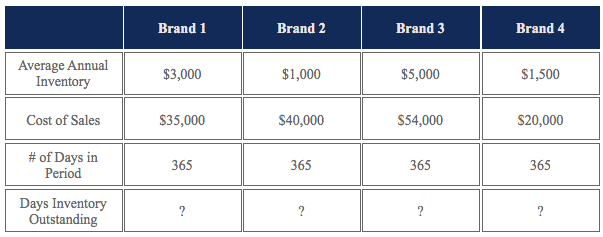
To determine the DIO of each brand:
- DIO Brand 1: ($3,000 / $35,000) x 365 = 31.29 days
- DIO Brand 2: ($1,000 / $40,000) x 365 = 9.13 days
- DIO Brand 3: ($5,000 / $54,000) x 365 = 33.80 days
- DIO Brand 4: ($1,500 / $20,000) x 365 = 27.38 days

From determining the DIO of each brand, you can easily see which brands are doing well relative to other brands. In this case, Brand 2 is doing extremely well, while Brands 1,3, and 4 are all lagging about equally behind. The manager may then meet with the sales and marketing team to try to figure out how to improve sales of those brands. The company might consider dropping Brand 3, the poorest performer, entirely.
Download the Free Template
Enter your name and email in the form below and download the free template now!
Interpretation of Days Inventory Outstanding
A low days inventory outstanding indicates that a company is able to more quickly turn its inventory into sales. Therefore, a low DIO translates to an efficient business in terms of inventory management and sales performance.
A high days inventory outstanding indicates that a company is not able to quickly turn its inventory into sales. This can be due to poor sales performance or the purchase of too much inventory. Having too much idle inventory is detrimental to a company as inventory may eventually become obsolete and unsellable. Holding excess inventory also negatively impacts cash flow.
In financial analysisFinancial Analyst Job DescriptionThe financial analyst job description below gives a typical example of all the skills, education, and experience required to be hired for an analyst job at a bank, institution, or corporation. Perform financial forecasting, reporting, and operational metrics tracking, analyze financial data, create financial models, it is important to compare DIO with the DIO of similar companies within the same industry. For example, companies in the food industry generally have a DIO of around 6, while companies operating in the steel industry have an average DIO of 50. Therefore, comparing DIO between companies in the same industry offers a much better, more accurate and fair, basis for comparison.
Importance of Days Inventory Outstanding
- DIO is a measure of inventory management effectiveness and is used by management to determine how long the company’s stock of inventory typically lasts – how long it takes to convert existing inventory to sales/cash.
- DIO shows the liquidity of inventory. A short DIO means inventory is converted to cash more quickly while a high DIO shows poor inventory liquidity.
- DIO should never be compared across industries, as the DIO varies greatly between industries.
- A lower DIO is generally more favorable than a high DIO.
More Resources
CFI offers the Financial Modeling & Valuation Analyst (FMVA)®Become a Certified Financial Modeling & Valuation Analyst (FMVA)®CFI's Financial Modeling and Valuation Analyst (FMVA)® certification will help you gain the confidence you need in your finance career. Enroll today! certification program for those looking to take their careers to the next level. To keep learning and advancing your career, the following CFI resources will be helpful:
- Inventory TurnoverInventory TurnoverInventory turnover, or the inventory turnover ratio, is the number of times a business sells and replaces its stock of goods during a given period. It considers the cost of goods sold, relative to its average inventory for a year or in any a set period of time.
- Day Sales OutstandingDays Sales Outstanding (DSO)Days Sales Outstanding (DSO) represents the average number of days it takes credit sales to be converted into cash, or how long it takes a
- Accounts ReceivablesAccounts ReceivableAccounts Receivable (AR) represents the credit sales of a business, which have not yet been collected from its customers. Companies allow
- Financial Accounting TheoryFinancial Accounting TheoryFinancial Accounting Theory explains the why behind accounting - the reasons why transactions are reported in certain ways. This guide will
-

Understanding Inventory Age: A Key Metric for Business Efficiency
The average age of inventory represents the average number of days that pass before a company sells its inventory balance. It is an important working capital efficiency metric that is also referred to
-

Inventory Write-Downs: Understanding & Accounting for Value Reduction
An inventory write down is an accounting process used to record the reduction of an inventory’s value and is required when the inventory’s market value drops below its book value on the ba
Accounting
- Inventory Turnover Ratio: Definition & Calculation | AccountingTools
- Understanding Shadow Inventory: What Banks Hold & What It Means for the Market
- Understanding Throughput: A Key Metric for Business Efficiency
- Understanding Days Deduction Outstanding (DDO) & Its Impact
- Understanding Days of Inventory on Hand (DOH): A Comprehensive Guide
- Understanding Days Payable Outstanding (DPO): A Key Metric
- Days Sales Outstanding (DSO): Definition & Calculation
- Understanding Inventory: Definition & Importance in Financial Statements
- Inventory Shrinkage: Causes, Impact & Reconciliation
-
 Understanding Accounts Receivable Aging: A Comprehensive Guide
Accounts receivable aging refers to a management technique used by accountants to evaluate the accounts receivablesAccounts ReceivableAccounts Receivable (AR) represents the credit sales of a business...
-
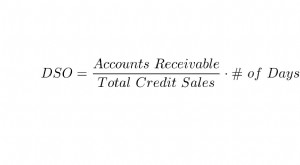 Days Sales Outstanding (DSO): Definition & Calculation
What Is Days Sales Outstanding (DSO)? Days sales outstanding (DSO) is a measure of the average number of days that it takes a company to collect payment for a sale. DSO is often determined on a...