
Understanding Arrears: Definition, Causes & Management
Arrears refers to payments that are overdue and that are supposed to be made at the end of a given period after missing out on the required payments. Total arrears equals the sum of all the payments that have accumulated over time since the first payment was due. The term can be used in relation to various costs such as rent payments, water bills, child support, royalties, dividendsDividendA dividend is a share of profits and retained earnings that a company pays out to its shareholders. When a company generates a profit and accumulates retained earnings, those earnings can be either reinvested in the business or paid out to shareholders as a dividend., loan repayments, etc.
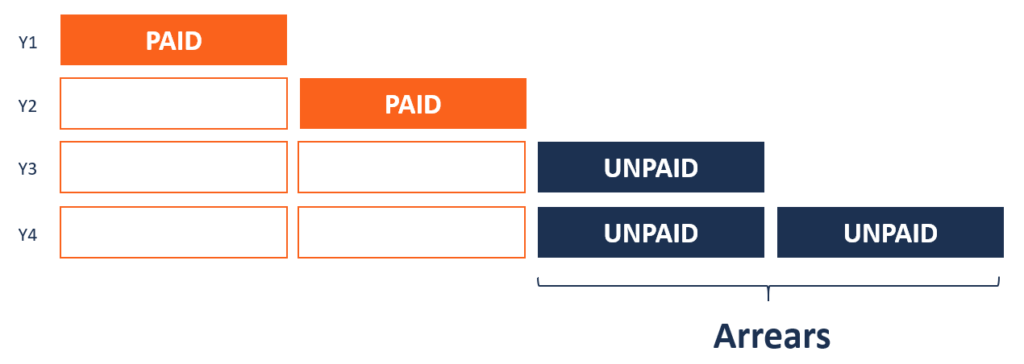
An account can also be said to be in arrears if the service has already been rendered, and the payment is due to be made at the end of the agreed period. For example, an employee is paid a salaryRemunerationRemuneration is any type of compensation or payment that an individual or employee receives as payment for their services or the work that they do for an organization or company. It includes whatever base salary an employee receives, along with other types of payment that accrue during the course of their work, which in arrears because the service must be offered and completed before any payments can be made.
Payment in Arrears
Payment in arrears is a payment that is made once a service has been offered. It differs from payments in advance or past due payments. For salaried employees, payments are made once the service has been delivered by the employee to the employer.
The payment may also be referred to as a singular arrear not classified as a late payment. Other examples of payments in arrears include postpaid phone service, postpaid water bills, postpaid electricity bills, property taxes, etc.
Payment in Advance
Payment in advance is made before the actual service has been provided. An example of a payment in advance is rent, which is paid at the start of the month. If a tenant fails to honor the payment at the start of the month and makes the payment one month later, the payment is said to be one month in arrears.
Other examples of payments that are made in advance include insurance premiums, internet service bills, prepaid phone service, lease, prepaid electricity bills, etc.
How the Term “Arrears” is Used?
1. Call-in arrears
Call-in arrears refers to the amount that a defaulter shareholder has not paid on the call money by the due date. It is calculated by deducting the paid-up capital from the called-up capital. The issuer may recover the unpaid call money if the received shares are forfeited. If there is no difference between the called up capitalNet Working CapitalNet Working Capital (NWC) is the difference between a company's current assets (net of cash) and current liabilities (net of debt) on its balance sheet. and the paid-up capital, the call-in arrears will be zero.
2. Annuities in arrears
Arrears also apply in the financial industry when making annuity payments. An annuityAnnuityAn annuity is a financial product that provides certain cash flows at equal time intervals. Annuities are created by financial institutions, primarily life insurance companies, to provide regular income to a client. is a transaction that occurs in equal intervals and in equal amounts over a defined period of time. For example, an annuity transaction may involve equal payments of $300 over a period of 10 years.
If the annuity payment is made at the end of a fixed period rather than at the start, it is referred to as an annuity in arrears or an ordinary annuity.
3. Dividend in arrears
The concept of arrears also applies when a publicly-traded company issues dividends to its investors. It occurs when the company delays in paying the cumulative dividends to its preferred stockholders by the agreed date. Preferred stockholders are a type of stockholders that must be paid regardless of whether the company makes profits or not.
The delay in dividend payments to the preferred stockholders occurs because the company lacks sufficient cash flow to pay the dividends, and therefore, the dividend may not be authorized by the board of directorsBoard of DirectorsA board of directors is a panel of people elected to represent shareholders. Every public company is required to install a board of directors.. Information about the dividends in arrears is recorded in the notes to the financial statements.
When dividends are in arrears, there is usually a legal agreement between the preferred stockholders and the management that prevents the company from paying dividends to ordinary stockholders. Also, the company may be restricted from using cash during the period when the dividends are in arrears.
If the company’s financial situation improves in the future, the board of directors will authorize the payment of all or a portion of the cumulative dividends. Preferred stockholders must be paid first before any payments are made to common stockholders. The paid dividends will be recorded as a short-term liability in the balance sheet.
Arrears Swap in Derivatives
An arrears swap is a type of interest rate swapInterest Rate SwapAn interest rate swap is a derivative contract through which two counterparties agree to exchange one stream of future interest payments for another that sets and pays the interest rate at the end of the coupon period, rather than in the beginning. On the contrary, a standard swap sets the interest rate at the beginning and pays the interest at the end.
An arrears swap is preferred by speculators who predict the yield curve and receive interest payments at the end of the coupon period. The interest reflects the timeliness of the predictions they made at the start of the coupon period.
Related Readings
CFI offers the Financial Modeling & Valuation Analyst (FMVA)™Become a Certified Financial Modeling & Valuation Analyst (FMVA)®CFI's Financial Modeling and Valuation Analyst (FMVA)® certification will help you gain the confidence you need in your finance career. Enroll today! certification program for those looking to take their careers to the next level. To keep learning and advancing your career, the following CFI resources will be helpful:
- InsolvencyInsolvencyInsolvency refers to the situation in which a firm or individual is unable to meet financial obligations to creditors as debts become due. Insolvency is a state of financial distress, whereas bankruptcy is a legal proceeding.
- Loan CovenantLoan CovenantA loan covenant is an agreement stipulating the terms and conditions of loan policies between a borrower and a lender. The agreement gives lenders leeway in providing loan repayments while still protecting their lending position. Similarly, due to the transparency of the regulations, borrowers get clear expectations of
- Revolving Credit FacilityRevolving Credit FacilityA revolving credit facility is a line of credit that is arranged between a bank and a business. It comes with an established maximum amount, and the
- US Bankruptcy CodeUS Bankruptcy CodeThe US Bankruptcy Code is also referred to as Title 11 of the United States Code, and it governs the procedure that businesses and individuals follow
-

PC Banking: A Comprehensive Guide to Online Banking Security & Features
PC banking refers to a person being able to access their banking information from a "personal computer." It has become a popular method for people to manage money and pay bills using online
-
IRA CDs: Secure Retirement Savings with FDIC Insurance
An Individual Retirement Account, referred to as an IRA, offers tax advantages to help you save for retirement. An IRA acts like a basket to hold different types of investments and assets. One of the
finance
- Understanding 'Paid in Arrears': Definition & Examples
- Advance Payment Explained: Definition, Purpose & Structure
- Automatic Bill Payment: A Comprehensive Guide
- Understanding Down Payments: A Comprehensive Guide
- Online Payment Companies: A Comprehensive Guide
- Understanding Payment Processing Fees: A Comprehensive Guide
- Principal Payments Explained: Understanding Loan Repayment
- Stop Payment Orders: Definition, Process & How to Request
- Single Payment Loans: Definition, How They Work & Key Features
-
 Understanding Expired Payments on PayPal: What to Do
A woman is shopping online. When you pay for something with your PayPal account, you can follow the processing of your payment through the "Status" column in your account overview. ...
-
Understanding Unearned Premiums in Insurance: A Comprehensive Guide
Unearned Premium refers to the amount of an insurance premium that is paid in advance. It has not been earned by the insurer until the period for the payment has been reached. For example, if an...