
Understanding the Asian Financial Crisis: Causes, Impact, and Lessons Learned
The Asian Financial Crisis is a crisis caused by the collapse of the currency exchange rate and hot money bubble. It started in Thailand in July 1997 and swept over East and Southeast Asia. The financial crisis heavily damaged currency values, stock marketsNew York Stock Exchange (NYSE)The New York Stock Exchange (NYSE) is the largest securities exchange in the world, hosting 82% of the S&P 500, as well as 70 of the biggest, and other asset prices in many East and Southeast Asian countries.
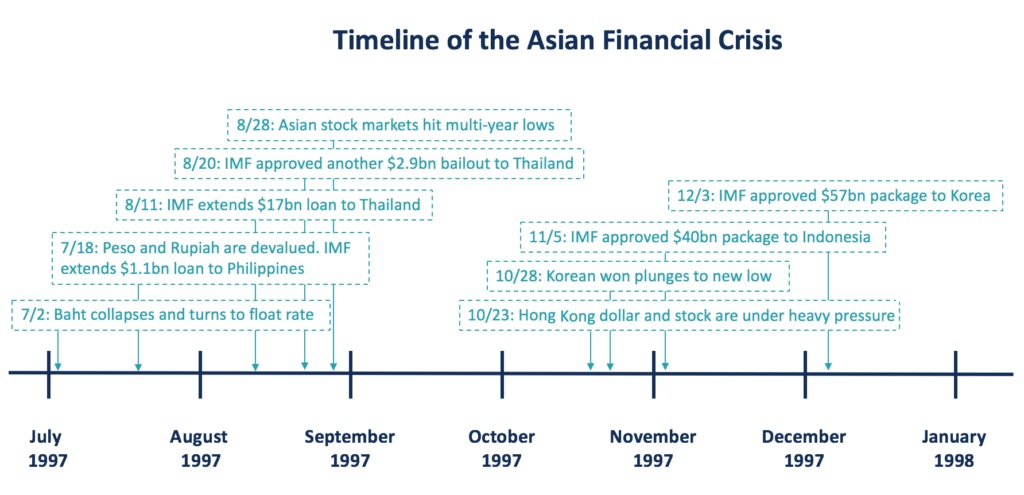
On July 2, 1997, the Thai government ran out of foreign currency. No longer able to support its exchange rate, the government was forced to float the Thai baht, which was pegged to the U.S. dollar before. The currency exchange rateFixed vs. Pegged Exchange RatesForeign currency exchange rates measure one currency's strength relative to another. The strength of a currency depends on a number of factors such as its inflation rate, prevailing interest rates in its home country, or the stability of the government, to name a few. of the baht thus collapsed immediately.
Two weeks later, the Philippian peso and Indonesian rupiah underwent major devaluations as well. The crisis spread internationally, and Asian stock markets plunged to their multi-year lows in August. The capital market of South Korea maintained relatively stable until October. However, the Korean won dropped to its new low on October 28th, and the stock market experienced its biggest one-day drop to that date on November 8th.
Summary
- The Asian Financial Crisis is a crisis caused by the collapse of the currency exchange rate and hot money bubble.
- The financial crisis started in Thailand in July 1997 after the Thai baht plunged in value. It then swept over East and Southeast Asia.
- As a result of the financial crisis, currency values, stock markets, and other asset values in many Southeast Asian countries collapsed.
Causes of the Asian Financial Crisis
The causes of the Asian Financial Crisis are complicated and disputable. A major cause is considered to be the collapse of the hot money bubble. During the late 1980s and early 1990s, many Southeast Asian countries, including Thailand, Singapore, Malaysia, Indonesia, and South Korea, achieved massive economic growth of an 8% to 12% increase in their gross domestic product (GDP)Gross Domestic Product (GDP)Gross domestic product (GDP) is a standard measure of a country’s economic health and an indicator of its standard of living. Also, GDP can be used to compare the productivity levels between different countries.. The achievement was known as the “Asian economic miracle.” However, a significant risk was embedded in the achievement.
The economic developments in the countries mentioned above were mainly boosted by export growth and foreign investment. Therefore, high interest rates and fixed currency exchange rates (pegged to the U.S. dollar) were implemented to attract hot money. Also, the exchange rate was pegged at a rate favorable to exporters. However, both the capital market and corporates were left exposed to foreign exchange risk due to the fixed currency exchange rate policy.
In the mid-1990s, following the recovery of the U.S. from a recession, the Federal ReserveFederal Reserve (The Fed)The Federal Reserve is the central bank of the United States and is the financial authority behind the world’s largest free market economy. raised the interest rate against inflation. The higher interest rate attracted hot money to flow into the U.S. market, leading to an appreciation of the U.S. dollar.
The currencies pegged to the U.S. dollar also appreciated, and thus hurt export growth. With a shock in both export and foreign investment, asset prices, which were leveraged by large amounts of credits, began to collapse. The panicked foreign investors began to withdraw.
The massive capital outflow caused a depreciation pressure on the currencies of the Asian countries. The Thai government first ran out of foreign currency to support its exchange rate, forcing it to float the baht. The value of the baht thus collapsed immediately afterward. The same also happened to the rest of the Asian countries soon after.
Effects of the Asian Financial Crisis
The countries that were most severely affected by the Asian Financial Crisis included Indonesia, Thailand, Malaysia, South Korea, and the Philippines. They saw their currency exchange rates, stock markets, and prices of other assets all plunge. The GDPs of the affected countries even fell by double digits.
From 1996 to 1997, the nominal GDP per capita dropped by 43.2% in Indonesia, 21.2% in Thailand, 19% in Malaysia, 18.5% in South Korea, and 12.5% in the Philippines. Hong Kong, Mainland China, Singapore, and Japan were also affected, but less significantly.
Besides its economic impact, the Asian Financial Crisis also resulted in political repercussions. The Prime Minister General of Thailand, Yongchaiyudh, and the President of Indonesia, Suharto, resigned. An anti-Western sentiment was triggered, especially against George Soros, who was blamed for triggering the crisis with large amounts of currency speculation by some individuals.
The impact of the Asian Financial Crisis was not limited to Asia. International investors became less willing to invest in and lend to developing countries, not only in Asia in other areas of the world. Oil prices also fell due to the crisis. As a result, some major mergers and acquisitions in the oil industry took place to achieve economies of scale.
IMF’s Role in the Asian Financial Crisis
The International Monetary Fund (IMF) is an international organization that promotes global monetary cooperation and international trades, reduces poverty, and supports financial stability. The IMF generated several bailout packages for the most affected countries during the financial crisis. It provided packages of around $20 billion to Thailand, $40 billion to Indonesia, and $59 billion to South Korea to support them, so they did not default.
The bailout packages are structural-adjustment packages. The countries that received the packages were asked to reduce their government spending, allow insolvent financial institutions to fail, and raise interest rates aggressively. The purpose of the adjustments was to support the currency values and confidence over the countries’ solvency.
Lessons Learned from the Asian Financial Crisis
One lesson that many countries learned from the financial crisis was to build up their foreign exchange reserves to hedge against external shocks. Many Asian countries weakened their currencies and adjusted economic structures to create a current account surplus. The surplus can boost their foreign exchange reserves.
The Asian Financial Crisis also raised concerns about the role that a government should play in the market. Supporters of neoliberalism promote free-market capitalism. They considered the crisis as a result of government intervention and crony capitalism.
The conditions that IMF set within their structural-adjustment packages also aimed to weaken the relationship between the government and capital market in the affected countries, and thus to promote the neoliberal model.
More Resources
CFI is the official provider of the global Commercial Banking & Credit Analyst (CBCA)™Program Page - CBCAGet CFI's CBCA™ certification and become a Commercial Banking & Credit Analyst. Enroll and advance your career with our certification programs and courses. certification program, designed to help anyone become a world-class financial analyst. To keep advancing your career, the additional resources below will be useful:
- 2008-2009 Global Financial Crisis2008-2009 Global Financial CrisisThe Global Financial Crisis of 2008-2009 refers to the massive financial crisis the world faced from 2008 to 2009. The financial crisis took its toll on individuals and institutions around the globe, with millions of American being deeply impacted. Financial institutions started to sink, many were absorbed by larger entities, and the US Government was forced to offer bailouts
- Black MondayBlack Monday"Black Monday" – as it is referenced today – took place on October 19 (a Monday) in 1987. On this day, stock markets around the world crashed, though the
- 2010 Flash Crash2010 Flash CrashThe 2010 Flash Crash is the market crash that occurred on May 6, 2010. During the 2010 crash, leading US stock indices, including the Dow
- The Great DepressionThe Great DepressionThe Great Depression was a worldwide economic depression that took place from the late 1920s through the 1930s. For decades, debates went on about what caused the economic catastrophe, and economists remain split over a number of different schools of thought.
-

Legal Guardian Financial Responsibilities: A Comprehensive Guide
A legal guardian is a person who has been legally appointed to care for the personal and/or financial interests of another person. Typically, a guardian is the parent of a child, but that isn't tr
-

Understanding Foreign Exchange: Impact on Investment & Economy
Currency is essentially a commodity. Foreign exchange is important for one major reason: it determines the value of foreign investment. A volatile exchange rate discourages foreign investment
finance
- Understanding the 2008-2009 Global Financial Crisis: Causes & Impact
- Asset-Liability Committee (ALCO): Definition & Risk Management
- Basel Accords: Understanding Banking Regulations & Credit Risk
- Understanding the CAPE Ratio: A Guide to Cyclically Adjusted P/E
- Common Size Ratios: Understanding and Application
- Dodd-Frank Act Explained: Impact & Key Provisions
- Understanding Financial Crises: Causes, Impacts, and Examples
- Understanding the Financial Sector: Institutions and Services
- Understanding the Asian Financial Crisis: Causes & Impact
-
 Understanding Forex Spreads: A Comprehensive Guide
The foreign exchange spread (or bid-ask spread) refers to the difference in the bid and ask prices for a given currency pair. The bid price refers to the maximum amount that a foreign exchange trader5...
-
 MiFID Explained: Understanding Financial Market Transparency in the EU
The Markets in Financial Instruments Directive (MiFID) is a European Union regulatory framework that exerts a higher degree of transparency in the operation of financial marketsFinancial MarketsFinanc...