
Budgeting Explained: A Comprehensive Guide for Individuals & Businesses
A budget is an estimation of future revenues and expenses for a certain period. The budgeting process creates plans to make expenses or allocate resources. It can be made for an individual, project, business, government, or other organizations.
Summary
- A budget is an estimation of future revenues and expenses, which helps to plan for future expenses or allocation of resources for a certain period.
- A personal budget depends on the individual’s standard of living, age, lifestyle, personal preferences, and so on.
- A corporate budget depends on a series of assumptions and aligns with the firm’s business strategy and objective.
Understanding Budgets
Based on the concept of limited resources, it is common for individuals and organizations to create budgets to allocate their incomes or capital efficiently. It is a process of creating financial plans for a specific period, which can be a month, a year, or the term of a project.
Budgeting is important for individuals to achieve financial success, as well as for organizations to complete projects and operate successively.
Budgets can be either flexible or static. A static budget keeps constant without adjustments over the entire budgeting term. Personal budgets are usually static. Budgets depend on assumptions and estimation of future incomes.
Changes in relevant factors such as economic conditionsEconomic ConditionsEconomic conditions are the present state of affairs in the overall economy of a country or geographical region. Economic conditions evolve will cause changes in these assumptions, and the original budget might not be appropriate anymore.
A flexible budget can adapt to the changing variables. It is usually created by corporates and designed to move along with the changing industry indicators, sales levels, production level, as well as other internal and external factors.
Surplus, Balanced, and Deficit Budgets
Based on the relationship between estimated incomes and expensesExpensesAn expense is a type of expenditure that flows through the income statement and is deducted from revenue to arrive at net income. Due to the, budgets can be categorized into surplus, balanced, and deficit ones.
Surplus Budget
A surplus budget is a plan with incomes exceeding expenditures during a certain period. In surplus budgets, expenses can be fully covered by incomes, and the residuals can be saved for future use.
The term “surplus:” is often used by governments. It indicates the government will not run out of their tax revenues and other incomes in that year. For individuals, a surplus budget allows them to make savings.
Balanced Budget
Expenditures are planned to be equal to incomes in a balanced budget. There will be neither residuals nor the need to borrow.
Deficit Budget
In a deficit budget, expenditures cannot be fully covered by incomes for that period. If a company is running under a budget deficit, it has to finance the deficit by issuing bondsBondsBonds are fixed-income securities that are issued by corporations and governments to raise capital. The bond issuer borrows capital from the bondholder and makes fixed payments to them at a fixed (or variable) interest rate for a specified period. or stocks. If an individual has a budget deficit, they can withdraw their savings or borrow from others.
A government usually has a deficit during economic recessions, as it intends to boost the economy by pumping money into the market.
Personal Budgets
Personal budgets help individuals and families to determine how to spend their incomes to fulfill their daily needs and wants while maintaining financial health. Budgets vary for individuals, and there is no unified standard.
The factors that impact personal budgets include the average cost of living in a city, an individual’s income level, lifestyle, and personal preferences.
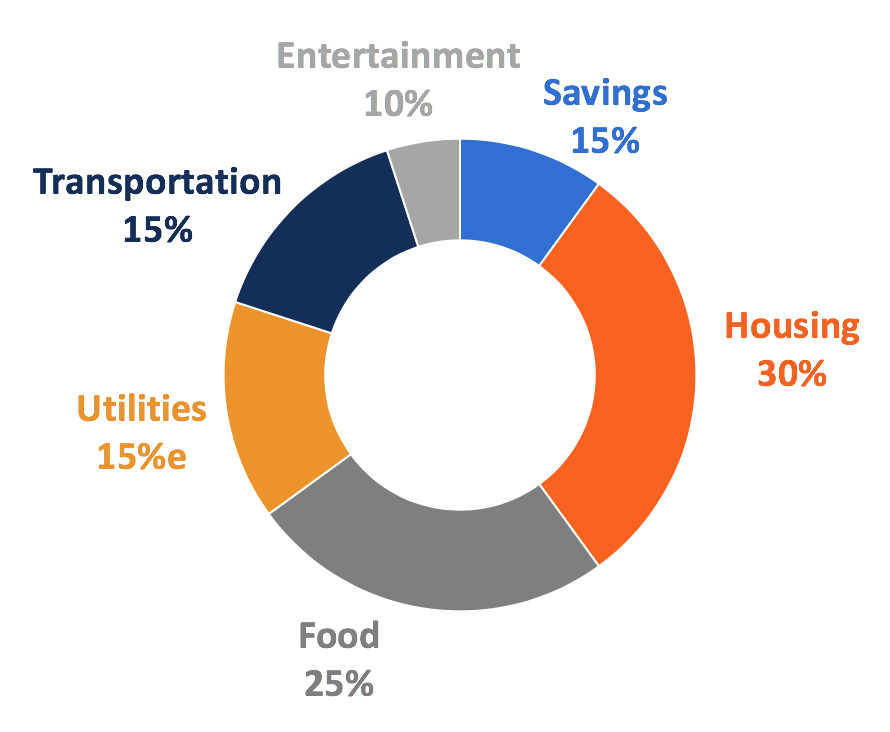
The personal budgeting process usually starts with determining the costs on necessities – such as housing (rentals or mortgage payments), food, transportation, and utilities. Most individuals also keep a certain portion for savings or investments. The rest of the income can be spent on dining out, movies, shopping, and other entertainments.
A commonly used personal budgeting principle is the “50-20-30” rule. It suggests spending 50% of an individual’s after-tax income on necessities, 30% on entertainment or other unnecessary events, and save the rest 20% for future needs or investments.
Corporate Budgets
A company’s corporate budget generally aligns with its business strategy and objective. The budget developing process starts with a set of assumptions, including the economic outlook, industry trend, sales trend, relationship with suppliers and distributors, and so on.
Based on the assumptions, sales budgets can be developed. Companies with several subsidiaries or product lines might budget the sales for them, respectively.
Sales budgeting allows firms to forecast their future cash flows. Combining the information of future cash flows, historical expenses, assumptions of future trends, and business strategies, companies can budget their expenses.
If a company realizes that it will not be able to cover its expenses with future cash flows, it might need to consider borrowing and budget the interest expenses.
Government Budgets
A government budget comprises government incomes – such as tax revenues – as well as government expenditures, including infrastructure facilities, public health care insurance plans, and costs to run different departments.
A government usually runs under budget surplus during economic expansions with increasing tax revenues. A budget deficit often appears during recessions, as the government intends to cut taxes and inject cash into the market.
More Resources
CFI offers the Commercial Banking & Credit Analyst (CBCA)™Program Page - CBCAGet CFI's CBCA™ certification and become a Commercial Banking & Credit Analyst. Enroll and advance your career with our certification programs and courses. certification program for those looking to take their careers to the next level. To keep learning and developing your knowledge base, please explore the additional relevant resources below:
- Income vs Revenue vs EarningsIncome vs Revenue vs EarningsIncome, revenue, and earnings are probably the three most widely used concepts in accounting and finance. All the terms denote measures of a
- Budget DeficitBudget DeficitA budget deficit occurs when government expenditures exceed revenues from taxes and other sources. It is most commonly applied to government budgets.
- Government SpendingGovernment SpendingGovernment spending refers to money spent by the public sector on the acquisition of goods and provision of services such as education,
- Investment PortfolioInvestment PortfolioAn investment portfolio is a set of financial assets owned by an investor that may include bonds, stocks, currencies, cash and cash equivalents, and commodities. Further, it refers to a group of investments that an investor uses in order to earn a profit while making sure that capital or assets are preserved.
-

Zero-Based Budgeting (ZBB): A Comprehensive Guide
Zero-based budgeting (ZBB) is a budgeting technique that allocates funding based on efficiency and necessity rather than budget historyFiscal Year (FY)A fiscal year (FY) is a 12-month or 52-week perio
-

Back-to-School Savings: Budget-Friendly Tips & Free Printables
The long summer days are coming to an end soon, which means that back-to-school season is almost upon us. While back-to-school shopping might be a source of excitement for the little ones
finance
- Program Budget: Definition, Importance & Creation
- Understanding Budget Constraints: A Comprehensive Guide
- Rollover Budget: How It Works & Benefits for Financial Planning
- Advertising Budget: Definition, Planning & Best Practices
- Understanding Balanced Budgets: Definition & Importance
- Understanding Budget Deficits: Causes, Effects & Solutions
- Budget Variance Explained: Causes, Types & Analysis
- Negotiated Budgeting: A Collaborative Approach to Financial Planning
- Project Budget: Definition, Template & Cost Estimation
-
 Top-Down Budgeting: Definition, Advantages & Disadvantages
Top-down budgeting refers to a budgeting method where senior managementCorporate StructureCorporate structure refers to the organization of different departments or business units within a company. De...
-
 Budget Deficit Explained: Causes, Effects & Solutions
If you pay attention to politics, work for a company, or are around accountants often, you’ve probably heard of a budget deficit. While the way people talk about budget deficits make them...