
Top-Down Budgeting: Definition, Advantages & Disadvantages
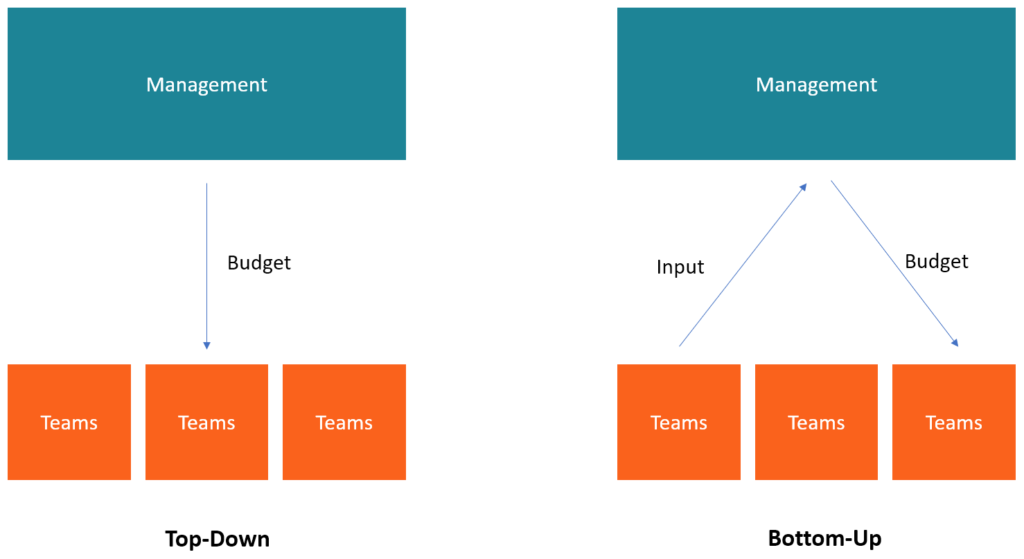
Top-down budgeting refers to a budgeting method where senior managementCorporate StructureCorporate structure refers to the organization of different departments or business units within a company. Depending on a company’s goals and the industry prepares a high-level budget for the company. The company’s senior management prepares the budget based on its objectivesCorporate StrategyCorporate Strategy focuses on how to manage resources, risk and return across a firm, as opposed to looking at competitive advantages in business strategy and then passes it on to department managers for implementation.
Sometimes, the managers may put forward suggestions for the budget before the budget preparation. Whether their contribution to the budgeting process will be used or not is at the management’s discretion. After the budget is created, the management makes specific allocations to the different departments, which must then create their own budgets based on their budget allocation and goals.
Learn more in CFI’s Budgeting and Forecasting Course.
During top-down budgeting, the company’s management considers past experiences and current market conditions. They use the previous year’s budget and financial statementsThree Financial StatementsThe three financial statements are the income statement, the balance sheet, and the statement of cash flows. These three core statements are as a benchmark for making allocations to departments and functions. Senior management may take inputs from lower-level managers, which helps acknowledge the concerns of the regular staff who are tasked with implementing the budget. They also consider internal and external influences such as prevailing economic conditions, changes in tax legislation, margin pressure, increase/decrease in salary costsSG&ASG&A includes all non-production expenses incurred by a company in any given period. It includes expenses such as rent, advertising, marketing, profitability levels of their peers, etc.
The Top-Down Budgeting Process
The top-down budgeting process starts with senior management meeting to come up with the objectives for the year. They discuss and determine high-level targets for the company in terms of sales, expenses, and profits. When formulating these figures, the management takes into account the contribution of each department in the previous year’s revenues. Usually, department managers and lower-level staff do not participate in the meetings but may put forward suggestions for consideration. Once management finishes preparing the targets, the objectives are passed on to the finance department.
Budget Allocations to Departments
The finance department is tasked with making allocations to departments. The department may use the previous year’s figures to split the allocations. For example, if the marketing department incurred 10% of the overall expenses during the previous year, then the finance department may allocate 10% of the total expenditure estimates for the next year.
The allocation may be higher or lower depending on what the departmental managers presented to the senior management. For example, if the company plans to roll-out a new product into the market, the finance department may increase the budget allocation for the marketing department to cover the promotional costs of the new product.
Department-level Budgets
Once the finance department assigns allocations to the various departments, department managers take the targets and prepare a budget of their own. Ideally, the work of the department manager is to take the revenue and cost estimates and develop a budget that shows how the department will spend the allotted funds to generate the desired revenues.
Department-level budgets should include the specifics of expected expenditures, e.g., purchasing computers and office equipment, and salaries, as well as the projected number of products that the department aims to sell to generate revenues.
Harmonization of Departmental Budgets
Each department within the organization is then required to submit their budgets to the finance department for harmonization. The finance department reviews the department budgets to make sure they are aligned with the overall objectives of the company. If there are departments with insufficient or excess budgets, the finance department may send the budgets back for revision, and the allocations may be adjusted upwards or downwards.
Once the department budgets are completed and finalized, they are loaded onto the financial system to track monthly expenditures. Management deploys resources based on targets set by the budget. The departments receive monthly or periodic reports to show the amount of expenses incurred from the allocated budget, as well as the revenues generated vis-à-vis the department’s targets.
Advantages of Top-Down Budgeting
- The budget features an overall corporate functional approach because senior management is concerned with the overall growth of the organization. It allows management to allocate resources to departments with a view to propelling the growth of the company, starting with the most critical departments.
- Top-down budgeting saves time for lower management. Rather than spending time creating a budget from scratch, lower-level managers are given an already-formulated budget to implement. This saves both time and resources that the managers would’ve had to use to formulate the budget.
- Top-down budgeting creates one budget at a time, rather than allowing departments to develop their budgets and later combining them. As a result, the budgeting process will be less tedious, since senior management will formulate a single budget that the departments will follow. The departments are only allowed to create their budgets based on the targets set by the original budget from the top management. This makes the budget process quicker than bottom-up budgeting.
Disadvantages of Top-Down Budgeting
- The level of motivation decreases since the managers who are required to implement the budget do not own the budget-making process. The managers do not take part in the preparation of the budget and may, therefore, lack incentive to ensure its success.
- Senior managers are not involved in the day-to-day operations of individual departments, so they may not have realistic expectations of the expenses related to each department. Therefore, lower-level managers may find it difficult to implement the budget because they are unaware of how the top management arrived at the set targets. Also, the budget may be inaccurate since the targets for revenues and costs may be overstated or understated.
Bottom-Up Budgeting
Unlike top-down budgeting, bottom-up budgeting starts at the department level and moves up to the top management. The departmental heads/managers prepare their budget based on present information and past experiences and present it to senior management for approval. They take into account margin pressures and market conditions to make the budget more realistic and attainable. The budget presented to top management contains an explanation of each item indicated in the budget.
Related Reading
Thank you for reading CFI’s explanation of top-down budgeting. CFI is a global provider of financial analyst training and career advancement for finance professionals, including the Financial Modeling & Valuation Analyst (FMVA)™Become a Certified Financial Modeling & Valuation Analyst (FMVA)®CFI's Financial Modeling and Valuation Analyst (FMVA)® certification will help you gain the confidence you need in your finance career. Enroll today! certification program. To learn more and expand your career, explore the additional relevant CFI resources below.
- Budget HeadBudget HeadThe person who is ultimately responsible for the framing and creation of the Budget for a project is known as the Budget Head for that project. The Budget itself is a document that lists the expected revenues and expenditures associated with a project.
- Operating BudgetOperating BudgetAn operating budget consists of revenues and expenses over a period of time, typically a quarter or a year, which a company uses to plan its operations. Download the Free Excel Template. The monthly budgeting template has a column for each month and totals to be the full year annual figures
- Zero-based BudgetingZero-Based BudgetingZero-based budgeting (ZBB) is a budgeting technique that allocates funding based on efficiency and necessity rather than on budget history
- Guide to Financial ModelingFree Financial Modeling GuideThis financial modeling guide covers Excel tips and best practices on assumptions, drivers, forecasting, linking the three statements, DCF analysis, more
-
Business Budgeting: A Comprehensive Guide to Planning & KPIs
Budgeting is the tactical implementation of a business plan. To achieve the goals in a business’s strategic planCorporate StrategyCorporate Strategy focuses on how to manage resources, risk and
-
![Budgeting Software: Types, Features & Comparison - [Year]](https://www.etffin.com/article/uploadfiles/202110/2021100815344465_S.jpeg)
Budgeting Software: Types, Features & Comparison - [Year]
Budgeting software is any computer program that helps an individual or business design, manage, monitor and alter their budgetTypes of BudgetsThere are four common types of budgeting methods that comp
finance
- Understanding Balanced Budgets: Definition & Importance
- Bottom-Up Budgeting: A Comprehensive Guide
- Imposed Budgeting: Definition, Pros & Cons | [Your Company Name]
- Negotiated Budgeting: A Collaborative Approach to Financial Planning
- Output/Input Budgeting: A Comprehensive Guide
- Participative Budgeting: Definition, Benefits & Implementation
- Zero-Based Budgeting (ZBB): A Comprehensive Guide
- Zero-Based Budgeting: A Comprehensive Guide for Businesses
- Incremental Budgeting: Pros, Cons & Why It's Often Problematic
-
 Advertising Budget: Definition, Planning & Best Practices
An advertising budget is a company’s allocation of promotional expenditures over a specified time period. It is a measure of a company’s planned expenditure on accomplishing marketing obje...
-
 Understanding Budget Deficits: Causes, Effects & Solutions
A budget deficit occurs when government expenditures exceed revenues from taxes and other sources. Although the concept of a budget deficit applies to any organization with operating revenues and expe...