
Currency Basket Explained: Diversification & Risk Management
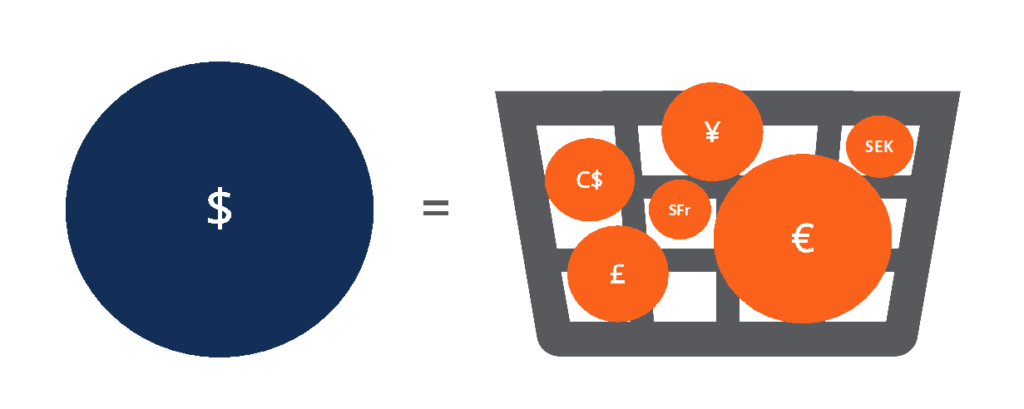
A currency basket is a portfolio of various currencies that are weighted against a chosen currency. The weighted value can be used to determine the market value of a chosen currency or by investors to reduce currency risk.
Summary
- A currency basket is a portfolio of various currencies with different weightings. It is useful for reducing foreign exchange volatility and valuing a chosen currency.
- Choosing currencies and their relative weights are subject to the purpose of the currency basket.
- The contents of the basket can be adjusted to reflect changes in exchange rates and expectations over time.
Making a Currency Basket
Choosing Currencies
For any given currency basket, the currency components are chosen according to the purpose of the basket. Investors looking to mitigate their currency risk may choose stable, liquid currencies. On the other hand, investors looking to value the chosen currency may choose criteria related to the country of the currency.
For example, the currency basket on the US dollar (USDX) includes the currencies of the biggest trading partners of the U.S. Any number of criteria could be used at the judgment of the basket creator.
Choosing Weights
The process of choosing the ratio of each currency or relative weight is also subject to the purpose of the currency basket. Investors may choose a basket of currencies they believe are stable since their objective is to minimize currency risk. The outlook on currency performance can be based on several factors, such as inflationInflationInflation is an economic concept that refers to increases in the price level of goods over a set period of time. The rise in the price level signifies that the currency in a given economy loses purchasing power (i.e., less can be bought with the same amount of money)., interest rates, risk events, and more.
For valuation, weightings are aligned with how the currencies are chosen. Referring back to the USDX, the weights of the currencies are assigned according to the various countries’ importance of trade with the U.S. Since Europe is the U.S.’ biggest trade partner, the USDX weighs the euro at 57.6% of the currency basket.
Using a Currency Basket
Reducing Currency Risk
Investors abroad are continually exposed to foreign currency risk. This means that on top of the performance of their asset, the conversion back into the home currency can erase profits or even worsen losses if the exchange rate proves to be unfavorable. To reduce foreign currency exposure, investors can create a currency basket to generate diversification. Doing so takes out the idiosyncratic (diversifiable) riskIdiosyncratic RiskIdiosyncratic risk, also sometimes referred to as unsystematic risk, is the inherent risk involved in investing in a specific asset – such as a stock – the associated with investing with a single currency.
As expected, currencies within the basket may also move unfavorably; however, the smaller weights and diversified currencies with low correlation will have less of a negative impact than only holding one currency.
Valuing Currency
Valuation using a currency basket is built on the basis that a currency can derive value by its worth to other currencies. Under the gold standard and the subsequent Bretton Woods system, all currencies were pegged to gold and the US dollar, respectively. Pegged currencies are easy to value because their value moves with the asset it is fixed to.
Following the dissolution of the Bretton Woods systemBretton Woods AgreementThe Bretton Woods Agreement was reached in a 1944 summit held in New Hampshire, USA on a site by the same name., many global currencies decided to adopt a floating rate. The floating rate system creates more uncertainty because each floating currency is subject to multiple factors that affect its movements. On the other hand, under a fixed rate, all currencies moved with the fixed asset. Currency baskets are useful for valuing currencies under a floating rate which removes biases inherent with comparing individual currency pairs.
For example, if we compare the USD/CAD exchange rate, we may find that the USD appreciated against the CAD over a certain time horizon and conclude that the USD rose in value. However, it turns out that the USD depreciated against most other currencies, actually declining in value overall.
Because the CAD depreciated even more against other currencies, the larger depreciation of the CAD relative to the smaller depreciation of the USD looks like a rise in the USD’s value. A currency basket provides an aggregate view of performance, eliminating wrong conclusions associated with comparing single currency pairs.
Adjusting Currency Baskets
Currency baskets can be easily adjusted by adding or removing currencies and adjusting weights according to needs. Interestingly, the USDX only made one adjustment since its inception in 1973, despite currencies such as the Swedish krona’s and the Swiss francSwiss Franc (CHF)The Swiss franc refers to Switzerland’s national currency and is represented by ISO code CHF. It was formally recognized as Switzerland's‘s increasingly small role in the US trades. The newer trade-weighted US index (or broad index) may be a better interpretation of the US dollar’s value since its weightings and currencies are updated yearly.
More Resources
CFI offers the Commercial Banking & Credit Analyst (CBCA)™Program Page - CBCAGet CFI's CBCA™ certification and become a Commercial Banking & Credit Analyst. Enroll and advance your career with our certification programs and courses. certification program for those looking to take their careers to the next level. To keep learning and advance your career, the following resources will be helpful:
- Floating Exchange RateFloating Exchange RateA floating exchange rate is an exchange rate system where a country’s currency price is determined by the foreign exchange market, depending
- Currency PairCurrency PairA currency pair is a quotation of two different currencies, where one is quoted against the other. The first listed currency within a currency
- Foreign Exchange RiskForeign Exchange RiskForeign exchange risk, also known as exchange rate risk, is the risk of financial impact due to exchange rate fluctuations. In simpler terms,
- Gold StandardGold StandardIn the simplest terms, the gold standard is a monetary system that ties a currency’s value directly with gold. Therefore, the currency can be
-
Currency Swap Contracts: Definition & How They Work
A currency swap contract (also known as a cross-currency swap contract) is a derivative contract between two parties that involves the exchange of interest payments, as well as the exchange of princip
-

Understanding Direct Quotes in Forex: A Comprehensive Guide
A direct quote is an exchange rate quotation in the foreign exchange market. It quotes a fixed unit of a foreign currency against a variable amount of the domestic currency. In other words, a direct q
finance
- Currency Speculation: Understanding the Market & Trading
- USD: Understanding the United States Dollar (USD)
- Understanding the Backing of the U.S. Dollar: History & Current System
- Currency Basket Explained: Definition, Uses & Forex Trading
- Currency Overlay: Protecting Your Investments from FX Risk
- Demonetization Explained: Understanding Currency Withdrawal
- Understanding Hard Currencies: Stability and Global Trade
- Key Currencies: Definition, Importance & Global Impact
- Understanding Currency: Definition, Types & History
-
 Dual Currency Services: Understanding Forex Rate Speculation
What Is a Dual Currency Service? A dual currency service is a forex trading service that allows an investor to speculate on exchange rate movement between two specific currencies through a fund...
-
 Currency Forward Explained: Contracts for Future Exchange Rates
A currency forward is a customized, written contract between parties that sets a fixed foreign currency exchange rate for a transaction that will occur on a specified future date. The future date for ...