
Key Currencies: Definition, Importance & Global Impact
Key currency is a currency that does not fluctuate too broadly, helps in setting exchange rates, and supports global transactions. The term “key currency” can also be used to define prominent currencies in the world.
Since a key currency is recognized globally, it can set the value of other currencies. Key currencies are the currencies of countries that are economically stable, financially strong, developed, and are participants of the global market.
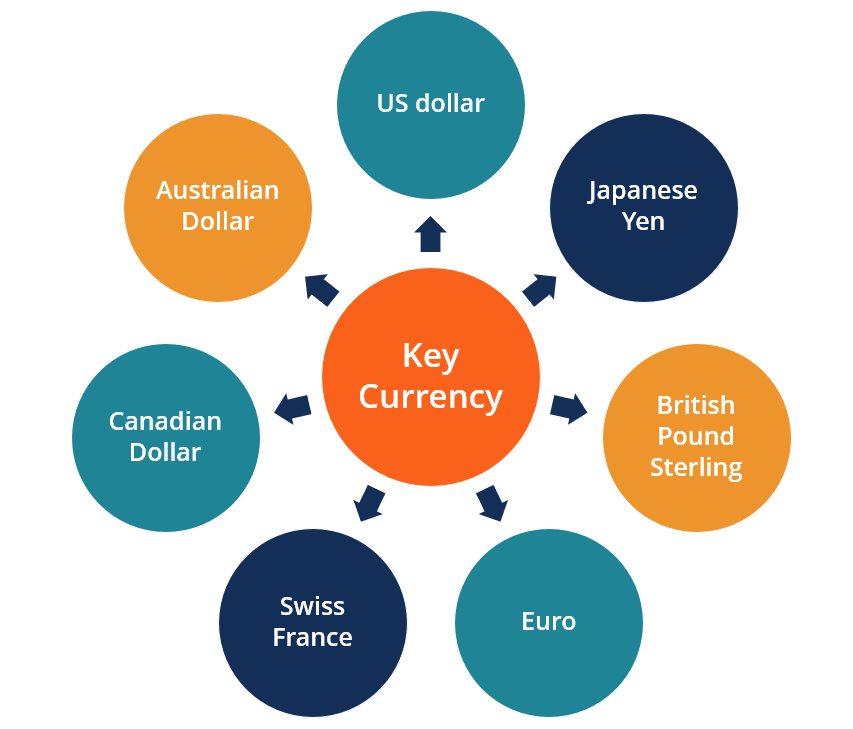
A key currency acts as a reference value in global financial transactions. In the foreign exchange market, it provides stable exchange rates for other currencies. Hence, small countries relying heavily on export may implement key currencies to reduce the currency risks involved in international tradeInternational TradeInternational trade is an exchange involving a good or service conducted between at least two different countries. The exchanges can be.
Summary
- Key currency is a major currency that does not vary much, helps in international transactions, and sets the exchange rates.
- Smaller and developing countries hold reserves of key currencies to settle global debt obligations and support investments.
- Many countries peg their currencies to one or a basket of key currencies to stabilize their economy and ease international transactions.
Significance of a Key Currency
A key currency affects the exchange rate of smaller countries; hence, central banks hold reserves of key currencies. The reserve currencies help complete global transactions, pay foreign debt obligations, and support investments. A reserve currency may or may not be a key currency.
Countries hold key currencies to pay for a lot of internationally-traded commoditiesCommoditiesCommodities are another class of assets just like stocks and bonds. Most commodities are products that come from the earth that possess, such as oil and gold, which are generally rated at a key currency. Furthermore, when different countries agree upon a deal, they usually use a key currency for transaction purposes to reduce the risk of changes in exchange rates during the time of the deal.
Countries with non-key currencies usually peg their national currencies to key currencies. By doing so, smaller and developing countries hope to ease international transactions and stabilize the economy.
Although the fixing of national currency to key currency reduces the flexibility of monetary policies, it increases the confidence in the economy of the country.
The U.S. Dollar as the International Key Currency
Over the past seven decades, the U.S. dollar has attained a leading position among all other currency units in the world. It has evolved into a global medium of exchange, facilitating global investments and trade in a safer environment.
The global dominance of the U.S. in gross domestic product (GDP)Gross Domestic Product (GDP)Gross domestic product (GDP) is a standard measure of a country’s economic health and an indicator of its standard of living. Also, GDP can be used to compare the productivity levels between different countries., currency stability, world trade, capital flows, and foreign direct investments has led the U.S. dollar to be the key currency of the world. According to the International Monetary Fund (IMF), in Q1 2020, the U.S. dollar accounted for about 62% of the foreign exchange holdings compared to 20% for Euro and 6% for Yen.
Moreover, during times of crisis or panic, the U.S. treasuries or cash in any liquid currency are the most demanded investments. The U.S. dollar is being used extensively in almost everything from foreign-exchange transactions to commodity pricing to international trade. It makes the U.S. dollar an important currency for investors and businesses.
Many countries make investments in U.S. dollar-denominated assets due to its stability and international value. Also, it provides a market with the most liquid bonds.
Furthermore, treasuries are believed to be the best risk-free asset in the world, and the yields of U.S. treasuries are more than the Japanese and European treasuries. Even when the yields of the U.S. treasuries fall to a record low, they are 1% above their counterparts.
Key Currency Pairs
In the foreign exchange market, a currency pair is the estimate of one currency’s value relative to another. The currency used as a reference is called the quote currency, and the other one is called the base currency. The following are some of the key currency pairs:
Euro/U.S. Dollar (EUR/USD)
Also known as the Euro, it is the most popular pair. Economic releases by the U.S. Federal Reserve and the European Central Bank impact the currency pair. The value of EUR/USD falls as the dollar value rises and vice versa.
British Pound Sterling/U.S. Dollar (GBP/USD)
In the 1800s, the exchange between the countries used to be via a cable laid along the Atlantic Ocean’s floor. Hence, trading in GBP/USD is referred to as trading the “Cable.”
U.S. Dollar/Japanese Yen (USD/JPY)
The above key currency pair is referred to as “Gopher.” The Japanese yen is a popular currency for carry trade strategies, which is similar to the buy low and sell high strategy. Traders and investors can benefit from the difference in interest rates of the Japanese yen and USD since the interest rate on the USD/JPY pair remains low.
U.S. Dollar/Canadian Dollar (USD/CAD)
It is a commodity pair commonly called the “Loonie.” While the proximity of Canada to the U.S. enables the sharing of high volumes of trade, tariffs imposed by the governments of both countries have made CAD vulnerable to the volatility of the market.
U.S. Dollar/Swiss Franc (USD/CHF)
Known as the “Swissie,” the interest rate difference between the Swiss National Bank and the U.S. Federal Reserve greatly impacts this key currency pair. Similar to the USD, the Swiss franc is considered a safe haven currency and also appreciates during times of uncertain global markets.
The choice of a currency pair depends on the country where the investor will be trading or looking for investment opportunities.
More Resources
CFI offers the Commercial Banking & Credit Analyst (CBCA)™Program Page - CBCAGet CFI's CBCA™ certification and become a Commercial Banking & Credit Analyst. Enroll and advance your career with our certification programs and courses. certification program for those looking to take their careers to the next level. To keep learning and developing your knowledge base, please explore the additional relevant resources below:
- Hard CurrencyHard CurrencyA hard currency refers to a currency that is generally issued by developed countries, globally traded, and seen as politically and
- Exchange RateExchange RateAn exchange rate is the rate at which one currency can be exchanged for another between nations or economic zones. It is used to determine the
- International Monetary Fund (IMF)International Monetary Fund (IMF)The International Monetary Fund (IMF) is an institution of the United Nations that sets standards for the global economy with the aim of
- EUR/USD Currency CrossEUR/USD Currency CrossThe Euro to Dollar exchange rate (EUR/USD or €/$ for short) is the number of U.S. dollars for every 1 Euro. It is the convention for quoting the exchange rate between the two currencies. This guide will provide an overview of the factors that impact the FX rate, and what investors and speculators need to know
-
Currency Swap Contracts: Definition & How They Work
A currency swap contract (also known as a cross-currency swap contract) is a derivative contract between two parties that involves the exchange of interest payments, as well as the exchange of princip
-

Quanto Swap Explained: A Comprehensive Guide for Investors
A quanto swap is a type of derivative that is cash-settled and a cross-currency interest rate swapInterest Rate SwapAn interest rate swap is a derivative contract through which two counterparties agre
finance
- Understanding the Backing of the U.S. Dollar: History & Current System
- Currency Basket Explained: Diversification & Risk Management
- Currency Overlay: Protecting Your Investments from FX Risk
- Demonetization Explained: Understanding Currency Withdrawal
- Understanding Hard Currencies: Stability and Global Trade
- Understanding Currency Risk: A Comprehensive Guide
- Bitcoin Explained: A Comprehensive Guide to Cryptocurrency
- Understanding Currency Pairs in Forex Trading: A Beginner's Guide
- Cryptography Explained: Secure Communication & Encryption Techniques
-
 Eurobonds: A Comprehensive Guide to Foreign Currency Debt
A Eurobond is a fixed-income debt instrument (security) denominated in a different currency than the local one of the country where the bond’s been issued. Hence, it is a unique type of bond.&nb...
-
 Understanding Currency Pegs: EUR/USD and Exchange Rate Basics
In finance, pegging refers to two different actions. 1) A peg is the act of linking the exchange rateEUR/USD Currency CrossThe Euro to Dollar exchange rate (EUR/USD or €/$ for short) is the numbe...