
Deutsche Bank Restructuring: Understanding the 2019 Job Cuts
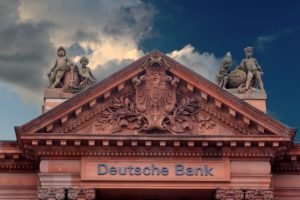
In June 2019, Deutsche Bank announced that they will be cutting 18,000 jobs in an effort to restructure the corporationCorporationA corporation is a legal entity created by individuals, stockholders, or shareholders, with the purpose of operating for profit. Corporations are allowed to enter into contracts, sue and be sued, own assets, remit federal and state taxes, and borrow money from financial institutions.. Corporate restructuring can include a large variety of changes, all of which are designed to make the company more profitableProfitProfit is the value remaining after a company’s expenses have been paid. It can be found on an income statement. If the value that remains. Changes can include ownership structure, debt and financing structuresCapital StructureCapital structure refers to the amount of debt and/or equity employed by a firm to fund its operations and finance its assets. A firm's capital structure, and updating management systems. Of course, changes can also be made to the business lines leading to an increase or decrease in jobs.
Quick Summary Points
- Deutsche Bank is eliminating the equities sales and trading business lines and laying off 18,000 employees.
- The bank has not been able to recover from the financial crisis and has been fined numerous times for misconduct.
- Instead of focusing on sales and trading, which can create volatile earnings, they are shifting focus to corporate money management.
History of Deutsche Bank
Deutsche is a German banking institutionBanking (Sell-Side) CareersThe banks, also known as Dealers or collectively as the Sell-Side, offer a wide range of roles like investment banking, equity research, sales & trading founded in 1870. Unfortunately, throughout the years, they have been involved with several scandals and poor business decisions. For example, the bank took part in the subprime mortgage crisis. Even when the bank sensed that the market was turning south, they continued to sell mortgage-based investmentsMortgage-Backed Security (MBS)A Mortgage-backed Security (MBS) is a debt security that is collateralized by a mortgage or a collection of mortgages. An MBS is an asset-backed security that is traded on the secondary market, and that enables investors to profit from the mortgage business. To make things worse, Deutsche also took bets against the products they were selling. These actions cost the bank $7.2 billion in fines, which was adjusted from $14 billion after a settlement with the US Department of Justice.
Between 2015 to 2018, Deutsche was also fined for other misdemeanors. They include rigging the LiborLIBORLIBOR, which is an acronym of London Interbank Offer Rate, refers to the interest rate that UK banks charge other financial institutions for interest rate, doing business with US-sanctioned countries, and failure to prevent money laundering. In the money laundering case, Deutsche Bank was fined $630 million for not preventing $10 billion of Russian money laundering.
Decisions that were made
In terms of business decisions, since 1989, Deutsche bank had plans to become a global bank. They acquiredPurchase Accounting – Mergers & Acquisitions (M&A)This guide will cover purchase accounting for mergers and acquisitions. In an acquisition, a company purchases another company’s assets, identifiable business segments, or subsidiaries. In a merger, a company purchases another company in its entirety. banks in other countries and obtained a greater global presence. By consolidating their US operations into one, they had plans to take on Wall StreetWall StreetWall Street takes up eight blocks in Manhattan, New York. It runs east to west from Broadway to South Street, in the heart of the financial district. Representing the heart of capitalism, Wall Street is home to the New York Stock Exchange (NYSE), numerous banks, other financial institutions, and corporations. banks such as Goldman SachsGoldman Sachs GroupGoldman Sachs Group Inc. is a multinational investment bank that was established in 1869 by Marcus Goldman. It offers asset management, mergers & acquisitions, brokerage, & security underwriting through 4 segments: Investment Banking, Investment Management, Investing & Lending, & Institutional Clients, Learn about GS. However, after the financial crisis, the sluggish European economy, and new regulations, such plans fell apart. In 2019, plans to merge with another German bank, Commerzbank, fell through. If the merger was successful, it would have created the eurozoneEurozoneAll European Union countries that adopted the euro as their national currency form a geographical and economic region known as the Eurozone. The Eurozone forms one of the largest economic regions in the world. Nineteen of the 28 countries in Europe use the euro‘s second-largest bank. These plans were made as both banks were struggling, with Deutsche trying to recover after the financial crisis.
Why cut 18,000 jobs?
Deutsche made the decision that their business operationsBusiness OperationsBusiness operations refer to activities that businesses engage in on a daily basis to increase the value of the enterprise and earn a profit. The activities are spread too thin or over-diversifiedDiversificationDiversification is a technique of allocating portfolio resources or capital to a variety of investments.The goal of diversification is to mitigate losses. One of the executives stated that the bank had tried to compete in too many business lines. To ratify this situation, they have decided to close the equities sales and tradingSales and TradingSales and Trading (S&T) is a group at an investment bank that consists of salespeople, who call institutional investors with ideas and opportunities, and traders, who execute orders and advise clients on entering and exiting financial positions. Sales and trading is the lifeblood that makes or breaks a securities firm business and decrease the rates division. By removing this business line from the banks, they are also letting go of 18,000 employees. Originally, executives were reluctant to cut this business line. Although it is high risk, issuing and trading derivativesDerivativesDerivatives are financial contracts whose value is linked to the value of an underlying asset. They are complex financial instruments that are can be very profitable if done properly. However, as Deutsche Bank becomes less profitable, the bank seeks more reliable business. Now the bank will shift focus to corporate money management.
The short term cost of Deutsche Bank’s restructuring process is $8.29 billion with a majority occurring in 2019. The cost mostly consists of severance packages for the employees that were let go. The estimated benefit is $6.7 billion in cost savings by 2022. Cost savings originate from lower salary expenses and bonuses paid each year. Other banks have called this plan ambitious and the actions radical.
Management
Christian Sewing became the chief executive in 2018. Sewing had already cut over 3,000 jobs and closed hundreds of branches. Sewing, along with the board, made the decision to cut the equities sales and tradingSales and TradingSales and Trading (S&T) is a group at an investment bank that consists of salespeople, who call institutional investors with ideas and opportunities, and traders, who execute orders and advise clients on entering and exiting financial positions. Sales and trading is the lifeblood that makes or breaks a securities firm division as it lacks revenueRevenueRevenue is the value of all sales of goods and services recognized by a company in a period. Revenue (also referred to as Sales or Income) reliability. As mentioned above, cost savings are also expected from lower payment of bonuses. The previous chief executive was criticized for the continuous payment of high bonuses for investment bankers.
Not all of the executives agree with or was unscathed by the decision. For example, Frank Strauss, the head of retail business, has left the bank, as he did not agree with the restructuring plan. Garth Ritchie, the chief of investment banking, will be leaving the bank as well.
What does it mean for investors?
The stock for Deutsche Bank has fallen by 95% since 2007 due to the difficulties the bank has faced. For existing investors, the bank has stated that they will not raise additional capitalCapitalCapital is anything that increases one’s ability to generate value. It can be used to increase value across a wide range of categories, such as financial, social, physical, intellectual, etc. In business and economics, the two most common types of capital are financial and human. to fund the restructuring plan. Many investors or potential investors are waiting to see how the plan will be executed, as well as the results it will deliver. While costs will be reduced, it is to be seen whether the revenue will be negatively impacted.
Additional Resources
Thank you for reading CFI’s article on Deutsche Bank’s restructuring plan. To keep learning and advancing your career, we recommend the following CFI resources.
- Zombie CompanyZombie CompanyA zombie company is an uncompetitive company that needs a bailout to operate. Zombie companies do not have excess cash or capacity and are stagnant.
- Bailout TakeoverBailout TakeoverA bailout takeover refers to a scenario where the government or a financially stable company takes over control of a weak company with the goal of helping
- Major Risks for BanksMajor Risks for BanksMajor risks for banks include credit, operational, market, and liquidity risk. Since banks are exposed to a variety of risks, they have well-constructed risk management infrastructures and are required to follow government regulations.
- Loan to Value RatioLoan-to-Value RatioThe loan-to-value (LTV) ratio is a financial ratio that compares the size of a loan to the value of an asset that is purchased using the proceeds of the loan.
-
Demand Draft: Definition, How It Works & Usage
A demand draft, also called a remotely created check (RCC), is a negotiable instrument to transfer funds from one bank to another. It is issued by a bank to a client (drawer) in order to direct a diff
-
Josef Ackermann: Biography & Career Highlights | Deutsche Bank & Beyond
Josef Ackermann (or Josef Meinrad Ackermann) is a Swiss banker who was born on February 7, 1948. Ackermann was the chairman of the Bank of Cyprus and CEO of the Deutsche Bank. Mr. Ackerman obtained a
finance
- Deutsche Bank Stock Decline: Causes & Future Outlook
- Swap Banks: Facilitating Interest Rate & Currency Swaps | [Your Company Name]
- Bank Drafts: Understanding Guaranteed Payment Instruments
- Understanding Bank Credit: Loans for Individuals & Businesses
- Understanding Bank Reserves: A Key to Financial Stability
- Understanding Banks: Types, Functions, and Regulations
- Bank Guarantee: Definition, Purpose & How It Works
- Bank Drafts: Definition, How They Work & Usage
- Debt Restructuring: A Comprehensive Guide for Individuals & Businesses
-
 Bank Stress Tests: Understanding Financial Resilience
A bank stress test is a simulation or analysis conducted to analyze how a bank will be impacted under adverse market conditions – for example, a financial market crash or recessionRecessionReces...
-
 Commercial Banks: Definition, Services & Bridge Loans
A commercial bank is a financial institution that grants loansBridge LoanA bridge loan is a short-term form of financing that is used to meet current obligations before securing permanent financing. I...