
Direct Capitalization Method: Definition & Application
The direct capitalization method is obtained by taking the income recorded over time and dividing it by the respective capitalization rates taken over the same period. The cap rate is obtained by dividing the net operating incomeNet Operating Income (NOI)Net Operating Income (NOI) is the value of a revenue-generating property when the total operating expenses and losses from vacant premises are by the value of the assets.
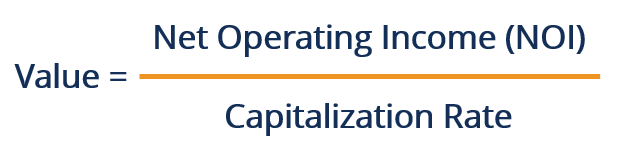
The direct capitalization method is not appropriate for owner-occupied premises due to its overdependence on the income from the property. The increase in the cap rateCap Rate (REIT)Cap rate is a financial metric that is used by real estate investors to analyze real estate investments, and determine their potential rate of return based reduces the quotient value significantly. Thus, a decrease in the cap rate means that the market value rises for the property. Hence, the market value to be determined is indirectly proportional to the cap rate.
On the other hand, the net operating income is directly proportional to the market valueFair Market ValueThe fair market value (of a good or service being exchanged) refers to the price at which both transacting parties agreed to independently.. An increase in the net operating income (NOI) results in a significant increase in the market value. A reduced market value means that the NOI is low and requires a strategic increase.
Quick Summary
- The direct capitalization method is a real estate appraisal method that helps in converting income into value.
- The direct capitalization method is achieved by dividing the income generated by the property by its cap rate.
- Unlike other appraisal methods, the method is easy to use and interpret when there is enough data over time for both income and cap rate.
Yield Capitalization vs. Direct Capitalization
Unlike direct capitalization, yield capitalization relies heavily on the funds from the real estate for valuation, whereas the former relies entirely on the income generated from the property. Yield capitalization banks on the fact that real estate as an investment is a long-term goal, which the investor should endlessly reap from for a long time in the future.
Usually, it is expected that towards the future, the rental income for a property should increase gradually due to the foreseeable inflation. Inflation also causes maintenance costs and repairs to rise, especially when the property was not properly maintained by the previous owner.
The income from a property can vary in future periods due to various factors. The yield capitalization method intends to foretell the expected changes to an investor. It does so by taking into consideration all factors, such as inflationInflationInflation is an economic concept that refers to increases in the price level of goods over a set period of time. The rise in the price level signifies that the currency in a given economy loses purchasing power (i.e., less can be bought with the same amount of money)., maintenance, costs and repairs, to ensure that the property is in the best form as possible.
Due to its future-telling capabilities, brokers, regulatory agencies, commercial appraisers, investors, and the general public heavily rely on the yield capitalization method for real estate valuation. However, the method works best when used alongside other valuation methods in order to get the best results.
Which is the Best Appraisal Method?
There are several capitalization/appraisal methods that are commonly used. The appraisal methods follow different approaches to the valuation of a property. They are all in regular use, either individually or collectively by brokers, commercial real estate assessors, investors, and the general public.
When conducting an appraisal of a property, it is not recommended to use a single appraisal method due to the uniqueness of situations in real estate valuations. Two or more valuation methods should be used interchangeably or individually when conducting valuations, but the most appropriate methods depend on the specific situation.
Direct and yield capitalization methods are the two most popular methods used in real estate valuation. However, the two methods are used in different instances, depending on the situation. For example, in properties with unstable income flows, the yield capitalization method is most appropriate. The yield cap method will look into the probable future stability of the property by taking into consideration future earnings, hence giving a better view of the property’s growth potential.
Less stable properties provide limited data that can be used to analyze their earnings, and therefore, the direct capitalization method is inappropriate. On the other hand, established properties with stable monthly or annual earnings offer adequate data points that can be used to analyze their earnings. Hence, the direct capitalization method is most preferred in such situations.
Factors to Consider When Valuing Real Estate Properties
Valuing real estate properties that an investor intends to acquire can help an investor determine whether to acquire the property or discontinue the investment plan. Investors should focus on looking for the hidden factors that may not be evident during valuation, but may appear in the future.
1. Financial difficulties or pending legal ownership disputes
A significant tenant may be facing a financial crisis, which may cast into doubt the ability to meet their monthly rental obligations. The property may also be subject to legal ownership disputes that may require the company to hire attorneys and incur additional legal costs.
2. Vacancy patterns
Another factor that investors can consider during property valuations is the vacancy patterns in the premises, which can explain the potential patterns of future earnings. If the vacancy patterns keep on fluctuating with time, it may be due to factors, such as poor maintenance of the building, specifically unpainted walls, broken fixtures, blocked sewer lines, etc.
The hidden factors may seem insignificant at first, but they will affect the viability of the project in the future. The issues are usually invisible to the valuation method, such as the direct capitalization method, and investors should attempt to investigate such issues before making the final decision on whether to invest or not.
Related Readings
CFI is the official provider of the global Commercial Banking & Credit Analyst (CBCA)™Program Page - CBCAGet CFI's CBCA™ certification and become a Commercial Banking & Credit Analyst. Enroll and advance your career with our certification programs and courses. certification program, designed to help you become a world-class financial analyst. To keep advancing your career, the additional CFI resources below will be useful:
- Current Income (Real Estate Investments)Current Income (Real Estate Investments)Current income is an investment strategy that gives investors exposure to consistent above-average payouts. The most common current income-focused
- Functional ObsolescenceFunctional Obsolescence (Real Estate)In real estate, functional obsolescence refers to the diminishing of the usefulness of an architecture design such that changing it to suit current real
- Real Estate Development ModelReal Estate Development ModelA real estate development model usually consists of two sections: Deal Summary and Cash Flow Model. Within the Deal Summary, all important
- Replacement CostReplacement Cost (Real Estate)Replacement cost refers to the price that it would cost to replace an existing asset with a similar asset at the current market price.
-

Hope Credit: Understanding Your Post-Secondary Education Tax Credit
The Hope Credit is one of the lifetime education tax credits in the U.S. that provides financial assistance to taxpayers or their children who are pursuing post-secondary education. The creation of th
-

Libra Cryptocurrency: A Comprehensive Overview
Libra is a cryptocurrencyCryptocurrencyCryptocurrency is a form of digital currency that is based on blockchain networking. Cryptocurrency like Bitcoin and Ethereum are becoming widely accepted. creat
finance
- Direct Deposit: Definition, Benefits & How It Works
- Understanding the Temporal Method for Currency Translation
- Effective Interest Method Explained: Bond Amortization & Accounting
- Understanding the Completed Contract Method: Revenue Recognition Explained
- Consolidation Method Explained: A Comprehensive Guide
- Cost Method Explained: Accounting & Investment Strategies
- Cost Recovery Method: Understanding Revenue Recognition
- Direct Method for Cash Flow Statements: A Comprehensive Guide
- Equity Method Accounting: Definition & Intercorporate Investments
-
 Direct Security Explained: Types & How It Works
Direct security is typically collateralCollateralCollateral is an asset or property that an individual or entity offers to a lender as security for a loan. It is used as a way to obtain a loan, acting...
-
 Understanding Forward Rates: A Comprehensive Guide
The forward rate, in simple terms, is the calculated expectation of the yield on a bondBondsBonds are fixed-income securities that are issued by corporations and governments to raise capital. The bond...