
Direct Security Explained: Types & How It Works
Direct security is typically collateralCollateralCollateral is an asset or property that an individual or entity offers to a lender as security for a loan. It is used as a way to obtain a loan, acting as a protection against potential loss for the lender should the borrower default in his payments. that can be used to secure a loan. Securities can be broadly divided into two distinct types: asset securities and collateral securities.
Asset security represents ownership interest held by shareholders in an enterprise, realized in the form of shares of capital stock. Holders of equity securities are generally not entitled to regular payments, although equity securities often pay out dividends. However, they can profit from capital gains while selling the securities. Equity securities provide the holder with some control over the business through voting rights.
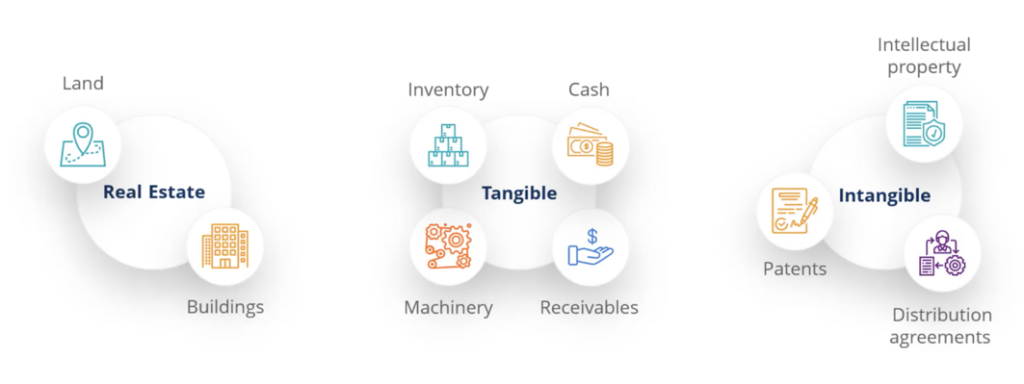
Types of Direct Security
There are three major types of direct securities:
- Real estate
- Tangible assets
- Intangible assets
Real estate assets (e.g., land, residential, or commercial properties), tangible non-current assets (e.g., machinery and equipment), cash, securities, and inventory can serve as security. Intangible assets, such as any intellectual property rights, patents, and distribution agreements, can also be taken as security.
How to Secure a Position Using Assets
Fixed and floating charges are the ways of securing a position by a financial institution.
A fixed charge is attached to a certain item of an organization’s property, plant, and equipment (PP&E)PP&E (Property, Plant and Equipment)PP&E (Property, Plant, and Equipment) is one of the core non-current assets found on the balance sheet. PP&E is impacted by Capex,. The lender owns the legal rights to a specific asset that was pledged as security for a loan, which means that the borrower cannot sell the asset without the lender’s consent. Real estate properties are usually subject to a fixed charge.
A floating charge attaches to a general class of assets rather than a particular asset. It allows the borrower to trade its assets during the ordinary course of business. The floating charge will be fixed if the borrower becomes insolvent or defaults on its loan repayments. If it happens, the borrower gives up its legal right over the pledged asset.
Examples of floating charges include account receivablesAccounts ReceivableAccounts Receivable (AR) represents the credit sales of a business, which have not yet been collected from its customers. Companies allow, inventory, marketable securitiesMarketable SecuritiesMarketable securities are unrestricted short-term financial instruments that are issued either for equity securities or for debt securities of a publicly listed company. The issuing company creates these instruments for the express purpose of raising funds to further finance business activities and expansion., and work in progress.
There are two ways that direct security can be pledged to the lender:
The first way is through a general security agreement (GSA), and the second is by identifying and assigning specific collateral. It serves as protection for the lender. Using specific collateral means assigning specific assets or pledging the assets to the lender so that if the borrower goes bankrupt, the lender will repossess the ownership of the pledged asset.
All assets are pledged as security to the lender in case of the general security agreement, and in case of a default, the lender can seize all the borrower’s assets.
Indirect Security vs. Direct Security
Indirect security represents the security of a loan that is not directly related to assets pledged against the loan by a borrower being a part of direct securities. The two common types of indirect security are:
1. Guarantee
The most common type of indirect security is a guarantee. In other words, a third party, called a guarantorGuarantorA guarantor is a third party that pays for a debt if the borrower misses their payments. They are usually a form of insurance for the lender., takes responsibility for any debt outstanding that has not been repaid by the borrower because of its default. Such a responsibility is documented in writing as evidence of the fact.
There are three common types of guarantees:
- Personal
- Corporate
- Joint and several
A personal guarantee is used in case a guarantor is an individual. If a borrower goes bankrupt and is no longer able to service debt, then the guarantor (the individual) will need to cover the unpaid outstanding debt. It also means that the lender may pursue the guarantor’s assets.
A corporate guarantee is used when the guarantor is a company. Corporate guarantees are common when companies are related through ownership. For example, a corporate parent enterprise can be asked to provide a corporate guarantee for loans provided to a subsidiary company that is owned by the parent.
Finally, joint and several guarantees are utilized when there are several guarantors. Any and all guarantors may be pursued to repay the debt of the defaulted borrower. Joint and several guarantees are common when lending to groups of companies with shared ownership.
Personal, corporate, and joint and several guarantees come in several versions. For example, personal and corporate guarantees can be unlimited or limited.
Unlimited guarantees obligate the guarantor to repay the full amount of the outstanding loan if the borrower went bankrupt, whereas limited guarantees are used for a particular dollar amount of a borrower’s obligation, meaning the guarantor will need to repay a certain amount that can be less than the loan amount originally taken by the borrower.
2. Letter of comfort
A letter of comfort is another form of indirect security. It is a letter given by a third party (a parent company) to help secure debt financing for a borrower. Importantly, it is a weaker form of reassurance in comparison to guarantees.
Letters of comfort are non-binding and can be thought of as letters of recommendation. They do not require any legal obligation.
For example, a letter of comfort can include something like: “The parent company will be responsible for the business of the subsidiary or the borrower, in a way as to meet all liabilities under the loan agreement.” It does not mention a guarantee, which is why it is a weaker reassurance guarantee.
To conclude, direct securities are those that a borrower directly uses as a pledge against the loan, whereas indirect securities are securities provided by a third-party (a guarantor) that will take responsibility for the loan repayment should the borrower default on it.
More Resources
CFI is the official provider of the global Commercial Banking & Credit Analyst (CBCA)™Program Page - CBCAGet CFI's CBCA™ certification and become a Commercial Banking & Credit Analyst. Enroll and advance your career with our certification programs and courses. certification program, designed to help anyone become a world-class financial analyst. To keep advancing your career, the additional CFI resources below will be useful:
- Corporate GuaranteeCorporate GuaranteeA corporate guarantee is an official letter where a guarantor becomes responsible for handling debt payments or takes overall responsibility for debt
- DefeasanceDefeasanceDefeasance is a provision in business law that renders an agreement void under certain conditions. In cases of a debt agreement, defeasance provisions
- Comfort LetterComfort LetterA comfort letter is a document of assurance by a parent company to reassure a subsidiary company of its willingness to provide financial support.
- General Security AgreementGeneral Security AgreementA General Security Agreement (GSA) is a contract signed between two parties – a creditor (lender) and a debtor (borrower) – to secure personal loans,
-

Understanding Household Assets: A Comprehensive Guide
If you've ever had to write a will, buy home owners' insurance or handle a break-in or fire that damaged your home, you probably needed to create a list of your household assets. A list of hou
-

Depreciation Explained: Calculation, Methods & Importance
For purposes of financial reporting and tax liability, businesses need to demonstrate how their assets decrease
finance
- Understanding Security Deposits: What You Need to Know
- Asset Management: Definition, Types & Importance
- Asset Turnover Ratio: Definition & Importance
- Direct Deposit: Definition, Benefits & How It Works
- Fixed Assets: Definition, Examples & Importance for Businesses
- Understanding Momentum in Finance: A Comprehensive Guide
- Direct Labor Explained: Definition, Examples & Importance
- Understanding Asset Impairment: Causes and Impact
- Understanding Trusts: A Comprehensive Guide to Asset Management & Estate Planning
-
 Understanding Deficit Equity: Causes, Impacts & Solutions
Deficit equity, more commonly referred to as negative owners' equity, results when the total value of an organization's assets is less than the sum total of its liabilities. In any company, &q...
-
 Asset Dissipation: Financing Your Home with Liquid Assets
A family is in front of their house. Asset dissipation, sometimes called "asset utilization," "asset depletion" or an "asset-based loan," allows individuals to f...