
Fixed Assets: Definition, Examples & Importance for Businesses
Fixed assets refer to long-term tangible assetsTangible AssetsTangible assets are assets with a physical form and that hold value. Examples include property, plant, and equipment. Tangible assets are that are used in the operations of a business. They provide long-term financial benefits, have a useful life of more than one year, and are classified as property, plant, and equipment (PP&E) on the balance sheet.

Key Characteristics of a Fixed Asset
The key characteristics of a fixed asset are listed below:
1. They have a useful life of more than one year
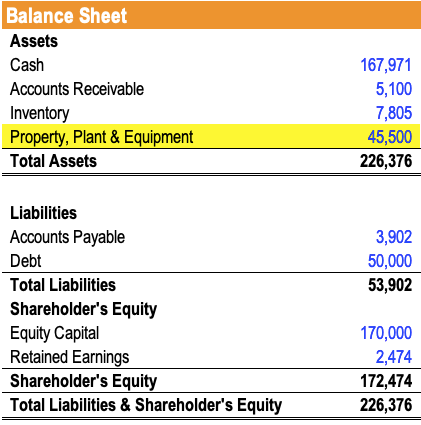
Fixed assets are non-current assets that have a useful life of more than one year and appear on a company’s balance sheet as property, plant, and equipment (PP&E)PP&E (Property, Plant and Equipment)PP&E (Property, Plant, and Equipment) is one of the core non-current assets found on the balance sheet. PP&E is impacted by Capex,.
2. They can be depreciated
With the exception of land, fixed assets are depreciated to reflect the wear and tear of using the fixed asset.
3. They are used in business operations and provide a long-term financial benefit
Fixed assets are used by the company to produce goods and services and generate revenue. They are not sold to customers or held for investment purposes.
4. They are illiquid
Fixed assets are non-current assets on a company’s balance sheetBalance SheetThe balance sheet is one of the three fundamental financial statements. The financial statements are key to both financial modeling and accounting. and cannot be easily converted into cash.
Importance of Fixed Assets
Fixed assets are crucial to any company. Apart from being used to help a business generate revenue, they are closely looked at by investors when deciding whether to invest in a company. For example, the fixed asset turnover ratio is used to determine the efficiency of fixed assets in generating sales.
Companies that more efficiently use their fixed assets enjoy a competitive advantageCompetitive AdvantageA competitive advantage is an attribute that enables a company to outperform its competitors. It allows a company to achieve superior margins over their competitors. An understanding of what is and isn’t a fixed asset is of great importance to investors, as it impacts the evaluation of a company.
Examples of Fixed Assets
- Land
- Machinery
- Buildings and facilities
- Vehicles (company cars, trucks, forklifts, etc.)
- Furniture
- Computer equipment
- Tools
Although the list above consists of examples of fixed assets, they aren’t necessarily universal to all companies. In other words, what is a fixed asset to one company may not be considered a fixed asset to another.
For example, a delivery company would classify the vehicles it owns as fixed assets. However, a company that manufactures vehicles would classify the same vehicles as inventoryInventoryInventory is a current asset account found on the balance sheet, consisting of all raw materials, work-in-progress, and finished goods that a. Therefore, consider the nature of a company’s business when classifying fixed assets.
Relevance to Financial Statements
A fixed asset has certain implications on a company’s financial statements:
Balance Sheet
A fixed asset is capitalized. When a company purchases a fixed asset, they record the cost as an asset on the balance sheet instead of expensing it onto the income statement. Due to the nature of fixed assets being used in the company’s operations to generate revenue, the fixed asset is initially capitalized on the balance sheet and then gradually depreciated over its useful life. A fixed asset shows up as property, plant, and equipment (a non-current asset) on a company’s balance sheet.
For example, a company that purchases a printer for $1,000 would record an asset on its balance sheet for $1,000. Over its useful life, the printer would gradually decapitalize itself from the balance sheet.
Income Statement
With the exception of land, fixed assets are depreciated. This is to reflect the wear and tear from using the fixed asset in the company’s operations. Depreciation shows up on the income statement and reduces the company’s net income.
For example, a company that purchases a printer for $1,000 with a useful life of 10 years and a $0 residual value would record depreciation of $100 on its income statement annually.
Statement of Cash Flow
When a company purchases or sells a fixed asset with cash, that is reflected in the investing activities section of the cash flow statementCash Flow StatementA cash flow Statement contains information on how much cash a company generated and used during a given period.. Purchases of fixed assets are an outflow of cash and are categorized as “capital expenditures,” while the sale of fixed assets is an inflow of cash and is categorized as “proceeds from the sale of property and equipment.”
For example, a company that purchases a printer for $1,000 using cash would report capital expenditures of $1,000 on its cash flow statement.
Additional Resources
CFI is the official provider of the Financial Modeling and Valuation Analyst (FMVA)®Become a Certified Financial Modeling & Valuation Analyst (FMVA)®CFI's Financial Modeling and Valuation Analyst (FMVA)® certification will help you gain the confidence you need in your finance career. Enroll today! certification program, designed to transform anyone into a world-class financial analyst.
To keep learning and developing your knowledge of financial analysis, we highly recommend the additional CFI resources below:
- Depreciation MethodsDepreciation MethodsThe most common types of depreciation methods include straight-line, double declining balance, units of production, and sum of years digits.
- Projecting Balance Sheet Line ItemsProjecting Balance Sheet Line ItemsProjecting balance sheet line items involves analyzing working capital, PP&E, debt share capital and net income. This guide breaks down how to calculate
- Projecting Income Statement Line ItemsProjecting Income Statement Line ItemsWe discuss the different methods of projecting income statement line items. Projecting income statement line items begins with sales revenue, then cost
-

Understanding Unrestricted Net Assets for Nonprofits
Unrestricted net assets are the asset (current and/or fixed) donations made to not-for-profit organizations (NPOs)Not-for-Profit OrganizationsA not-for-profit organization focuses on a particular soci
-
Capital Expenditures (CAPEX): Definition & Examples
Capital expenditures refer to funds that are used by a company for the purchase, improvement, or maintenance of long-term assetsLong Term AssetsLong term assets are assets that a company uses in its p
finance
- Investable Assets: A Comprehensive Guide for Investors
- Understanding Household Assets: A Comprehensive Guide
- Fixed Capital: Definition, Examples & Importance
- Understanding Fixed Costs: Definition, Examples & Importance
- Monetary Assets: Definition, Examples & Key Characteristics
- Understanding Non-Monetary Assets: Definition & Examples
- Understanding Quick Assets: Definition & Examples
- Understanding Hard Assets: Definition, Examples & Investment
- Understanding Liquid Assets: A Comprehensive Guide
-
 Understanding Redundant Assets: Definition & Impact on Business
Redundant assets are assets that generate incomeOperating IncomeOperating income is the amount of revenue left after deducting the operational direct and indirect costs from sales revenue. for the bus...
-
 Risk-Weighted Assets (RWA): A Comprehensive Guide for Finance Professionals
Risk-weighted assets is a banking term that refers to an asset classification system that is used to determine the minimum capital that banks should keep as a reserve to reduce the risk of insolvency....