
Electronic Fund Transfer Act (EFTA): Rights & Regulations
The Electronic Fund Transfer Act (EFTA), originally enacted in 1978, is a United States consumer protection law that lays out the rights, responsibilities, and liabilities of parties involved in electronic money transfers. The original legislation has undergone several amendments, primarily to keep up with changing technology.

The oversight, regulation, and rule-making authority of the EFTA was originally the province of the Federal Reserve Board. However, the Dodd-Frank Wall Street Reform and Consumer Protection Act of 2010Dodd-Frank ActThe Dodd-Frank Act, or the Wall Street Reform and Consumer Protection Act of 2010, was enacted into law during the Obama administration as a response to the financial crisis of 2008. It sought to introduce significant changes to financial regulation and create new government agencies tasked with implementing the various clauses in the law. transferred the authority to the Consumer Financial Protection Bureau (CFPB), with effect from July 2011.
The basic purpose of the EFTA legislation was two-pronged: to protect the rights of consumers – individuals engaged in electronically transferring money – and to clarify the rules governing electronic monetary transfers.
Summary
- The Electronic Fund Transfer Act (EFTA) is a United States consumer protection law that lays out the rights, responsibilities, and liabilities of parties involved in electronic money transfers.
- The EFTA governs transfers, such as ATM withdrawals, credit and debit card transactions, and electronic checks.
- Part of the EFTA lays out, in detail, consumers’ rights concerning electronic funds transfers.
Understanding the Electronic Fund Transfer Act
The Electronic Fund Transfer Act, also known as “Regulation E,” essentially lays out all the rules applicable to electronic transfers of money. Its provisions are directed at banks and other financial institutions that handle electronic transfers, as well as consumers who wish to send or receive money electronically.
Electronic funds transfers include transactions between computers and over cell phones and all of the everyday transactions where consumers use a credit or debit card to make purchases. Primary areas covered in the EFTA include automated teller machine (ATM)Automated Teller Machine (ATM)An Automated Teller Machine, better known as an ATM, is a specialized computer that makes it convenient for bank account holders to manage their money transactions, direct deposits and other pre-authorized money transfers, automated clearinghouse (ACH) transactions, and point-of-sale transactions made with a credit or debit card.
One of the Electronic Fund Transfer Act’s key provisions enables consumers to challenge erroneous or unauthorized charges to their credit or debit cards and lays out the procedure for doing so. It also provides the rules on limited liability for consumers concerning unauthorized transactions or lost or stolen credit or debit cards.
On the other hand, the EFTA delineates the requirements that banks and other financial institutions must meet regarding handling such situations, and they apply to the information that credit and debit card issuers must provide to consumers.
Areas Governed by the EFTA
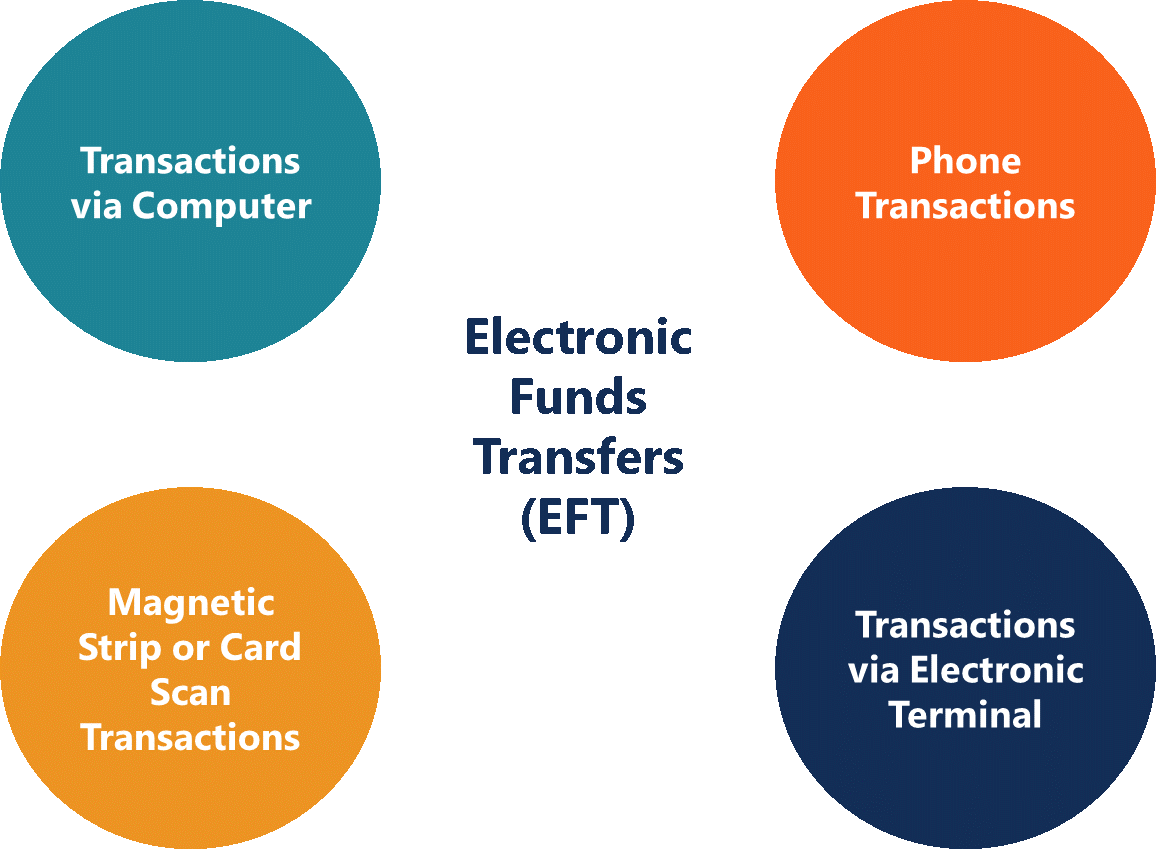
The EFTA covers a wide range of financial transactions. Listed below the key areas regulated by the law:
1. Direct Deposits and Recurring Bill Payments
The EFTA regulates both incoming (deposits) and outgoing (payments) electronic transfers that represent financial transactions that are pre-authorized by consumers. For example, many people set up automatic bill payments of some of their regular, recurring bills, such as utility bills.
The funds necessary to pay the bill are automatically debited from a consumer’s designated account – checking, savings, or money marketMoney MarketThe money market is an organized exchange market where participants can lend and borrow short-term, high-quality debt securities. – on a specified date each month and transferred to the entity to which the bill payment is due. Under the EFTA, consumers are allowed to cancel such automatic money transfers at any time by contacting their financial institution.
2. Internet Transactions
The EFTA also outlines how consumers can access their financial accounts online and arrange money transfers, either to other accounts – such as transferring funds from a checking to a savings account – or to make purchases or pay bills.
3. Electronic Checks
The EFTA also outlines how consumers can access their financial accounts online and arrange money transfers, either to other accounts – such as transferring funds from a checking account to a savings account – or to make purchases or pay bills.
Consumer Rights
A great deal of the Electronic Fund Transfer Act deals with consumer rights concerning electronic transfers. It requires financial institutions to provide consumers with clear information on fees related to EFTs (such as ATM fees), consumer liability concerning unauthorized transactions or stolen cards, consumer rights (such as the right to receive regular, periodic account statements), and the limited circumstances under which the institution is allowed to share a consumer’s information with a third party.
The EFTA regulations cover, in detail, the subject of consumer liability when an error occurred in an electronic transaction or in instances of unauthorized transactions. The law denotes varying liability across three time frames. If a consumer reports an unauthorized transaction or a lost or stolen credit or debit card within two days, their total liability is limited to $50.
If they fail to report such a problem within two days but do so within 60 days, their liability is limited to $500. However, if a consumer fails to report a transaction or card problem within 60 days, their liability for losses incurred by unauthorized use of the card is unlimited.
Once notified of a transaction or card problem, the issuing financial institution must complete an investigation of the incident within 10 days. Under some limited circumstances, they may be allowed 45 days to complete the investigation. One consumer protection clause of the EFTA that many consumers object to limits the amount of money that a consumer may withdraw from an account during a 24-hour period. The amount is typically set by banks at $200-$300.
While the limitation is intended to protect consumers from someone stealing money from their account, many people find the restriction annoying and problematic when they want to transfer a larger sum from one account to another.
Learn More
CFI is the official provider of the Commercial Banking & Credit Analyst (CBCA)™Program Page - CBCAGet CFI's CBCA™ certification and become a Commercial Banking & Credit Analyst. Enroll and advance your career with our certification programs and courses. certification program, designed to transform anyone into a world-class financial analyst.
In order to help you become a world-class financial analyst and advance your career to your fullest potential, these additional resources will be very helpful:
- Automated Clearing House (ACH)Automated Clearing House (ACH)The Automated Clearing House network, also known as ACH, is a channel run by the National Automated Clearing House Association (NACHA), which transfers
- Depository Transfer Check (DTC)Depository Transfer Check (DTC)A depository transfer check (DTC), also known as a depository transfer draft, is used when a third-party service provider collects daily
- Fair Credit Billing Act (FCBA)Fair Credit Billing Act (FCBA)The Fair Credit Billing Act (FCBA) is a US federal law that mandates the protection of consumers from exploitation by creditors through billing errors. Enac
- National Securities Markets Improvements Act (NSMIA)National Securities Markets Improvement Act (NSMIA)The National Securities Markets Improvement Act (NSMIA) was introduced in 1996 to more efficiently allocate capital in financial markets.
-
Trinidad and Tobago Heritage and Stabilization Fund (HSF): An Overview
Heritage and Stabilization Fund (HSF) is a sovereign wealth fund established by the Republic of Trinidad and Tobago. Founded in 2007, HSF was established to reinvest excess capital resulting from expo
-

Understanding Management Expense Ratio (MER): A Comprehensive Guide
The management expense ratio (MER) – also referred to simply as the expense ratio – is the fee that must be paid by shareholders of a mutual fund or exchange-traded fund (ETF)Exchange Trad
finance
- Celler-Kefauver Act: History, Purpose & Impact on Antitrust
- Clayton Antitrust Act: A Comprehensive Overview | Legal Definitions & Impact
- Dodd-Frank Act Explained: Impact & Key Provisions
- Glass-Steagall Act: History, Impact, and Significance
- Hart-Scott-Rodino Act (HSR Act): Antitrust Review Explained
- Sherman Antitrust Act: History, Purpose & Impact - Corporate Law Explained
- Brazil's Sovereign Wealth Fund: Purpose, Objectives & History
- Volcker Rule Explained: Understanding Banking Restrictions
- Understanding the Electronic Fund Transfer Act (EFTA): Consumer Protection
-
 Emergency Banking Act of 1933: History, Purpose & Impact
The Emergency Banking Act of 1933 was enacted during the Great DepressionThe Great DepressionThe Great Depression was a worldwide economic depression that took place from the late 1920s through the 19...
-
 Special Revenue Funds: Definition & Purpose for Government Entities
A special revenue fund is a fund that is used by government entities to accumulate proceeds from certain revenue sources whose use is restricted to specific purposes or activities. The primary reason ...