
European Banking Authority (EBA): Supervision & Financial Stability
The European Banking Authority (EBA) is an agency that aims to supervise financial integrity and ensure financial stability across the European Union (EU)European Union (EU)The European Union (EU) is a unified international organization that governs the economic, political, and social policies of 27 member.

The EBA is a part of the European System of Financial Supervision (ESFS), which works to ensure that the European single market functions efficiently through a regulatory framework that can be applied to all EU members.
Summary
- The European Banking Authority (EBA) is a regulatory agency of the European Union and oversees the financial integrity, stability, and security of the European banking system.
- The EBA’s responsibilities include monitoring the health of banks, resolving disagreements, developing a framework for resolution, and taking action in emergencies.
- It is composed of four main bodies, and the highest decision-making power rests on the Board of Supervisors.
Brief History of the European Banking Authority
The European Banking Authority was established on January 01, 2011, as part of the ESFS. Since then, the EBA’s been overseeing financial supervision and stability in the EU. The EBA took over the responsibilities of the Committee of European Banking Supervisors, which ceased to operate after the inception of the EBA.
Functions of the European Banking Authority
The European Banking Authority serves the EU’s financial system in several ways.
1. The European Single Rulebook
The European Single Rulebook refers to a set of rules that underpin a single market in banking across the EU. The EBA develops technical standards and also previously created a Q&A tool to answer stakeholders’ practical questions about legislation.
2. A common approach to banking supervision
The EBA is responsible for creating a common banking supervision culture across the EU. To achieve a consistent supervisory culture, the EBA develops regulatory standards and supervisory methodologies that can be used for evaluation and supervision.
3. Monitoring the health of EU banks
The EBA is responsible for monitoring the potential risks and vulnerabilities in the EU banking system. It uses the EU-wide stress testBank Stress TestA bank stress test is a simulation or analysis conducted to analyze how a bank will be impacted under adverse market conditions. – a risk assessment tool that tests the resilience of financial institutions – to evaluate the condition of the banking sector.
4. Disclosing information to investors globally
The EBA creates a disclosure framework that all EU banks must adhere to while issuing and reporting information. It allows the information to be publicly accessible and makes the market more transparent and reliable.
5. Consumer protection, financial innovation, and payments
The EBA protects the EU’s banking consumers by identifying risks in their transactions with financial companies. It also monitors financial innovation to assess the potential risks that may arise in the future.
6. Action in emergency situations
The EBA plays an important role in situations that jeopardize the financial system and stability of the EU. It is responsible for the coordination of EU supervisory authorities.
7. Dispute mediation
The EBA assists agreements during disputes between EU authorities that operate in more than one member state. It is authorized to make binding decisions that require specific actions to be taken.
8. Developing a harmonized resolution framework
The EBA contributes to developing a framework for dealing with a failing bank or investment firm. The EU strategy for resolution foresees the training and technical assistance for authorities and monitoring of how rules are being applied.
Structure of the European Banking Authority
The European Banking Authority is composed of three governing bodies:
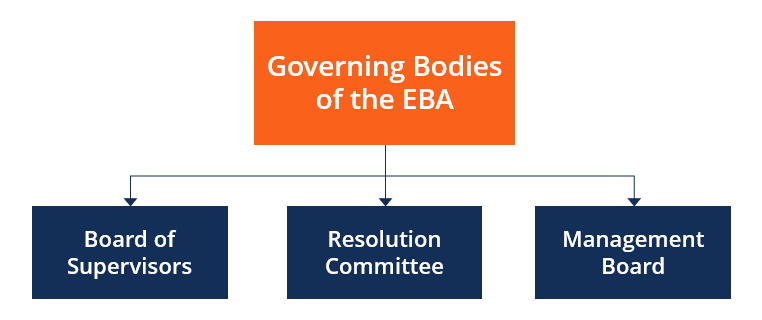
1. Board of Supervisors (BoS)
The Board of Supervisors is the primary decision-making body of the EBA. The board makes all policy decisions and is responsible for deciding the EBA’s final budget each year. The Board of Supervisors is made up of the EBA’s chairperson and representatives from the 27 member states.
2. Resolution Committee (ResCom)
The Resolution Committee focuses on making decisions related to the resolution of matters in disputes or disagreements. The Board of Supervisors delegates the matters that the Resolution Committee deals with. The committee comprises a chairperson and resolution authorities from all member states.
3. Management Board (MB)
The Management Board is responsible for the EBA’s operational matters and ensures that the EBA achieves its objectives. The MB is composed of the EBA’s chairperson and six elected members of the Board of Supervisors.
The EBA also oversees the Standing Committee on Anti-Money Laundering and Counter-Terrorist Financing, which coordinates measures and takes decisions to prevent misuse of the European financial system.
More Resources
CFI is the official provider of the Commercial Banking & Credit Analyst (CBCA)™Program Page - CBCAGet CFI's CBCA™ certification and become a Commercial Banking & Credit Analyst. Enroll and advance your career with our certification programs and courses. certification program, designed to transform anyone into a world-class financial analyst.
In order to help you become a world-class financial analyst and advance your career to your fullest potential, these additional resources will be very helpful:
- European Central BankEuropean Central Bank (ECB)The European Central Bank (ECB) is one of the seven institutions of the EU and the central bank for the entire Eurozone.
- Hong Kong Monetary Authority (HKMA)Hong Kong Monetary Authority (HKMA)The Hong Kong Monetary Authority is a government entity that was founded on April 1, 1993 as the de facto central bank and Hong Kong's
- Federal ReserveFederal Reserve (The Fed)The Federal Reserve is the central bank of the United States and is the financial authority behind the world’s largest free market economy.
- Money LaunderingMoney LaunderingMoney laundering is a process that criminals use in an attempt to hide the illegal source of their income. By passing money through complex transfers and
-

Understanding NCREIF: Real Estate Investment Performance Data
NCREIF is an acronym of the National Council of Real Estate Investment Fiduciaries, and it operates as a non-profit entity. The main aim of the NCREIF is to inform concerned parties on the actual perf
-

Operating Ratio: Definition, Calculation & Importance
The operating ratio is a measure of efficiency that is used by management to determine day-to-day operational performance. This metric compares operating expenses, also known as OPEX, to net sales. Th
finance
- Understanding Offshore Banking: Benefits and Regulations
- PC Banking: A Comprehensive Guide to Online Banking Security & Features
- Business Banking: Services, Accounts & Loans Explained
- Corporate Banking: Services, Loans & Financial Solutions
- Emergency Banking Act of 1933: History, Purpose & Impact
- Home Banking: A Comprehensive Guide to Online & Phone Banking
- Hong Kong Monetary Authority (HKMA): Role & Function
- Mobile Banking: A Comprehensive Guide for 2024
- Understanding the Shadow Banking System: Definition & Key Features
-
 Libra Cryptocurrency: A Comprehensive Overview
Libra is a cryptocurrencyCryptocurrencyCryptocurrency is a form of digital currency that is based on blockchain networking. Cryptocurrency like Bitcoin and Ethereum are becoming widely accepted. creat...
-
 Modigliani-Miller Theorem: Understanding Capital Structure & Firm Value
The M&M Theorem, or the Modigliani-Miller Theorem, is one of the most important theorems in corporate finance. The theorem was developed by economists Franco Modigliani and Merton Miller in ...