
Understanding Financial Distress: Causes, Consequences & Bankruptcy
Financial distress is a term commonly used in corporate finance that describes any situation where an individual’s or company’s financial condition leaves them struggling to pay their bills, especially loan payments due to creditors. Severe, prolonged financial distress may eventually lead to bankruptcyBankruptcyBankruptcy is the legal status of a human or a non-human entity (a firm or a government agency) that is unable to repay its outstanding debts.

When a condition of financial distress occurs, it must be addressed immediately in order for the condition not to worsen. Financial troubles often lead to more financial troubles if they cannot be promptly remedied.
For example, an individual or company in financial distress may see their credit ratingCredit RatingA credit rating is an opinion of a particular credit agency regarding the ability and willingness an entity (government, business, or individual) to fulfill its financial obligations in completeness and within the established due dates. A credit rating also signifies the likelihood a debtor will default. drop. It would cause lenders to charge them higher interest rates, making it difficult for them to borrow additional money to help them manage a period of reduced income or revenue.
Summary
- Financial distress describes any situation where an individual’s or company’s financial condition leaves them struggling to pay their bills, especially loan payments due to creditors.
- There are numerous potential causes of financial distress, and some of them are beyond the control of the individual or company that ends up suffering financial problems.
- Common remedies for financial distress include cutting costs, improving revenues or cash flow, and restructuring existing debt.
Financial Distress in Companies
It is easy for a company to encounter a period of financial distress, even a well-managed company. It is because financial distress can occur for several reasons, some of which are completely beyond a company’s control. For example, a sudden, unexpected downturn in the overall economy may result in a substantial drop in a company’s revenues.
As a result of the quarantine and lockdown conditions imposed in the wake of the COVID-19 pandemic, many brick and mortarBrick and MortarBrick and mortar is the common term used to reference a retailer or business that operates a minimum of one physical location. It references the material stores that previously enjoyed a high, steady income for years suddenly saw their revenues plummet to zero.
A company might have taken out a large loan with an adjustable interest rate. In that situation, a sharp increase in interest rates can significantly raise the company’s cost to repay its loan, thereby causing financial problems for the organization.
Of course, many times, a company suffers financial distress as a result of failures by management. Top executives may overextend the company financially by borrowing money to fund growth. If the borrowed money does not lead to increased revenues or profits quickly enough, then the company may begin to struggle to meet its debt payments.
Bad decisions related to marketing or pricing can also lead to financial distress for a company. An expensive advertising campaignMarketing CampaignA marketing campaign, or a marketing strategy, is a long-term approach to promote a product or service through multiple mediums. It has that doesn’t work or ineffective changes to a product or pricing structure that leads to a loss in sales are other potential causes of financial distress. Such missteps can be made by even the most successful companies.
Consider as an example Coca-Cola Company’s introduction in 1995 of a new beverage product, “New Coke,” which was a disaster for the blue-chip company. Consumers utterly rejected the new product, and it led to a severe drop in revenue, as some bottlers even refused to carry New Coke. However, it’s interesting to note that when Coca-Cola abandoned New Coke and reintroduced “Coca-Cola Classic,” its sales soared to new heights.
Poor budgeting, inability to collect accounts receivables in a timely manner (which can cause severe cash flow problems), and poor accounting practices are other potential causes of financial distress.
The most common remedies that companies apply to ease financial distress include cutting costs, improving cash flow or revenues, and debt restructuring aimed at reducing the size of debt payments.
Individual Financial Distress
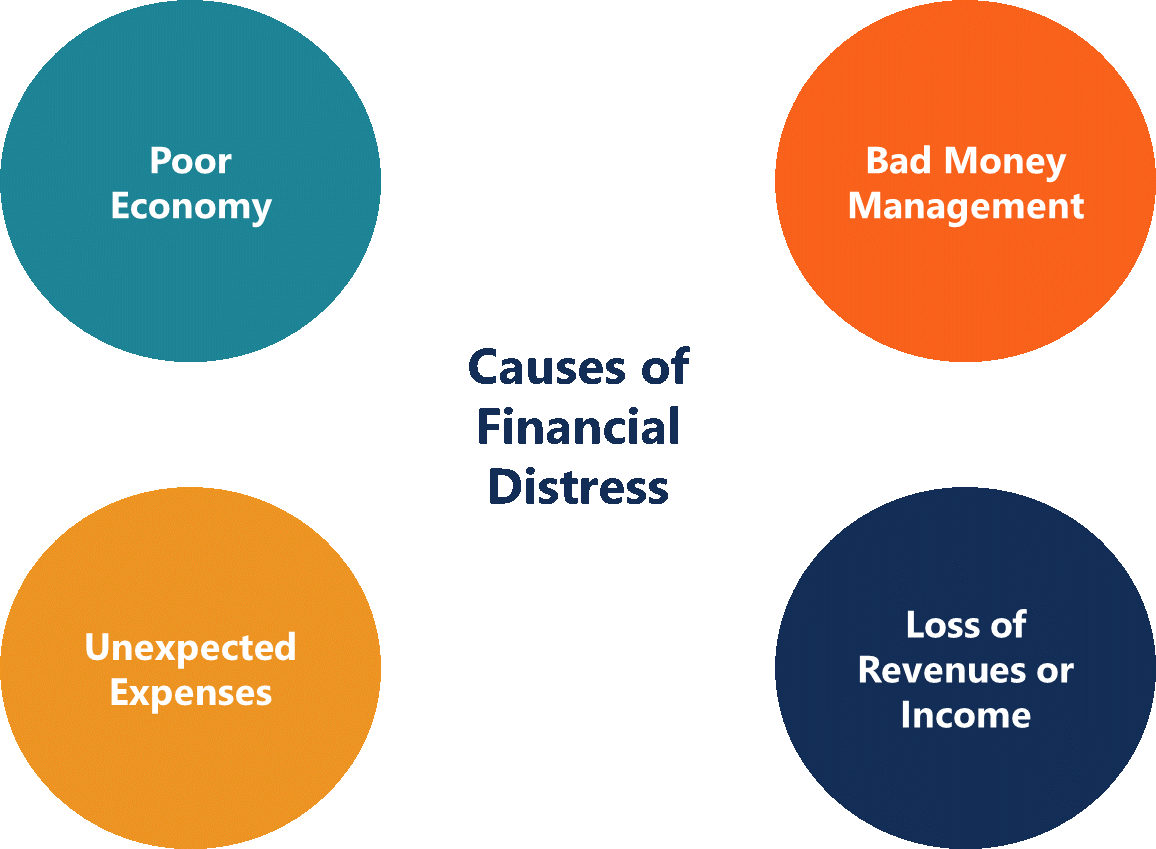
Because many people struggle financially paycheck-to-paycheck, with little or no savings, it is very easy for an individual to experience financial distress. As is the case with companies, an individual’s financial distress may be a result of their own poor management of their finances or may come about through no fault of their own. Below are some of the most common causes of financial distress for individuals:
1. Lost or reduced income
Anyone can suffer a sudden drop in income at any time. You may be unexpectedly fired or laid off from a job, or the company that you work for may go out of business, leaving you suddenly unemployed.
A severe economic crisis or other circumstance may compel you to take a substantial pay cut to remain employed. Whatever the cause, if you don’t have savings to dip into, you may quickly find yourself struggling just to pay your most basic expenses, such as housing, utilities, and food.
2. Unexpected expenses
Large unexpected expenses, such as high medical bills or an expensive car repair, are another common cause of financial difficulties.
3. Divorce
Divorce is one of the most frequent and severe causes of financial distress. In fact, divorce is such a financial strain often on both parties that, according to studies, the rate of bankruptcy filings for single mothers in the United States is 300% higher than the national average.
4. Failure to adequately manage your finances
Even people with high incomes can end up in financial distress if they fail to manage their money well. Expenses can creep upward, such as credit card bills, and suddenly a person finds themselves struggling financially. It’s important to always budget your money carefully.
If you should experience a time of financial distress, your best options are the same as those used by large corporations – look for ways to reduce your expenses and/or increase your income and consider negotiating with your creditors for at least a temporary period of reduced debt payment requirements.
Keep Learning
CFI is the official provider of the global Commercial Banking & Credit Analyst (CBCA)™Program Page - CBCAGet CFI's CBCA™ certification and become a Commercial Banking & Credit Analyst. Enroll and advance your career with our certification programs and courses. certification program, designed to help anyone become a world-class financial analyst. To keep advancing your career, the additional resources below will be useful:
- Deferred InterestDeferred InterestDeferred interest is a deal offered on what is essentially a loan, allowing the borrower to avoid paying interest for a set period of time, provided the
- Economic CollapseEconomic CollapseEconomic collapse refers to a period of national or regional economic breakdown where the economy is in distress for a long period, which can
- Financial CrisisFinancial CrisisA financial crisis is defined as any situation where one or more significant financial asset – such as stocks, real estate, or oil – suddenly
- Personal FinancePersonal FinancePersonal finance is the process of planning and managing personal financial activities such as income generation, spending, saving, investing, and protection. The process of managing one’s personal finances can be summarized in a budget or financial plan.
-

Financial Engineering: Principles, Applications & Career Paths
Financial engineering encompasses a broad, multidisciplinary field of study and practice that, essentially, applies an engineering approach and methodology to the world of finance. It integrates and u
-

Understanding Your Financial Health: A Comprehensive Guide
Financial health is a basic measure of the soundness of an individual’s finances – essentially, it’s about what kind of financial shape you’re in overall. You may also view it
finance
- Amalgamation Explained: Mergers & Corporate Combinations
- Financial Leverage: Definition, Calculation & Impact on Profitability
- Understanding Financial Distress: Causes, Consequences & Bankruptcy
- Financial Guarantee: Definition, Types & How They Work
- Financial Leverage Explained: Using Debt for Growth
- Understanding Financial Ratios: A Comprehensive Guide
- Understanding Financial Statement Normalization: A Comprehensive Guide
- Understanding the Role of an Accountant: Key Responsibilities & Importance
- Financial Reinsurance: A Comprehensive Guide for Businesses
-
 Understanding Finance: A Comprehensive Overview of Key Concepts
Finance is defined as the management of money and includes activities such as investing, borrowing, lending, budgeting, saving, and forecasting. There are three main types of finance: (1) personalPers...
-
 Understanding Financial Crises: Causes, Impacts, and Examples
A financial crisis is defined as any situation where one or more significant financial assets – such as stocks, real estateReal EstateReal estate is real property that consists of land and impro...