
Functional Obsolescence in Real Estate: Understanding & Impact
In real estate, functional obsolescence refers to the diminishing of the usefulness of an architecture design such that changing it to suit current real estate designs is almost impossible. In the long term, functional obsolescence results in losses to investors due to the fact that real estate investmentsCurrent Income (Real Estate Investments)Current income is an investment strategy that gives investors exposure to consistent above-average payouts. The most common current income-focused are financially intense.

When a property becomes obsolete, it can no longer be useful to the owner nor the community. Making it curable may involve demolition costs and costs of removing debris, which may bring more losses to the owner or investor.
Quick Summary
- Functional obsolescence refers to the state when a design feature in real estate loses its demand since it is archaic, and other modern designs have taken over.
- Functional obsolescence is not easily corrected since the outdated design is not curable with ease.
- Real-life examples of functional obsolescence include bridges with inadequate lane and shoulder widths and roads that cannot handle modern traffic demands.
Understanding Functional Obsolescence
Investors in the functional obsolescence situation can consider the long-term usefulness of the property in question. For example, an old, two-bedroom house in an area with modern three bedrooms with a bathroom in each room can be considered functionally obsolete.
Other items that are highly prone to functional obsolescence include electronics, such as smartphones. The smartphone industry is constantly changing, and new designs become obsolete fast due to incompatibility and old designs.
However, sometimes, it is possible to make a comeback from functional obsolescence. For example, companies in the furniture industry can redesign their furniture to conform to the latest trends and present them for sale in modern designs.
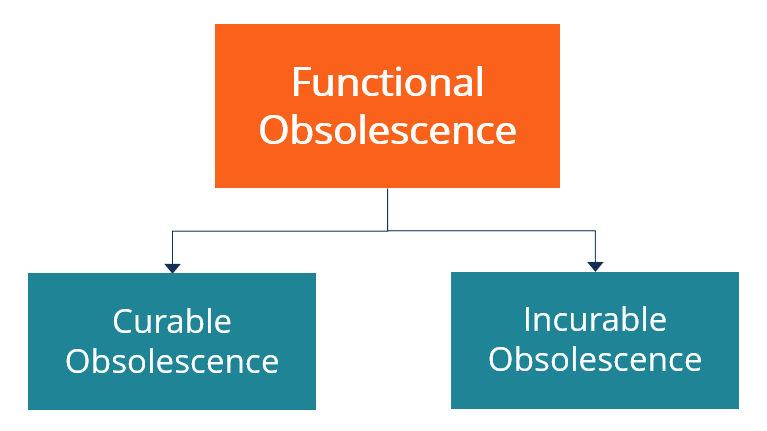
Types of Functional Obsolescence
The two main types of functional obsolescence are:
1. Curable obsolescence
Curable obsolescence can be caused by a lack of specific fixtures that can be remedied by purchasing the required fixtures, the presence of a fixture that is no longer important to the property, or the lack of a fixture(s) that can be remedied by replacing the required item.
2. Incurable obsolescence
The incurable functional obsolescence is mostly caused by external factors that the property owner has no influence on. Investors can prevent the occurrence of such obsolescence by conducting proper research on the most recent trends and designs in real estate before committing to the investment.
Incurable obsolescence is a type of obsolescence that is not financially practical to cure. It occurs when it too costly to fix the problem. For example, an old residential building in an area with modern residential houses can be considered incurable because it would require heavy renovations to make it modern and increase its resale value.
The cost of the renovations will be significantly higher than the amount it will bring back when sold. In general, functional obsolescence can be foreseen in the initial stages of the analysis and valuation of q real estate property before the acquisition.
The Impact of Functional Obsolescence on Properties
Functional obsolescence leads to a decline in the valuation of real estate during an appraisalAppraisalAn appraisal is basically a way to conduct an unbiased analysis or evaluation of an asset, a business or organization, or to evaluate a performance against a given set of standards or criteria. Performed by a qualified appraiser, an appraisal is usually done whenever a property or asset is to be sold and its value needs to be determined. Real estate is highly prone to functional obsolescence since the industry is dynamic, and the demand for modern houses causes this dynamism.
For example, an old house found in a vibrant neighborhood with modern, storeyed bungalows is functionally obsolete. The house may not come with any defects, but the market at a particular time does not require such standards. However, such a house can be renovated to get close to the standards of its environment.
The worst effects for the real estate due to functional obsolescence are the losses incurred and the difficulty in changing the property into a conventionally modern structure to fit the current standards.
External Factors that Affect Functional Obsolescence
There are certain factors that affect functional obsolescence, and that investors can influence to their advantage. Such factors are curable and are not disadvantageous to the valuation of real estate. Curing such obsolescence can be as easy as repairing, repainting, or even installing missing modern facilities to make the property modern and up to date.
However, there are incurable external effects that can’t be influenced by property investors. The external and incurable obsolescence causes a severe drop in the appraisal of a property when valued. Examples of external incurable obsolescence factors include the following instances:
1. Busy roads
A property may be located close to a road that can become busy in the long term. Residential and commercial properties close to busy roads tend to be less attractive, and hence lose value quickly. Busy roads subject the residents to noise pollution and endless traffic, which lowers the demand in the property market.
Residential units located close to commercial establishments such as night clubs and restaurants can be affected by noise pollution from the businesses, causing them partial functional obsolescence.
2. Construction of landfills
In addition, the construction of landfills near residential or commercial premises causes noise and smell pollution that renders such property less on demand. The income from such properties can decrease significantly, as tenants vacant to more friendly areas.
3. Construction of low-income housing
Another instance can be the construction of low-income apartments in a high-end neighborhood. An affluent neighborhood distastes high-rise buildings since most of them build luxurious two-story mansions. Such apartments can discourage buyers of residential investments, hence reducing the value of such real estate property.
More Resources
CFI is the official provider of the global Commercial Banking & Credit Analyst (CBCA)™Program Page - CBCAGet CFI's CBCA™ certification and become a Commercial Banking & Credit Analyst. Enroll and advance your career with our certification programs and courses. certification program, designed to help anyone become a world-class financial analyst. To keep advancing your career, the additional resources below will be useful:
- Economic ObsolescenceOtherArticles covering other finance topics ranging from Warren Buffett to hedge fund strategies. These other finance topics are an interesting read
- Locational ObsolescenceLocational ObsolescenceLocational obsolescence is a type of depreciation on a real estate property that is caused by factors other than the property itself. The factors can either
- Negative ExternalitiesNegative ExternalitiesNegative externalities occur when the product and/or consumption of a good or service exerts a negative effect on a third party independent
- Real Estate Development ModelReal Estate Development ModelA real estate development model usually consists of two sections: Deal Summary and Cash Flow Model. Within the Deal Summary, all important
-

Understanding Inheritance Tax: A Comprehensive Guide
Inheritance tax is a tax paid by a person or persons who inherit the estate (money or property) of a deceased person. In some jurisdictions, the terms “estate tax” and “inheritance t
-
Real Estate Investing: A Comprehensive Guide for Beginners
Real estate investing is popular, and perhaps now more so than ever, as low mortgage rates make real estate more affordable. In fact, Americans love real estate, and a 2019 Bankrate survey showed tha
finance
- Understanding Letters of Assumption in Real Estate: A Comprehensive Guide
- Real Estate Option Contract: Definition, Benefits & How It Works
- TLC in Real Estate: Understanding 'Tender Loving Care' Properties
- Understanding Current Income Real Estate Investments
- Understanding Real Estate: Definition, Types & Key Concepts
- REITs Explained: Investing in Real Estate Through Trusts
- Real Estate Operating Companies (REOCs): Definition & How They Differ from REITs
- Real Estate Project Finance: A Comprehensive Guide
- Proof of Funds in Real Estate: A Comprehensive Guide
-
 Real Estate Advertising Regulations: A Comprehensive Guide
State and or federal laws typically govern real estate advertising rules. Rules for real estate licensees tend to be more stringent than rules for a consumer selling his own property. Some rules apply...
-
 Understanding Real Estate Companies: Types & Roles
When most people think of real estate, they think of the typical scenario of an agent handing a young family the keys to their new home. While this is a scenario that plays out every day in the United...